India Q1 FY27 GDP Growth Hits 7.8%: What It Means for Markets, RBI and Investors
Quick Summary
- India’s Q1 FY27 GDP growth came in at 7.8%.
- The reading was stronger than many forecasts and above the RBI’s earlier quarterly projection.
- Growth was supported by manufacturing, investment and services activity.
- The data is broadly positive for Indian market sentiment.
- Investors should still monitor crude oil, inflation and future RBI policy signals.
India’s Apr–June 2026 GDP growth beats forecasts
Percent change from previous year
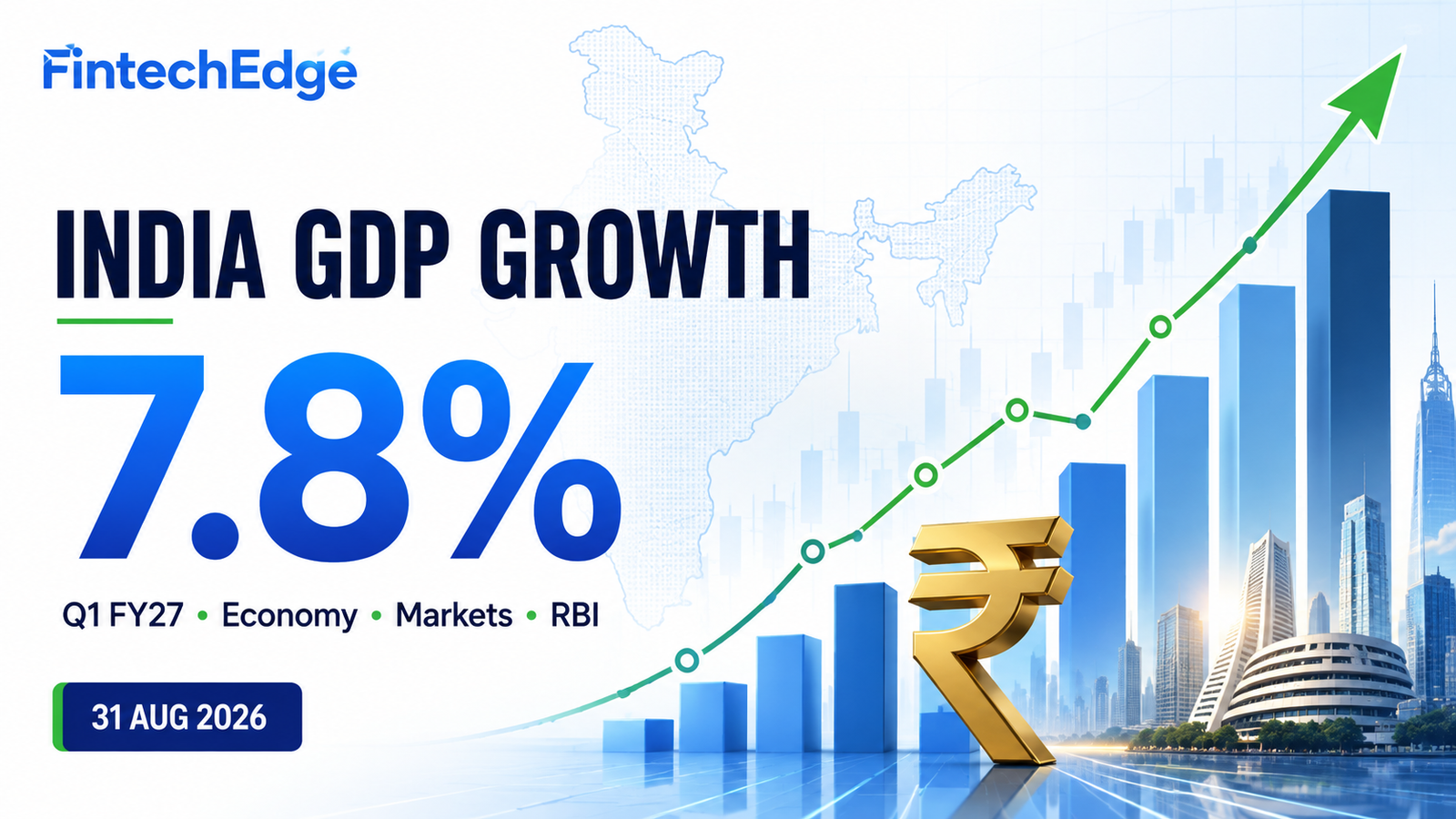
India GDP growth Q1 FY27 came in stronger than expected, with the economy expanding 7.8% year-on-year during the April–June 2026 quarter, according to government data released on 31 August 2026.
The reading exceeded the Reserve Bank of India’s 7% projection for the quarter and showed that domestic economic activity remained resilient despite elevated crude-oil prices, geopolitical uncertainty and tighter global financial conditions.
The numbers are particularly important for investors because they arrive at a time when Indian equities are dealing with competing forces: strong domestic growth on one side and rising oil prices, global interest-rate concerns and geopolitical risk on the other.
India Q1 FY27 GDP: Key Numbers
| Indicator | Q1 FY27 |
|---|---|
| Real GDP growth | 7.8% |
| Gross Value Added growth | 8.2% |
| Manufacturing growth | 9.2% |
| Services growth | 10.0% |
| Financial, real estate & professional services | 12.1% |
| Private consumption growth | 7.1% |
| Gross fixed capital formation | 11.9% |
| Agriculture growth | 3.6% |
Real GDP at constant prices was estimated at approximately ₹81.36 lakh crore, compared with ₹75.46 lakh crore in the corresponding quarter a year earlier.
What Drove India’s 7.8% GDP Growth?
Several parts of the economy contributed to the stronger-than-expected performance.
1. Investment remained strong
Gross fixed capital formation, an important measure of investment activity, expanded 11.9%.
That is significant because sustained investment can increase productive capacity and support sectors linked to infrastructure, manufacturing, industrial equipment and financial services.
2. Manufacturing grew strongly
Manufacturing expanded 9.2% during the quarter.
For equity investors, stronger manufacturing activity can be relevant to industrial companies, capital-goods businesses, banks financing corporate investment, and businesses exposed to India’s domestic investment cycle.
3. Services remained a major growth engine
Services recorded approximately 10% growth, while financial, real-estate and professional services expanded 12.1%.
The strength of these areas indicates that India’s growth was not dependent on one sector alone.
4. Household consumption stayed resilient
Private final consumption expenditure increased 7.1%, suggesting continued underlying consumer demand despite pressure from energy prices and broader global uncertainty.
Why the GDP Number Matters for the Stock Market
A 7.8% GDP print is fundamentally supportive for India’s longer-term economic story, but investors should avoid assuming that strong GDP automatically means stocks will immediately rise.
The market must balance the positive domestic data against several external risks.
On 31 August, the Nifty 50 closed at 24,080.40, down 0.39%, while the Sensex fell around 0.4%. Higher crude prices, fears of tighter U.S. monetary policy, and renewed geopolitical tension weighed on sentiment.
This means the GDP report provides a positive domestic cue, but international developments may continue to influence near-term market direction.
Which Sectors Could Investors Watch?
The GDP numbers highlight several areas worth monitoring—not as automatic buy signals, but as indicators of where economic activity is currently strongest.
Banks and financial services: Strong investment, consumption, and financial-services growth could support credit demand, although interest rates and asset quality remain important.
Capital goods and industrials: Double-digit investment growth is potentially constructive for companies exposed to infrastructure and corporate capital expenditure.
Manufacturing: The 9.2% expansion reinforces the importance of industrial production within the growth cycle.
Consumer-oriented companies: Consumption growth of 7.1% shows household demand remains an important economic driver.
Individual stock performance will still depend on valuations, earnings, margins, and company-specific fundamentals.
What Could the GDP Data Mean for RBI Policy?
The RBI kept the repo rate unchanged at 5.25% at its August monetary policy meeting and retained a neutral stance. It projected FY27 economic growth of 6.7% and inflation of around 5%.
The stronger Q1 GDP number gives policymakers greater confidence about economic momentum.
However, it does not automatically mean the RBI will raise interest rates.
The bigger issue remains inflation.
Crude oil has again climbed above $90 per barrel amid renewed U.S.-Iran tensions. Because India imports roughly 85% of its crude-oil requirements, persistently expensive energy can increase inflation pressure, affect corporate costs and put pressure on the currency and trade balance.
As a result, the RBI is likely to continue watching both growth and inflation rather than reacting to the GDP figure alone.
Strong Growth, but Risks Remain
Investors should continue monitoring four major risks.
Crude oil: Sustained oil prices above $90 would be a major macroeconomic concern for India.
Geopolitical tensions: Developments in West Asia can rapidly affect energy prices and global risk appetite.
Global interest rates: Higher U.S. Treasury yields and expectations around Federal Reserve policy can affect foreign flows into emerging markets.
Inflation: Strong growth is encouraging, but higher energy and commodity costs could complicate the RBI’s policy outlook.
What Investors Should Watch Next
The next few sessions should help reveal whether investors focus more heavily on India’s strong domestic growth or on global headwinds.
Important indicators include:
- movement in Brent crude oil;
- foreign institutional investor flows;
- Indian bond yields;
- the rupee against the U.S. dollar;
- manufacturing and services activity;
- inflation data;
- corporate earnings and management guidance;
- future RBI commentary.
For traders, strong macroeconomic data should be treated as one input, not as a standalone trading signal.
FintechEdge View
India’s 7.8% Q1 FY27 GDP growth demonstrates considerable resilience in the domestic economy.
Strong manufacturing, investment, consumption and services activity provide an encouraging fundamental backdrop.
At the same time, India’s dependence on imported energy means crude oil and geopolitical developments remain significant risks.
The key question for markets is therefore not simply whether India’s economy is growing strongly—it is whether that growth can remain robust while inflation, oil prices and global interest rates remain elevated.
For long-term investors, the GDP data strengthens the case for continuing to track businesses benefiting from India’s consumption, manufacturing, financialisation and capital-expenditure cycles while remaining disciplined about valuations and risk.
Disclaimer
This article is for educational and informational purposes only and does not constitute investment advice, trading advice or a recommendation to buy or sell any security. Investors should conduct their own research and consult a SEBI-registered investment adviser where appropriate.
Our content is written for educational purposes and focuses on clarity, evidence, risk awareness and practical decision-making.