Tracking Error vs Tracking Difference: What Matters More?
Quick Summary
- Tracking difference measures the actual return gap between a passive fund and its benchmark.
- Tracking error measures how much that return gap varies over time.
- A fund can have low tracking error but still consistently lag its benchmark.
- Expense ratio affects tracking difference, but it is not the only factor.
- For long-term investors, tracking difference often gives the clearest picture of the return actually delivered.
- Tracking error adds useful information about the consistency of the fund’s index replication.
- Comparing the correct benchmark, usually the relevant Total Return Index, is essential.
Tracking Error vs Tracking Difference: Which Should Index Fund Investors Check?
Two index funds can track the same Nifty 50 benchmark and still deliver slightly different returns.
Why?
Because matching an index in the real world is not frictionless. Funds have expenses, transaction costs, cash holdings, rebalancing differences, dividend timing and other operational factors that can create a gap between the fund and the benchmark.
That is where tracking error and tracking difference become useful.
They sound similar, but they answer two different questions:
Tracking difference tells you how much the fund actually lagged or beat its benchmark.
Tracking error tells you how consistently the fund tracked that benchmark over time.
For anyone comparing two index funds or ETFs, understanding both metrics is more useful than looking at expense ratio alone.
What Is Tracking Difference?
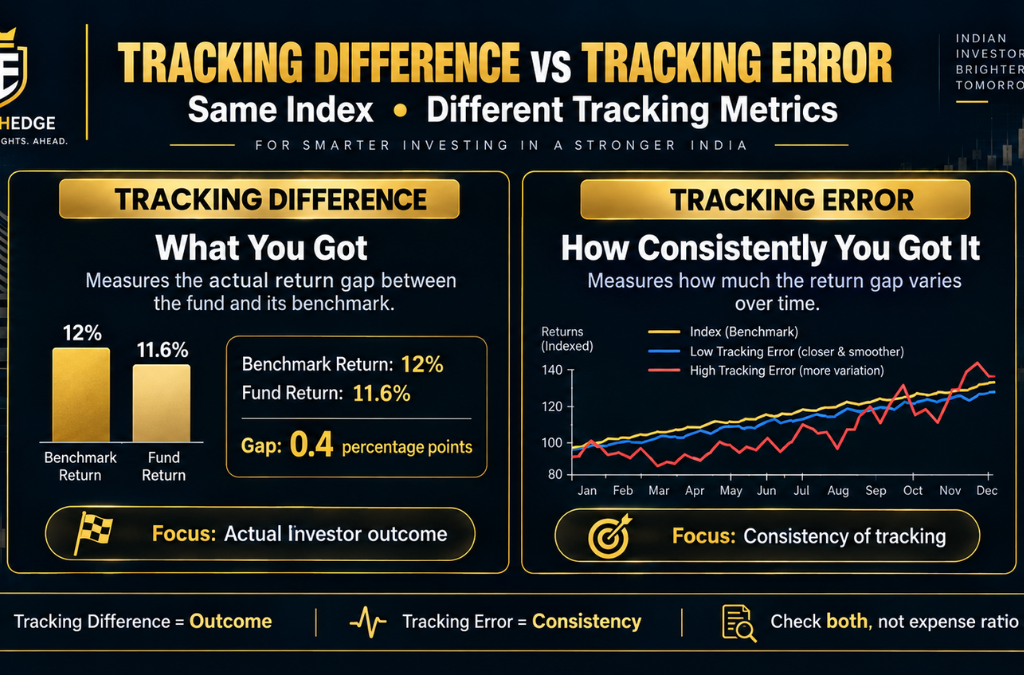
Tracking difference is the gap between the return of a fund and the return of the benchmark it is trying to replicate.
Suppose a Nifty 50 Total Return Index delivers 12% over a year.
An index fund tracking it delivers 11.6% over the same period.
The fund has therefore lagged its benchmark by:
0.4 percentage points
That gap is the tracking difference.
For an investor, this is a very practical number because it answers:
How much of the benchmark’s return actually reached me through the fund?
The difference usually comes from real-world costs and operational frictions that an index calculation itself does not bear.
These may include:
- expense ratio
- brokerage and transaction costs
- cash holdings
- rebalancing costs
- dividend timing
- securities lending income
- liquidity effects
Tracking difference can occasionally be positive as well, for example because of securities-lending income or timing effects. That is why it is better to look at the pattern over time rather than one isolated period.
What Is Tracking Error?
Tracking error measures something different.
Instead of asking:
“How large was the final return gap?”
it asks:
“How much did that gap fluctuate over time?”
SEBI describes tracking error as the standard deviation of the difference between portfolio returns and benchmark returns. In simple terms, it shows how consistently the fund stays close to the index.
A simple analogy helps.
Imagine two cars travelling on the same highway.
The first car is the benchmark.
The second car is the index fund.
Tracking difference tells you how far behind the second car finishes.
Tracking error tells you how much it drifted back and forth during the journey.
A fund can finish only slightly behind the benchmark but move inconsistently along the way.
Another fund can remain consistently behind by a small amount every day.
The first might have a smaller tracking difference but higher tracking error.
The second might have a larger tracking difference but lower tracking error.
That is why the two metrics should not be treated as interchangeable.
Tracking Error vs Tracking Difference
| Factor | Tracking Difference | Tracking Error |
|---|---|---|
| What it measures | Actual return gap between fund and benchmark | Variability of that return gap |
| What it tells you | How much benchmark return reached the investor | How consistently the fund tracked the benchmark |
| Direction | Can show underperformance or occasional outperformance | Expressed as a non-negative variability measure |
| Better result generally | Smaller gap | Lower variability |
| Main use | Evaluate realised tracking outcome | Evaluate consistency of replication |
| Influenced by | Costs, cash drag, transactions, dividends, rebalancing | Rebalancing, liquidity, cash levels, implementation quality |
The simplest way to remember it is:
Tracking difference tells you what you got. Tracking error tells you how consistently you got it.
Why Do Two Index Funds Tracking the Same Index Deliver Different Returns?
In theory, two funds following the same index should perform similarly.
In practice, several factors create differences.
Expense Ratio
The expense ratio is deducted from the fund’s assets.
That creates a regular drag on performance relative to the benchmark.
But expense ratio alone does not explain the full tracking gap.
Transaction Costs
Whenever an index changes its constituents or weights, the fund needs to trade.
Those trades involve costs.
The benchmark calculation itself does not face brokerage, market impact or execution costs in the same way a real fund does.
Cash Drag
Index funds may hold some cash for redemptions, subscriptions or operating needs.
That cash may not participate fully in market movements.
During a strong market rally, cash can reduce fund returns relative to the index.
Dividend Timing
The benchmark and the fund may not reinvest dividends at exactly the same moment.
That timing difference can temporarily affect performance.
Index Rebalancing
When the benchmark changes its constituents, the fund must adjust its holdings.
Execution prices may differ from the theoretical prices used in the index calculation.
Sampling
Some passive funds, especially those tracking broad or less-liquid indices, may use a sampling approach instead of holding every security in exact index weight.
That can increase tracking variation.
Securities Lending
Funds may lend securities and earn additional income.
That income can partly offset costs and sometimes improve tracking difference.
Liquidity
Less-liquid underlying securities can make index replication more difficult and expensive.
Liquidity can therefore affect both tracking difference and tracking error.
Can a Fund Have Low Tracking Error but a Poor Tracking Difference?
Yes.
This is one of the most important ideas in the article.
Imagine Fund A consistently lags its benchmark by around 0.5 percentage points a year.
The gap is stable and predictable.
Because the return difference does not fluctuate much, the fund may have a low tracking error.
But the fund is still consistently giving investors less than the benchmark, so the tracking difference remains meaningfully negative.
Now imagine Fund B.
Its average return gap is smaller, but the gap moves around much more from period to period.
Fund B may therefore have:
- a better tracking difference,
- but a higher tracking error.
This shows why one number alone cannot tell the full story.
SEBI’s mutual fund framework treats tracking difference as the annualised difference between a scheme and its benchmark across periods such as 1 year, 3 years, 5 years, 10 years and since inception.
So tracking difference should not be interpreted as simply adding yearly gaps together.
Which Matters More for a Long-Term Investor?
For a long-term investor, tracking difference is often the more directly relevant outcome metric.
Why?
Because it tells you how much of the benchmark return actually reached the investor after costs and implementation frictions.
If two funds track the same index and one has historically delivered a smaller return gap over several periods, that is useful information.
But tracking error still matters.
It tells you how stable and disciplined the replication process has been.
A fund with a good tracking difference over one short period but very inconsistent tracking behaviour may not necessarily be the better long-term choice.
The more sensible approach is to look at both.
Think of them together:
Tracking difference:
What was the actual return gap?
Tracking error:
How stable was that gap?
That combination gives a much fuller picture.
Is the Lowest Expense Ratio Always Better?
No.
Expense ratio matters, but it should not be the only metric used to compare passive funds.
Suppose:
Fund A
- Expense ratio: 0.15%
- Tracking difference: 0.35 percentage points
Fund B
- Expense ratio: 0.10%
- Tracking difference: 0.55 percentage points
Even though Fund B has the lower advertised cost, Fund A has historically tracked the benchmark more closely in this hypothetical example.
That can happen because tracking difference captures more than management fees.
It also reflects:
- trading costs
- rebalancing efficiency
- cash management
- dividend treatment
- operational execution
So a low expense ratio is useful, but it is not the whole story.
Always Compare Against the Correct Benchmark
This is one of the easiest mistakes to make.
The Nifty 50 shown on television and market websites is usually the price index.
A price index reflects movements in share prices but does not include ordinary dividend income.
A Total Return Index (TRI) includes both price movement and dividends.
NSE specifically notes that the Total Return Index is more appropriate when evaluating investment returns because it includes dividend receipts and their reinvestment.
So when comparing an index fund with its benchmark, make sure you are comparing like with like.
For example:
Nifty 50 Index Fund → Nifty 50 TRI
not simply:
Nifty 50 Index Fund → Nifty 50 Price Index
Otherwise, the comparison can be misleading.
How to Compare Two Index Funds Properly
A practical comparison should go beyond one number.
1. Confirm the Benchmark
Make sure both funds track exactly the same index.
2. Check the Benchmark Variant
Confirm whether the benchmark is a Total Return Index or Price Return Index.
For most fund-performance comparisons, the TRI version is the more meaningful reference.
3. Check Tracking Difference Across Multiple Periods
Avoid judging a fund using only the most recent year.
Look at:
- 1 year
- 3 years
- 5 years
- since inception
where available and meaningful.
4. Check Tracking Error
Compare how consistently each fund has stayed close to the benchmark.
For applicable ETFs and index funds other than debt passive funds, SEBI’s current mutual fund framework says tracking error based on one-year rolling daily return differences generally should not exceed 2%, subject to specified exceptions.
5. Compare Expense Ratio
Lower cost is useful, but interpret it alongside actual tracking results.
6. Consider Fund Size and Liquidity
For ETFs especially, liquidity matters because investors buy and sell units on the exchange.
7. For ETFs, Check the Bid-Ask Spread
A wide bid-ask spread can create a real trading cost even if the ETF has an attractive expense ratio.
Does This Work Differently for ETFs?
The principles of tracking error and tracking difference still apply to ETFs.
But ETFs introduce another layer: market trading.
An index fund bought directly from an AMC is generally transacted based on NAV.
An ETF trades on the stock exchange.
That means the actual investor experience can also depend on:
- bid-ask spread
- market liquidity
- premium to NAV
- discount to NAV
- execution price
For example, an ETF may have excellent NAV-based tracking statistics but trade at a relatively wide spread.
An investor entering or exiting at an unfavourable market price may experience a worse outcome than the tracking statistics alone suggest.
So when comparing ETFs, don’t look only at tracking error and tracking difference.
Trading quality matters too.
Common Mistakes Investors Make
Looking Only at Expense Ratio
The cheapest fund is not automatically the most efficient index tracker.
Confusing Tracking Error With Underperformance
Tracking error measures variability.
It does not directly tell you how much the fund underperformed.
Comparing Different Benchmarks
A Nifty 50 fund and Nifty Next 50 fund should not be compared using tracking metrics as if they were trying to replicate the same portfolio.
Comparing TRI With a Price Index
This can make the tracking gap look misleadingly large.
Using Only One Short Period
One year can be affected by unusual rebalancing, cash flows or temporary market conditions.
Ignoring ETF Trading Costs
NAV-based tracking metrics do not capture every cost an ETF investor may experience when buying or selling on the exchange.
FintechEdge View
The cheapest passive fund is not automatically the best-tracking fund.
Expense ratio is easy to see, which is why investors often focus on it first.
But the more useful question is:
How efficiently has the fund actually delivered the return of the index it promises to track?
Tracking difference helps answer that from an outcome perspective.
Tracking error helps answer it from a consistency perspective.
Neither metric should be used alone.
For long-term investors comparing similar passive funds, the better approach is to look at tracking difference, tracking error, expense ratio, benchmark variant and, for ETFs, liquidity and trading costs together.
The key distinction is simple:
Tracking difference tells you what you got. Tracking error tells you how consistently you got it.
Frequently Asked Questions
What is the main difference between tracking error and tracking difference?
Tracking difference measures the return gap between a fund and its benchmark. Tracking error measures how much that return gap fluctuates over time.
Is lower tracking error always better?
Generally, lower tracking error indicates more consistent benchmark replication. But it should still be evaluated alongside tracking difference.
Why is tracking difference usually unfavourable to the fund?
Passive funds incur real-world costs such as expenses, transaction costs and cash drag that the benchmark itself does not face.
Can a fund have low tracking error but still lag its benchmark?
Yes. A fund can consistently lag its benchmark by a similar amount each period, producing low tracking error but a persistent tracking difference.
Does SEBI regulate tracking error?
Yes. SEBI’s current framework sets tracking-error requirements for applicable ETFs and index funds and requires passive schemes to disclose tracking-related information.
Should I choose the index fund with the lowest expense ratio?
Not necessarily. Expense ratio is important, but tracking difference can reveal whether the lower-cost fund actually delivered better benchmark replication.
Is tracking error different for ETFs?
The concept itself is the same, but ETF investors must additionally consider market liquidity, bid-ask spreads and premiums or discounts to NAV.
This article is for educational and informational purposes only and does not constitute investment advice, trading advice or a recommendation to buy or sell any security.
Our content is written for educational purposes and focuses on clarity, evidence, risk awareness and practical decision-making.