How to Choose the Best Mutual Fund in India: 2026 Guide

How to choose a mutual fund in India becomes much easier when you start with your financial goal rather than last year’s top-performing scheme. Choosing a mutual fund can feel difficult because investors face hundreds of schemes, categories, ratings and performance tables. A common mistake is to begin with last year’s top performer, a five-star rating or a list of the “best mutual funds.”
That is the wrong starting point.
A fund that fits someone else’s financial goal, investment horizon and ability to take risk may not fit yours—even if its recent returns look attractive.
A better selection process starts with the investor:
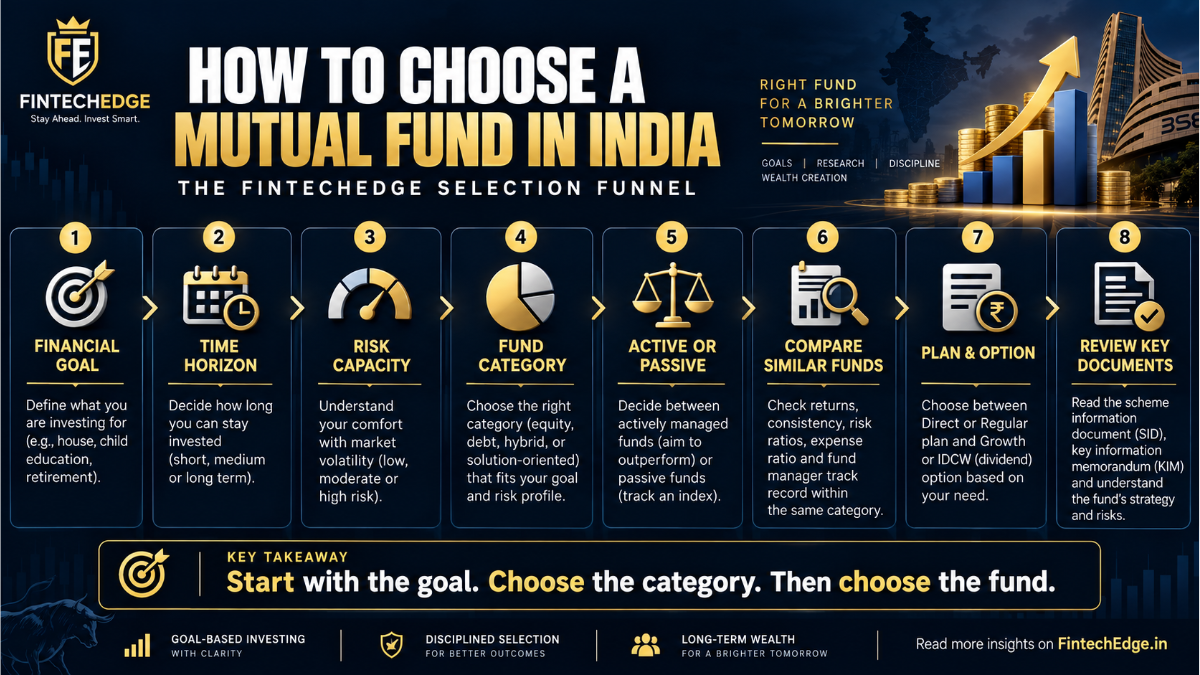
Financial goal → time horizon → risk capacity → fund category → compare relevant schemes → choose plan and option → invest → review periodically
The key principle is simple:
Choose the right category before trying to choose the right fund.
Quick Summary
- Start with your financial goal, not with last year’s top-performing mutual fund.
- Your investment horizon and risk capacity should help determine which mutual fund category may fit the role you need.
- Choose the fund category before comparing individual schemes; comparing different categories only by returns can be misleading.
- Evaluate funds using the right criteria for that fund type—such as consistency, benchmark comparison, risk, portfolio, costs, tracking error or liquidity where relevant.
- Do not rely only on recent returns, star ratings or expense ratio. A suitable mutual fund should fit your goal, time horizon, risk capacity and investment approach.
Step 1: Define Your Financial Goal
Before looking at mutual fund schemes, identify what the money is meant to achieve.
Your goal could be:
- retirement
- a child’s higher education
- buying a home
- building a long-term corpus
- funding another future financial requirement
For each goal, try to define three things:
Target amount: How much money might you need?
Target date: When will you need it?
Goal importance: How flexible is the goal if markets perform poorly near the target date?
These questions matter because two investors with the same amount of money may reasonably need very different investment approaches.
For example, money intended for a flexible long-term wealth-creation goal can usually tolerate more uncertainty than money needed for an essential expense on a fixed date.
The mutual fund should therefore follow the goal—not the other way around.
Step 2: Determine Your Investment Time Horizon
Your investment horizon is the period between investing the money and expecting to use it.
Time horizon matters because market-linked investments can fluctuate significantly.
A longer horizon may give an investor more opportunity to remain invested through periods of market volatility. A shorter horizon leaves less room for an unfavourable market move immediately before the money is required.
However, avoid oversimplified rules such as:
“Three years means debt.”
or
“Five years means equity.”
Time horizon is only one part of the decision.
The importance and flexibility of the goal, the investor’s financial position and the behaviour of the chosen asset class must also be considered.
The useful principle is:
The sooner you need the money, the more carefully you need to consider the consequences of volatility and potential loss.
Step 3: Understand Risk Capacity, Not Just Risk Appetite
Investors often ask:
How much risk am I comfortable taking?
That measures risk appetite, but there is another important concept: risk capacity.
Risk appetite
How comfortable you feel when the value of your investment rises and falls.
Risk capacity
How much financial risk your actual circumstances can reasonably absorb.
Risk capacity may depend on factors such as:
- income stability
- existing savings and investments
- debt and financial obligations
- dependence on the invested money
- flexibility of the financial goal
- time available before the money is required
An investor might emotionally tolerate large market swings but have low financial capacity to absorb a major loss because the money is required for an essential goal.
That is why risk appetite alone is not enough.
Use the Riskometer—but understand its limitation
SEBI requires mutual fund schemes to display a Riskometer, which helps investors understand the risk level associated with a scheme.
It is useful, but it answers:
“How risky is this scheme?”
It does not fully answer:
“Is this risk appropriate for my financial situation?”
Use the Riskometer as one part of the selection process, not as a complete suitability test.
Step 4: Choose the Mutual Fund Category Before the Fund
This is where a disciplined fund-selection process differs from many “best mutual fund” lists.
Before comparing individual schemes, decide which broad type of fund is relevant to the role you are trying to fill.
SEBI revised the framework for the Categorization and Rationalization of Mutual Fund Schemes on February 26, 2026.
At a broad level, mutual fund schemes are currently classified into:
Equity Schemes
These invest predominantly in equity and equity-related instruments and include different subcategories based on investment characteristics.
Debt Schemes
These invest predominantly in debt and debt-related instruments. Different debt categories can carry different levels of duration, interest-rate and credit risk.
Hybrid Schemes
These invest across a combination of permitted asset classes, such as equity and debt, according to the scheme mandate.
Life Cycle Funds
The 2026 framework includes Life Cycle Funds as a broad category.
Other Schemes
This includes:
- Fund of Fund schemes
- Passive schemes such as Index Funds and ETFs
You do not need to memorise every category before starting to invest.
The important lesson is:
Do not compare fundamentally different fund categories simply because one currently shows a higher return.
A debt fund and a small-cap equity fund do not serve the same portfolio role. Comparing their one-year returns does not tell you which is more suitable for your financial goal.
Step 5: Decide Between Active and Passive Investing
After identifying the relevant category, another decision may be whether to consider an actively managed or passive approach.
Active mutual funds
In an actively managed fund, the fund manager makes portfolio decisions within the scheme’s stated investment objective and mandate.
Investors generally evaluate active funds by considering factors such as:
- consistency of performance
- behaviour relative to the stated benchmark
- risk taken
- portfolio characteristics
- investment process
- costs
Passive mutual funds
Passive funds, such as index funds and ETFs, are designed to track a specified underlying index rather than relying primarily on active security selection.
This changes how they should be evaluated.
For passive funds, two particularly useful concepts are:
- tracking difference
- tracking error
FintechEdge has explained these in detail in Tracking Error vs Tracking Difference.
Neither active nor passive investing is automatically appropriate for every investor, category or objective.
The important point is that they should not be evaluated using exactly the same framework.
Step 6: Compare Funds Only With Relevant Peers
Once you have identified an appropriate category and investment approach, you can begin comparing individual schemes.
This is where many investors make another mistake: focusing almost entirely on returns.
Instead, evaluate several dimensions.
1. Performance consistency
A fund having an excellent single year does not establish that it has a consistently effective investment process.
Look at performance across different periods and market environments rather than anchoring to one recent return number.
Past performance can provide information about how a fund behaved, but it does not guarantee future returns.
2. Benchmark-relative performance
Consider the fund’s stated benchmark.
For an active fund, benchmark comparison can help provide context for the returns generated and the risk taken.
For a passive fund, the question is different: how effectively has the scheme tracked the underlying index?
3. Risk
Two mutual funds can generate similar returns while exposing investors to very different levels or types of risk.
Depending on the category, useful considerations may include:
- volatility
- drawdowns
- concentration
- credit risk
- interest-rate risk
- portfolio characteristics
Measures such as Sharpe or Sortino ratios can provide additional context for some investors, but they should not be treated as standalone answers.
The broader principle is more important:
Return should be considered together with the risk taken to generate it.
4. Expense ratio
The expense ratio represents recurring scheme expenses charged to the fund and therefore affects investor returns.
Lower costs are beneficial when everything else is comparable.
But:
The fund with the lowest expense ratio is not automatically the most suitable fund.
Cost is one factor in the decision—not the entire decision.
5. Portfolio characteristics
Look underneath the return number.
Depending on the type of fund, this could include:
- major holdings
- sector concentration
- stock concentration
- duration
- credit quality
- portfolio allocation
- turnover
- asset-class exposure
Different categories require different lenses.
Step 7: Use Different Criteria for Different Fund Types
There is no single metric that identifies the “best mutual fund” across every category.
| Fund Type | Important Factors to Evaluate |
|---|---|
| Active Equity Fund | Performance consistency, benchmark-relative behaviour, risk, portfolio characteristics and costs |
| Index Fund | Tracking difference, tracking error and expense ratio |
| ETF | Tracking quality, expense ratio, liquidity and bid-ask spread |
| Debt Fund | Duration, credit quality, interest-rate risk, credit risk and costs |
| Hybrid Fund | Asset-allocation mandate, risk characteristics and portfolio composition |
This distinction is important.
Evaluating a debt fund using only equity-fund metrics—or choosing an ETF based purely on recent returns without considering trading liquidity—means applying the wrong analysis to the product.
First identify what the fund is designed to do. Then judge how effectively it performs that role.
Step 8: Understand Direct vs Regular Plans
Once you have shortlisted a scheme, you may need to choose between its Direct and Regular plans.
Both belong to the same underlying mutual fund scheme and generally share the same portfolio and fund manager.
The major difference is the distribution and expense structure.
Direct Plan
You invest without routing the investment through a mutual fund distributor.
Direct plans generally have a lower expense ratio because distributor commissions are not included in the same way.
Regular Plan
You invest through a distributor or intermediary who may provide assistance with scheme selection, transactions or ongoing servicing.
The cost structure is therefore generally higher than the Direct Plan of the same scheme.
Does that mean Direct is automatically the correct choice?
Not necessarily.
A knowledgeable DIY investor may prefer the lower-cost Direct route.
Someone who needs assistance may value professional guidance and servicing.
The important thing is to understand what you are receiving and what you are paying for before choosing.
Step 9: Understand Growth vs IDCW
A mutual fund scheme may also offer different options.
Growth
Under the Growth option, income and gains attributable to the scheme remain within the scheme rather than being distributed through IDCW. Their effect is reflected in the NAV, which continues to fluctuate with the value of the underlying portfolio.
IDCW
IDCW stands for Income Distribution cum Capital Withdrawal.
Under this option, the scheme may declare distributions subject to the applicable rules and availability of distributable surplus. When an IDCW distribution is made, the NAV is adjusted accordingly.
IDCW should not be confused with guaranteed income.
Tax treatment can also affect the decision and may change over time, so investors should check the current rules applicable to them.
FintechEdge will cover Growth vs IDCW separately in greater detail.
Step 10: Read the Scheme Information Before Investing
Do not depend entirely on star ratings, social-media posts or third-party comparison websites.
Before investing, review the fund’s official information.
Useful documents and disclosures can include:
- Scheme Information Document
- Key Information Memorandum, where applicable
- scheme factsheet
- portfolio disclosure
- Riskometer
- stated benchmark
- expense ratio
- investment objective and strategy
- AMC disclosures
These documents help you understand what the scheme itself says it is designed to do and the risks involved.
That is a stronger foundation for analysis than simply relying on a ranking table.
The FintechEdge 10-Point Mutual Fund Selection Checklist
Before investing, ask:
1. Is my financial goal clearly defined?
2. Do I know when I will need the money?
3. Have I considered my actual risk capacity—not only my willingness to take risk?
4. Have I selected an appropriate fund category before comparing schemes?
5. Am I comparing genuinely similar funds?
6. Have I reviewed performance in context rather than chasing the latest winner?
7. Have I considered the relevant risks and portfolio characteristics?
8. Have I checked the expense ratio and other relevant costs?
9. Do I understand Direct vs Regular and Growth vs IDCW?
10. Have I reviewed the fund’s official scheme information?
If several of these answers are “no,” you probably need more research before choosing a scheme.
Common Mistakes When Choosing Mutual Funds
1. Choosing Last Year’s Top Performer
A fund can perform extremely well during one particular market environment.
That does not mean the same conditions will continue or that it is appropriate for your goal.
Performance chasing can lead investors to enter a category only after a strong run.
2. Comparing Different Categories Only by Returns
A small-cap equity fund and a short-duration debt fund serve different purposes and carry different risks.
The higher-returning one is not automatically the better choice.
Compare funds only after understanding their role.
3. Owning Too Many Similar Funds
Holding several mutual funds does not automatically create better diversification.
If multiple schemes hold similar securities or follow similar strategies, an investor may simply create unnecessary portfolio complexity.
Every additional fund should ideally have a clear role.
4. Looking Only at Expense Ratio
Lower cost is valuable, particularly when two products perform essentially the same function.
But choosing purely on cost can cause investors to ignore:
- category suitability
- risk
- portfolio characteristics
- tracking quality
- investment process
Expense ratio is important—but it is not the whole story.
5. Investing Without Connecting the Fund to a Goal
Buying a mutual fund merely because it is popular or has recently performed well makes it difficult to judge whether the investment is actually serving your financial plan.
A clear goal provides the context for deciding whether a fund belongs in your portfolio in the first place.
A Practical Example
Consider a hypothetical investor building money for a long-term financial goal approximately 15 years away.
The investor has stable income, adequate short-term liquidity and does not expect to use this particular investment for near-term expenses.
The process might look like this:
Goal: Long-term financial requirement.
Time horizon: Approximately 15 years.
Risk capacity: The investor evaluates income stability, other assets, liabilities and ability to tolerate market fluctuations.
Fund category: Instead of immediately searching for the previous year’s highest-returning fund, the investor first evaluates which broad category is appropriate for the goal and risk profile.
Active or passive: The investor then decides whether to evaluate active schemes, passive schemes or potentially both within the relevant allocation.
Peer comparison: Comparable funds are assessed using criteria appropriate to their category.
Risk and cost: Portfolio characteristics, risks, expenses and—where relevant—tracking quality are reviewed.
Plan and option: Only after selecting the scheme does the investor consider Direct versus Regular and Growth versus IDCW.
This example is purely illustrative. It does not recommend any particular asset allocation, mutual fund category or scheme.
Frequently Asked Questions
How should a beginner choose a mutual fund in India?
Start with your financial goal, time horizon and ability to take risk. Then identify an appropriate fund category. Only after that should you compare individual schemes within the relevant category based on factors such as risk, performance consistency, portfolio characteristics and costs.
What factors should I check before selecting a mutual fund?
Important factors can include the fund’s category, suitability for your goal and horizon, risk characteristics, performance in context, benchmark comparison, portfolio composition, expense ratio and whether you are choosing a Direct or Regular plan.
The appropriate metrics vary by fund type.
Should I choose a mutual fund based on past returns?
Past performance can provide useful historical information, but it should not be the main reason for choosing a mutual fund.
High past returns do not guarantee high future returns.
Look at the fund’s category, role, risks, consistency, benchmark and portfolio characteristics as well.
Is a lower expense ratio always better?
Lower costs generally benefit investors when other factors are comparable because expenses reduce the return retained by investors.
However, the cheapest fund is not automatically the most suitable fund.
Cost should be evaluated together with category fit, risk, portfolio characteristics and other relevant measures.
Direct or Regular mutual fund: which should I choose?
Direct plans generally have lower expense ratios because there is no mutual fund distributor commission built into the plan’s cost structure.
Regular plans involve a distributor who may provide assistance and servicing.
DIY investors capable of researching and managing their investments may consider Direct plans, while investors who require assistance may value the services associated with a Regular plan.
Understand the cost and service trade-off before deciding.
How many mutual funds should an investor hold?
There is no universal ideal number.
Instead ask whether every fund has a distinct purpose.
Owning several highly overlapping schemes may increase complexity without providing meaningful additional diversification.
Active fund or index fund: which is better?
Neither is universally better.
Active funds and passive funds follow different approaches and should therefore be evaluated differently.
Active funds require analysis of factors such as investment process, consistency, benchmark-relative behaviour, risk and cost.
Index funds require particular attention to tracking difference, tracking error and costs.
The appropriate choice depends on the investor’s objective, circumstances and preferred investment approach.
Final Takeaway
Choosing a mutual fund should not begin with the question:
“Which fund gave the highest return?”
A more useful question is:
“What type of investment do I need for this goal, and how should I evaluate the funds that can fulfil that role?”
That changes the process from chasing rankings to making a structured decision:
Goal → Horizon → Risk Capacity → Fund Category → Active or Passive → Compare Similar Funds → Evaluate Risk, Performance, Cost and Portfolio → Choose Plan and Option → Invest → Review
There may never be one mutual fund that is objectively “best” for every investor.
Understanding how to choose a mutual fund in India is less about finding one “best” scheme and more about following the right selection process.
The better objective is to understand the role you need the fund to play and then evaluate relevant schemes using the right criteria.
This article is for educational and informational purposes only and does not constitute investment advice, trading advice or a recommendation to buy or sell any security.
Our content is written for educational purposes and focuses on clarity, evidence, risk awareness and practical decision-making.