Gold ETF vs Gold Mutual Fund: Which Is Better for SIP, Cost and Tax?
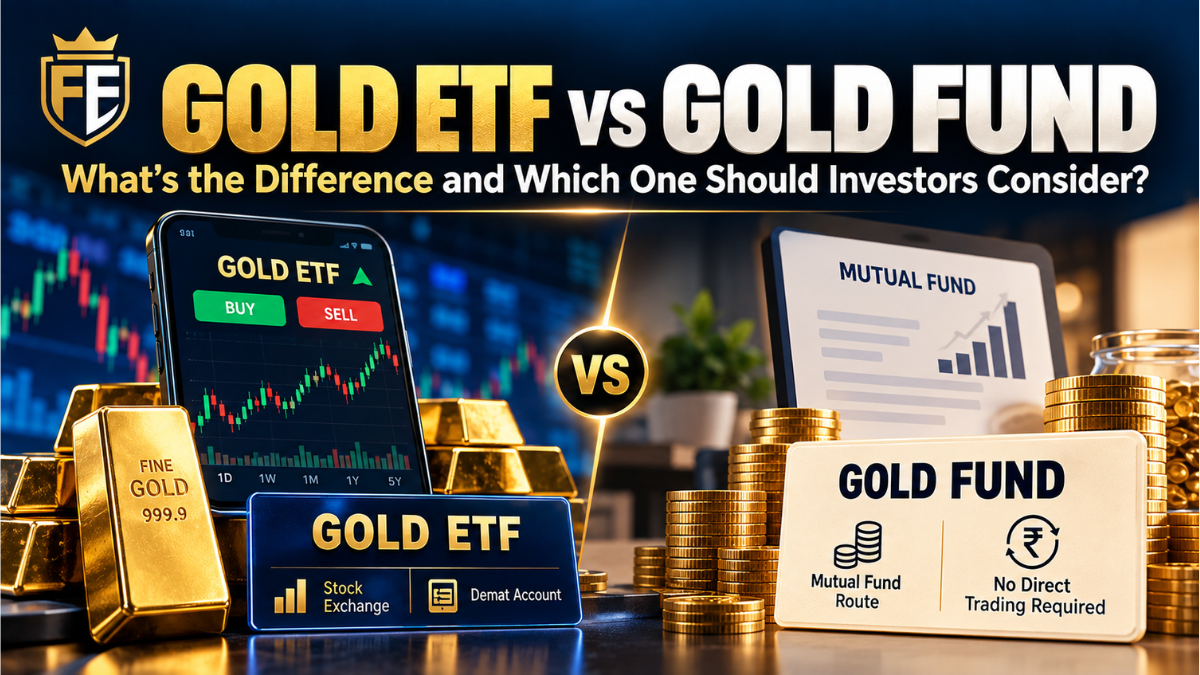
An investor wants exposure to gold without buying jewellery, bars or coins.
Two common mutual-fund routes are:
Gold ETF
and
Gold Fund
Both can provide exposure to movements in gold prices, but the way investors buy, hold, sell and pay for that exposure is different.
The simplest distinction is:
Gold ETF = Exchange + Demat
Gold Fund = Mutual Fund route + usually no direct exchange trading
Understanding Gold ETF vs Gold Fund therefore requires looking beyond gold itself and comparing the investment structure, cost, liquidity and convenience.
Quick Summary
- Gold ETFs trade on stock exchanges and are generally held in demat form.
- Gold Funds are usually Fund of Funds schemes that invest predominantly in an underlying Gold ETF.
- A Gold ETF has an exchange-traded market price, while a Gold Fund is transacted at the applicable NAV-based price.
- Gold Funds can be more convenient for SIP-style investing and generally do not require a demat account.
- Investors should compare cost, tracking quality, liquidity, convenience and tax treatment before choosing.
What Is a Gold ETF?
A Gold ETF, or Gold Exchange Traded Fund, is an ETF with gold as its underlying asset.
Gold ETF units are listed on a stock exchange and are bought or sold during market hours in a way similar to shares.
AMFI describes Gold ETFs as schemes with gold as the underlying asset, with the fund holding physical gold or permitted gold-related instruments under applicable rules.
The basic structure is:
Investor
↓
Gold ETF
↓
Physical gold / permitted gold-related instruments
Gold ETFs are designed to broadly track movements in domestic gold prices, subject to:
- expenses
- tracking difference
- tracking error
- cash holdings
- transaction costs
- operational factors
A Gold ETF unit does not necessarily represent exactly one gram of gold in every scheme. Unit denomination can vary by product.
How Does a Gold ETF Work?
To invest in a Gold ETF, an investor typically uses:
- a trading account
- a demat account
- a stock exchange
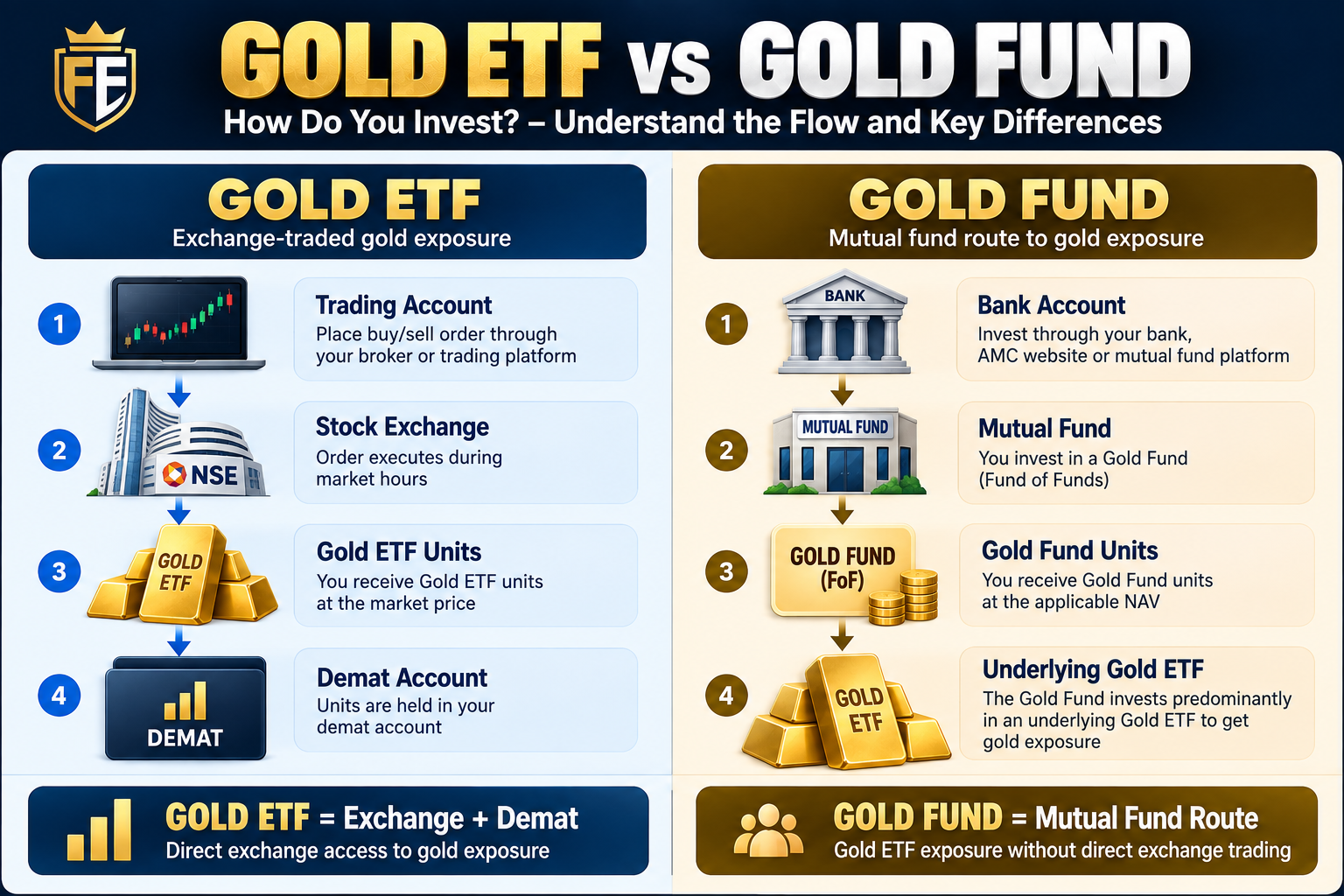
The basic flow is:
Trading Account
↓
Stock Exchange
↓
Gold ETF Units
↓
Demat Account
The investor places a buy order during market hours.
If the order is executed, the Gold ETF units are credited to the demat account.
When the investor wants to exit, the units can be sold on the stock exchange.
One important point is that:
The Gold ETF’s market price does not always have to equal its NAV exactly.
Because ETF units trade in the market, the price can temporarily differ from NAV depending on:
- supply and demand
- liquidity
- bid-ask spread
- market conditions
SEBI-filed ETF documents also distinguish between NAV and indicative NAV during trading hours.
What Is a Gold Fund?
What investors commonly call a Gold Fund is usually a Gold Fund of Funds, or Gold FoF.
Instead of directly holding physical gold itself, the Gold Fund typically invests predominantly in units of an underlying Gold ETF.
The structure is:
Investor
↓
Gold Fund / FoF
↓
Underlying Gold ETF
↓
Gold exposure
This is an important distinction.
A Gold Fund should not automatically be described as directly holding physical gold unless the specific scheme mandate says so.
Current SEBI-filed scheme documents show Gold FoFs investing in underlying Gold ETFs to obtain gold exposure.
How Does a Gold Fund Work?
A Gold Fund is accessed through the mutual-fund route rather than through direct exchange trading.
The typical flow is:
Bank Account
↓
Mutual Fund
↓
Gold Fund Units
↓
Underlying Gold ETF
Generally:
- no direct stock-exchange trade is required
- no demat account is required for the normal mutual-fund route
- units are allotted based on the applicable NAV framework
- SIP facilities may be available, subject to scheme terms
AMFI-filed Gold FoF documents specifically note that a demat account is not mandatory for investing through the FoF route and that systematic investments can be made through SIPs.
Gold ETF vs Gold Fund: Key Differences
| Factor | Gold ETF | Gold Fund |
|---|---|---|
| Structure | Exchange Traded Fund | Mutual Fund / Fund of Funds |
| Underlying exposure | Gold / permitted gold-related instruments | Usually underlying Gold ETF |
| How bought | Stock exchange | AMC / mutual-fund platform |
| Demat account | Required | Generally not required |
| Trading account | Required | Generally not required |
| Price | Market price during trading hours | Applicable NAV-based price |
| Intraday trading | Yes | No |
| SIP convenience | Depends on broker/platform | Usually simpler |
| Liquidity mechanism | Exchange trading | Redemption through mutual fund |
| Cost structure | ETF costs + trading-related costs | FoF-level cost + underlying ETF cost |
The easiest way to remember the Gold ETF vs Gold Fund difference is:
Gold ETF gives direct exchange access. Gold Fund gives mutual-fund access to an underlying Gold ETF.
Gold ETF vs Gold Fund: Do You Need a Demat Account?
Gold ETF
Yes.
Gold ETF units are generally held in demat form and traded through a stock exchange.
Gold Fund
Generally no.
An investor can usually invest through the normal mutual-fund route without opening a demat or trading account.
This practical difference can matter a lot for investors who do not already use a broker.
Gold ETF vs Gold Fund: How Are Prices Determined?
Gold ETF
A Gold ETF has:
- a scheme NAV
- an exchange-traded market price
The market price can move slightly above or below the NAV.
This difference is influenced by:
- liquidity
- demand and supply
- bid-ask spread
- market-making activity
- trading conditions
Gold Fund
A Gold Fund does not have a separate exchange-traded price.
Subscriptions and redemptions are processed according to the applicable mutual-fund NAV and cut-off rules.
So:
Gold ETF = real-time exchange price
Gold Fund = applicable NAV-based transaction
Gold ETF Liquidity: Why It Matters
Gold ETF liquidity is not only about whether the ETF can be bought or sold.
The quality of liquidity matters too.
An ETF with poor trading liquidity can have:
- wider bid-ask spreads
- higher transaction friction
- larger temporary differences between market price and NAV
Therefore, investors comparing Gold ETFs should not look only at trading volume.
They should also pay attention to:
- bid-ask spread
- underlying liquidity
- market-making quality
- how closely the market price remains aligned with NAV
Gold Fund Liquidity: How Is It Different?
Gold Fund investors do not need to find another exchange buyer at the exact moment they redeem.
They submit a redemption request to the mutual fund and receive proceeds according to the scheme’s redemption and settlement framework.
This does not mean Gold Funds are always more liquid.
It means their liquidity mechanism is different.
Gold ETF
Liquidity comes through exchange trading.
Gold Fund
Liquidity comes through mutual-fund redemption.
Gold ETF vs Gold Fund: Cost Comparison
Cost is one of the most important differences.
Gold ETF costs may include:
- ETF expense ratio
- brokerage, depending on broker
- bid-ask spread
- demat-related charges
- other applicable trading costs
Gold Fund costs may include:
- Gold Fund/FoF expense ratio
- expenses of the underlying Gold ETF
AMFI explicitly notes that Fund of Funds structures can involve expenses at both the FoF level and the underlying scheme level.
So Gold Fund investors should understand that there can be two cost layers.
Why Gold Funds Can Have an Extra Layer of Cost
The Gold Fund does not replace the underlying Gold ETF.
It invests in it.
Conceptually:
Investor
↓
Gold Fund / FoF cost
↓
Underlying Gold ETF cost
↓
Gold exposure
That is why Gold Funds can have an additional cost layer.
However, it would be too simplistic to just take two published expense ratios and add them without checking the actual scheme disclosures.
Current regulations govern combined expenses in FoF structures, so investors should use the latest AMC/AMFI TER disclosures rather than estimating costs themselves.
Gold ETF vs Gold Fund for SIP Investors
Gold Funds are often more convenient for investors who want:
- automated monthly investing
- conventional SIP mandates
- no demat account
- no manual exchange order
Gold ETFs can also be purchased regularly.
An investor could buy ETF units every month, and some brokers may provide automated or recurring investment features.
But the process depends more on the trading platform.
So:
Gold Fund SIPs are generally more standardised from an operational perspective.
That does not mean Gold ETF periodic investing is impossible.
Gold ETF vs Gold Fund for Lump-Sum Investors
For an investor who already has:
- a demat account
- a trading account
- comfort with exchange execution
a Gold ETF offers direct access to the market.
A Gold Fund may be simpler for an investor who prefers the normal mutual-fund process.
Neither route is universally superior.
The decision is partly about investment mechanics and convenience.
Tracking Error and Tracking Difference in Gold ETFs
Gold ETFs aim to replicate movements in gold prices.
But the ETF’s return may not perfectly match the underlying gold benchmark.
Differences can arise because of:
- expense ratio
- transaction costs
- cash holdings
- portfolio implementation
- valuation differences
- operational factors
That makes tracking quality important.
A Gold ETF with a low expense ratio is not automatically the best tracker.
This is the same principle discussed in our guide:
Tracking Error vs Tracking Difference
Does a Gold Fund Also Have Tracking Difference?
Yes, indirectly.
The Gold Fund invests in an underlying Gold ETF.
So there can be:
Gold price
↓
Underlying ETF tracking difference
↓
Gold Fund/FoF expense and implementation layer
↓
Investor return
As a result, the Gold Fund’s return may differ from the physical gold benchmark by more than the underlying ETF’s own return gap.
That does not automatically make the Gold Fund inferior.
It simply reflects the extra layer in the structure.
Gold ETF vs Gold Fund: Tax Treatment
This area needs careful handling because Indian tax rules have changed materially in recent years.
One important update is that the definition of Specified Mutual Fund under Section 50AA was revised for FY 2025-26 onward so that the provision is focused mainly on mutual funds investing more than 65% in debt and money-market instruments, and qualifying FoFs investing in those funds. The government specifically noted that the previous definition had unintentionally affected Gold ETFs and Gold Mutual Funds.
Therefore, older articles that simply say:
“Gold ETFs and Gold Funds are always taxed under Section 50AA regardless of holding period”
can be outdated.
The exact capital-gains treatment can depend on factors such as:
- whether the instrument is listed
- acquisition date
- holding period
- current tax law
- investor status
Because those rules can change, this article deliberately avoids giving a fixed tax-rate table.
For actual tax calculations, investors should check the latest Income Tax Department guidance or consult a qualified tax professional.
Gold ETF vs Gold Fund: Which Has Better Returns?
There is no universal winner.
Both ultimately derive most of their performance from the underlying movement in gold prices.
But investor returns can differ because of:
- expense ratios
- tracking difference
- tracking error
- Gold Fund FoF layer
- ETF bid-ask spread
- exchange execution price
- cash holdings
- operational efficiency
So:
The underlying gold price is the main return driver, but the investment structure affects how much of that return reaches the investor.
Gold ETF vs Gold Fund: Practical Example
Consider two hypothetical investors.
Investor A — Gold ETF
Investor A:
- has a demat account
- places a buy order on the exchange
- buys Gold ETF units at the prevailing market price
- holds the units in demat form
Investor B — Gold Fund
Investor B:
- invests through a mutual-fund platform
- does not use a demat account
- receives Gold Fund units at the applicable NAV
- indirectly obtains gold exposure through the underlying Gold ETF
Both investors ultimately receive gold-linked exposure.
But their:
- transaction process
- cost structure
- liquidity mechanism
- price execution
are different.
Gold ETF vs Physical Gold
Gold ETFs also differ from physical gold.
Compared with jewellery, coins or bars, Gold ETFs avoid several practical issues such as:
- storage
- purity verification
- theft risk
- jewellery making charges
However, a Gold ETF is a financial investment product.
It does not provide the physical-use benefit of jewellery or actual possession of gold.
This article focuses on Gold ETF vs Gold Fund, so physical gold is only a secondary comparison.
Common Gold ETF vs Gold Fund Mistakes
1. Assuming Gold Fund Means Physical Gold
Gold Funds are usually FoFs investing in Gold ETFs.
2. Assuming Gold ETF Market Price Always Equals NAV
Exchange price can differ from NAV.
3. Ignoring Bid-Ask Spread
The spread is a real transaction cost for ETF investors.
4. Looking Only at Expense Ratio
Tracking quality and liquidity also matter.
5. Ignoring the FoF Cost Layer
Gold Funds can involve expenses at both the FoF and underlying ETF levels.
6. Assuming Gold Fund Convenience Means Better Returns
Convenience and investment performance are separate issues.
7. Using Outdated Gold Tax Rules
Tax rules have changed substantially.
Always check current law.
8. Assuming Gold Is Risk-Free
Gold prices can rise or fall.
Neither a Gold ETF nor a Gold Fund removes the market risk of the underlying asset.
FintechEdge Gold ETF vs Gold Fund Decision Guide
Use this framework.
Already comfortable with demat and exchange trading?
A Gold ETF may be operationally relevant.
Prefer the mutual-fund route without direct exchange trading?
A Gold Fund may be operationally relevant.
Want a conventional SIP setup?
A Gold Fund can be simpler operationally.
Comparing Gold ETFs?
Check:
- expense ratio
- tracking error
- tracking difference
- liquidity
- bid-ask spread
For more on the relationship between cost and replication quality, see:
Expense Ratio vs Tracking Error
Comparing Gold Funds?
Check:
- FoF expense structure
- underlying Gold ETF
- tracking quality
- convenience
- scheme terms
The goal is not to ask:
“Which product is always better?”
The better question is:
Which structure better matches the way you want to access gold exposure?
Frequently Asked Questions
What is a Gold ETF?
A Gold ETF is an exchange-traded fund with gold as the underlying asset. Its units trade on a stock exchange and are generally held in demat form.
What is a Gold Fund?
A Gold Fund is typically a Fund of Funds scheme that invests predominantly in units of a Gold ETF and is bought or redeemed through the mutual-fund route.
Is a demat account required for Gold ETF?
Yes.
Gold ETF units are normally held in demat form and traded on an exchange.
Is a demat account required for Gold Fund?
Generally no when investing through the normal mutual-fund route.
Does a Gold Fund invest directly in physical gold?
Usually not.
A Gold Fund/FoF commonly invests in an underlying Gold ETF, although investors should always verify the mandate of the specific scheme.
Which is cheaper: Gold ETF or Gold Fund?
There is no universal answer.
Gold ETFs can involve ETF expenses, brokerage, spread and demat costs.
Gold Funds can involve a FoF-level expense plus the underlying ETF’s expense.
Can I do SIP in Gold ETF?
Periodic buying is possible.
Whether automated SIP-style functionality is available depends on the broker or platform.
Is Gold Fund suitable for SIP investing?
Gold Funds commonly offer SIP facilities, subject to scheme terms.
Which is more liquid: Gold ETF or Gold Fund?
They use different liquidity mechanisms.
Gold ETF liquidity depends on exchange conditions.
Gold Fund liquidity comes through the mutual-fund redemption process.
Is Gold ETF price equal to NAV?
Not necessarily.
The ETF’s market price can trade above or below its NAV temporarily.
Which gives better returns: Gold ETF or Gold Fund?
Neither has a guaranteed return advantage.
Performance depends mainly on gold prices, but expenses, tracking, execution and the FoF layer can affect investor returns.
How are Gold ETF and Gold Fund taxed?
Tax treatment depends on current law, product structure, acquisition date and holding period.
Because Indian tax rules have changed materially, investors should verify the latest tax treatment before making decisions.
Final Takeaway
The easiest way to understand Gold ETF vs Gold Fund is to focus on the route used to reach gold exposure.
With a Gold ETF:
Trading Account → Stock Exchange → Gold ETF → Demat
With a Gold Fund:
Bank Account → Mutual Fund → Gold Fund/FoF → Gold ETF
The underlying exposure may be broadly similar, but the investment experience differs.
Gold ETF tends to involve:
- demat
- exchange trading
- market price
- bid-ask spread
- direct ETF expenses
Gold Fund tends to involve:
- mutual-fund transactions
- no direct exchange trading
- conventional SIP convenience
- NAV-based transactions
- an additional FoF layer
Neither is universally superior.
The right comparison is:
Gold ETF vs Gold Fund = structure + cost + liquidity + tracking + convenience
not simply:
“Which one gives higher returns?”
Sources & References
- AMFI — Categorisation of Mutual Fund Schemes: Gold ETFs and Fund of Funds AMFI
- AMFI-filed Scheme Information Document — Gold ETF Fund of Fund mechanics and demat/SIP comparison AMFI इंडिया
- SEBI-filed Gold Fund of Fund Scheme Information Document — underlying Gold ETF structure Securities and Exchange Board of India
- Government of India — Finance Bill memorandum on revised Section 50AA definition India Budget
- AMFI — Current Mutual Fund Tax Regime
This article is for educational and informational purposes only and does not constitute investment advice, trading advice or a recommendation to buy or sell any security.
Our content is written for educational purposes and focuses on clarity, evidence, risk awareness and practical decision-making.