Indian Stock Market Today: Midcaps Outperform After Fed Hike
Quick Summary
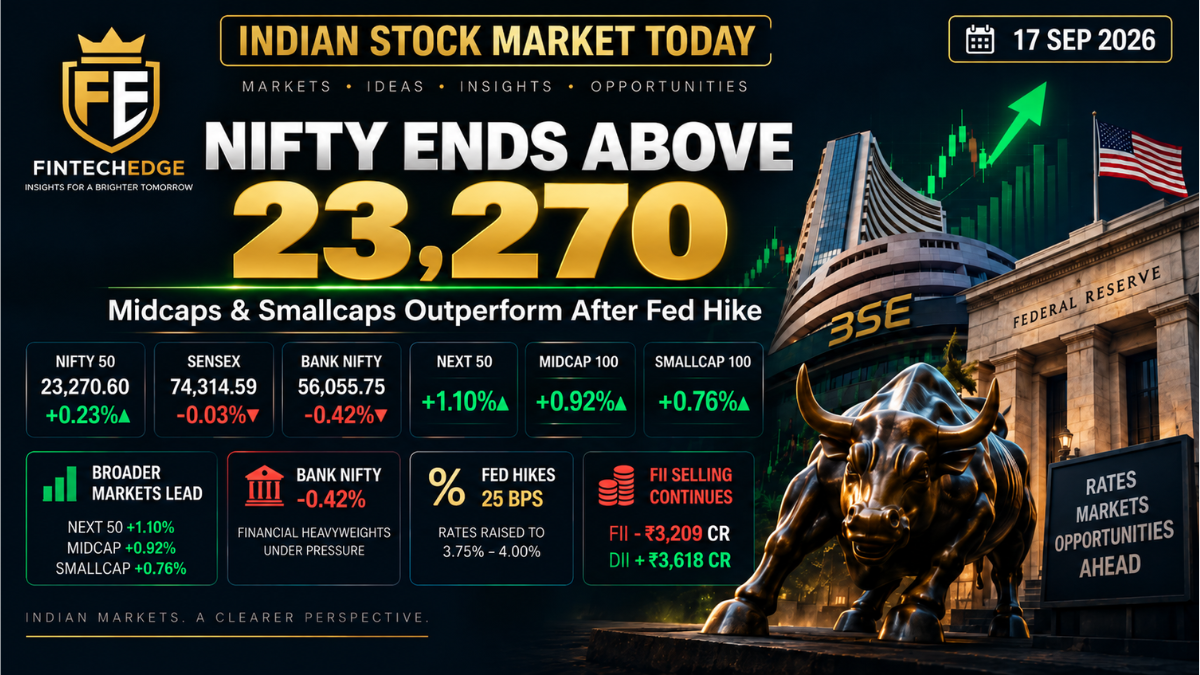
- Nifty 50 gained 0.23% to 23,270.60, while Sensex ended almost flat at 74,314.59.
- Bank Nifty declined 0.42%, limiting gains in the headline indices.
- Broader markets outperformed: Nifty Next 50 rose 1.10%, Midcap 100 gained 0.92%, and Smallcap advanced 0.76%.
- The US Federal Reserve raised interest rates by 25 basis points and indicated further tightening remains possible.
- Crude oil eased from recent highs, while the rupee remained close to ₹96 per US dollar.
- FIIs sold ₹3,209 crore, while DIIs bought ₹3,618 crore.
Indian Market Performance — 17 September 2026
Daily change in key Indian equity indices
Indian Stock Market Today: Nifty Ends Above 23,270 as Midcaps, Smallcaps Outperform After Fed Hike
Indian equities ended mixed on 17 September 2026, a day after the US Federal Reserve raised interest rates by 25 basis points.
The Nifty 50 gained 0.23% to close at 23,270.60, while the Sensex slipped 0.03% to 74,314.59. Bank Nifty underperformed, falling 0.42% to 56,055.75 as financial heavyweights weighed on the benchmarks.
The more important story was beneath the headline indices. The Nifty Next 50 gained 1.10%, Nifty Midcap 100 rose 0.92%, and Nifty Smallcap advanced 0.76%, showing materially stronger participation outside the largest benchmark stocks.
That made Thursday’s session less about a strong Nifty move and more about broader-market outperformance despite weak banks and a still-tight global rate environment.
Indian Market Performance — 17 September 2026
| Index | Close | Change |
|---|---|---|
| Nifty 50 | 23,270.60 | +0.23% |
| Sensex | 74,314.59 | -0.03% |
| Bank Nifty | 56,055.75 | -0.42% |
| Nifty Next 50 | 71,144.00 | +1.10% |
| Nifty Midcap 100 | 61,432.10 | +0.92% |
| Nifty Smallcap | 19,535.70 | +0.76% |
Sources: NSE market data | FintechEdge Research.
Why Markets Stayed Muted After the Fed Hike
The main global backdrop was the Federal Reserve’s decision to raise interest rates by 25 basis points, taking the benchmark range to 3.75%–4.00%.
The hike itself was largely expected. The more important signal was that policymakers continued to indicate the possibility of further tightening as inflation remained above target.
For Indian markets, that matters through several channels:
- US Treasury yields;
- the dollar;
- foreign portfolio flows;
- emerging-market currencies;
- and domestic rate expectations.
That helps explain why the Nifty’s gain remained modest even though participation improved across midcaps and smallcaps.
Broader Markets Outperform Large Caps
The strongest domestic signal was the clear outperformance outside the headline indices.
While the Nifty rose only 0.23%, the Nifty Next 50 gained 1.10%, Midcap 100 rose 0.92%, and Smallcap advanced 0.76%.
That is meaningful because it shows buying was not limited to a handful of heavyweight stocks.
In fact, Thursday produced almost the opposite structure of the previous session. On Wednesday, large caps and banks drove the recovery while broader indices lagged. On Thursday, broader-market participation improved while Bank Nifty weakened.
The useful takeaway is:
Market breadth improved even though the headline benchmarks remained muted.
That is more important than over-analysing each individual index.
Bank Nifty Falls as Financial Heavyweights Drag
Bank Nifty declined 0.42%, reversing the previous session’s strong outperformance.
HDFC Bank and ICICI Bank were among the financial names under pressure, which limited the performance of both the Nifty and Sensex. Reuters also highlighted banking weakness as one of the factors keeping the benchmarks subdued.
This created a clear market structure:
broader markets strong → banking weak → headline indices muted
That relationship explains Thursday’s session better than simply saying the Nifty rose 53 points.
Auto and Pharma Show Selective Strength
Auto and pharmaceutical stocks were among the stronger areas of the market, while several sectors finished in positive territory.
The important point is not that every sector rallied.
Rather, sector participation was broader than earlier in the week, helping midcaps and smallcaps outperform even while financial heavyweights remained under pressure.
Oil Eases, but Macro Pressure Remains
Crude oil eased from the sharp levels seen earlier in the week, with global oil prices falling as additional supply helped calm some of the previous pressure.
For India, softer crude is supportive because lower oil can reduce pressure on:
- the import bill;
- inflation;
- the current account;
- and the rupee.
However, crude remains elevated enough that the macro risk has not disappeared.
The rupee also remained close to the ₹96 per dollar area, keeping currency pressure relevant for investors. Reuters noted that the rupee was trading around ₹95.90–95.93 during the session.
So the macro backdrop improved slightly on oil, but not enough to call it a major shift.
FII Selling Continues, DIIs Offset the Pressure
Institutional flows remain one of the more useful indicators beneath the market.
On 17 September 2026:
- FIIs were net sellers of ₹3,209 crore
- DIIs were net buyers of ₹3,618 crore
Domestic institutions therefore more than offset the day’s net foreign selling in cash-market terms.
This pattern matters because foreign investors are still dealing with:
- elevated US rates;
- tight global liquidity;
- rupee weakness;
- and high energy prices.
DII buying continues to provide support, but persistent FII selling can still limit the strength of large-cap rallies.
NSE IPO Draws Investor Attention
The National Stock Exchange of India’s IPO opened for subscription on Thursday.
The issue is valued at about ₹225.69 billion, or roughly $2.3 billion, and received bids for about 42% of the shares available on the first day.
A large IPO can compete with the secondary market for investor attention and liquidity.
However, it would be too strong to say that the NSE IPO caused market weakness.
The better interpretation is that the IPO added another competing demand for capital at a time when global liquidity conditions are already relatively tight.
Stocks in Focus
Financial heavyweights such as HDFC Bank and ICICI Bank were among the notable laggards as banking stocks weighed on the benchmarks.
Tata-group stocks also attracted attention amid developments around Tata Sons and listing-related expectations.
Other pockets of strength appeared in autos, pharma and select midcap names, consistent with the broader-market outperformance.
The important distinction is that these were stock- and sector-specific moves, not the main explanation for the overall market.
What to Watch Next
A few variables matter more than routine day-to-day index movements.
Fed guidance:
Markets will continue digesting the central bank’s hawkish shift and expectations for additional tightening.
US Treasury yields:
Higher yields can keep pressure on emerging-market capital flows.
Crude oil:
A sustained decline from recent highs would help India’s inflation, import and currency backdrop.
USD/INR:
The rupee remains close to ₹96, making currency stability important.
FII/DII flows:
Thursday’s FII -₹3,209 crore / DII +₹3,618 crore pattern is worth monitoring over several sessions.
Broader-market participation:
The key question is whether stronger Next 50, midcap and smallcap participation continues or proves to be a one-session rebound.
FintechEdge View
September 17 was more constructive beneath the surface than the Nifty’s modest 0.23% gain suggests.
The Sensex was nearly flat and Bank Nifty declined, yet the Nifty Next 50, midcaps and smallcaps all posted materially stronger gains. That makes improved participation the most important signal from Thursday’s session.
At the same time, the external environment remains challenging. The Federal Reserve has returned to rate hikes, the rupee remains close to ₹96, global liquidity is tight and foreign investors continued to sell Indian equities.
So Thursday’s session should not be treated as proof that the recent correction has ended.
What improved was breadth, not the macro backdrop.
A stronger and more durable recovery would likely require both continued broader-market participation and some easing in global rates, currency pressure, crude prices or foreign selling.
This article is for educational and informational purposes only and does not constitute investment advice, trading advice or a recommendation to buy or sell any security.
Our content is written for educational purposes and focuses on clarity, evidence, risk awareness and practical decision-making.