Indian Stock Market Today: Nifty Falls 0.54% as Oil Surges Above $112

Quick Summary
- Nifty 50 fell 0.54% to 22,687.65, while Sensex declined 0.62% to 73,249.39.
- Brent crude surged 3.3% to around $112.40 per barrel, making oil the dominant macro headwind.
- The broader market remained weak, with Midcap 100 down 0.87% and Smallcap 100 down 1.13%.
- Bank Nifty held up better than the broader market, slipping only 0.09%.
- FIIs sold ₹3,459 crore, while DIIs bought ₹2,891 crore in the stock segment.
- The rupee weakened to around ₹94.82 per dollar, ending an eight-day winning streak.
- IT gave back part of its recent gains as most major sectors closed lower.
Indian Market Performance — 22 October 2026
Daily change in key Indian equity indices
Indian Stock Market Today: Closing Summary
Indian stock market today ended lower on 22 October 2026, with the Nifty 50 falling 0.54% to 22,687.65 and the Sensex declining 0.62% to 73,249.39 as crude oil surged above $112 per barrel and broader-market weakness continued. Pasted text
The pressure was visible beyond the headline indices. The Nifty Midcap 100 fell 0.87%, the Smallcap 100 dropped 1.13%, and the Nifty Next 50 declined 0.45%. Bank Nifty was comparatively resilient, closing almost flat at -0.09%. Pasted text
The clearest macro concern was crude oil. Brent climbed about 3.3% to $112.40 per barrel, its highest level since May, as Middle East supply concerns intensified. Foreign investors also returned to net selling, while the rupee snapped an eight-session winning streak.
Indian Market Performance
| Index | Close | Change |
|---|---|---|
| Nifty 50 | 22,687.65 | -0.54% |
| Sensex | 73,249.39 | -0.62% |
| Bank Nifty | 54,925.70 | -0.09% |
| Nifty Next 50 | 67,354.15 | -0.45% |
| Nifty Midcap 100 | 57,063.95 | -0.87% |
| Nifty Smallcap 100 | 18,275.90 | -1.13% |
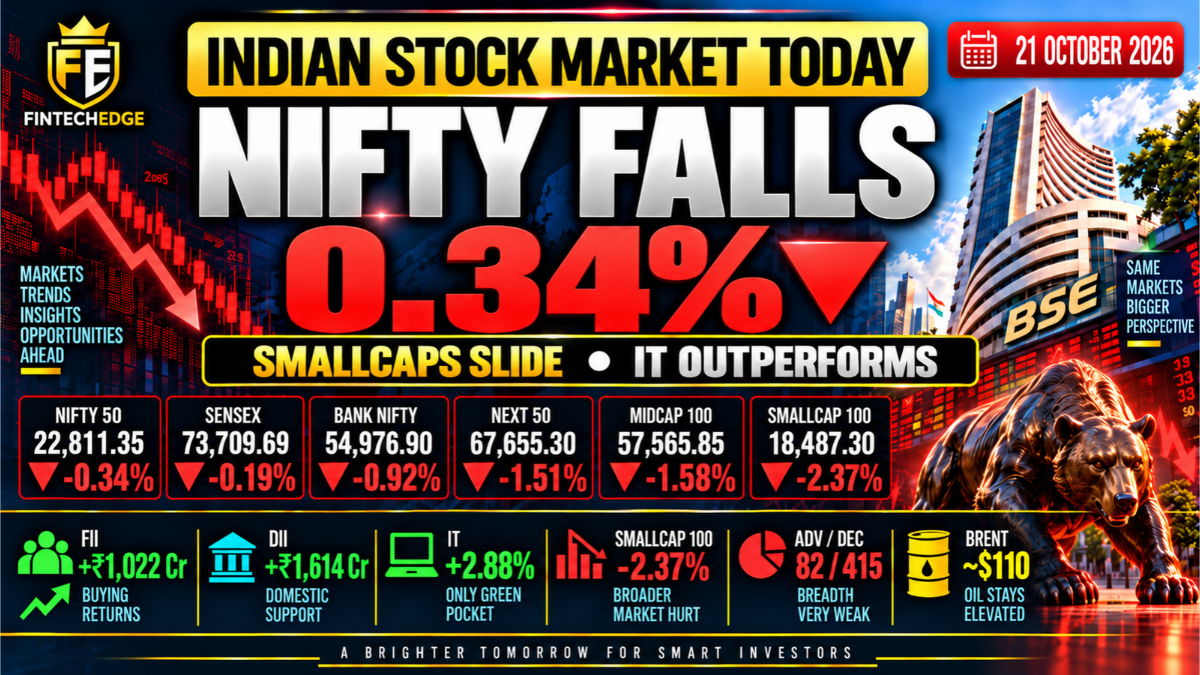
The broader market again underperformed the benchmarks, although the divergence was less severe than the 21 October session, when the Smallcap 100 fell 2.37% and the Midcap 100 lost 1.58%.
That distinction matters. Today was still a weak session, but not another collapse in breadth on the scale seen a day earlier.
Oil Above $112 Drives Macro Pressure
Crude oil was the most important macro development of the day.
Brent climbed around 3.3% to $112.40 per barrel, its highest level since May, as escalating Middle East tensions raised fresh concerns around energy supplies. Pasted text
For India, a large oil importer, sustained crude prices at these levels matter through several channels.
Higher oil can increase:
- the import bill;
- inflationary pressure;
- dollar demand;
- pressure on the current account;
- corporate input costs;
- and uncertainty around interest rates.
Oil therefore affects considerably more than energy companies.
A sharp rise in crude can also influence the rupee and foreign investor sentiment because investors must consider the potential impact on India’s external balances.
Still, today’s decline should not be attributed entirely to oil.
Broader-market weakness was already visible in recent sessions, foreign flows remained unstable, and global bond yields continued to keep financial conditions restrictive.
Oil intensified those existing concerns rather than creating them from scratch.
Smallcaps and Midcaps Stay Under Pressure
Broader-market weakness remained one of the most important features of the session.
The Midcap 100 fell 0.87%, while the Smallcap 100 declined 1.13%. The Next 50 lost 0.45%.
This follows the much sharper sell-off seen on 21 October, when smallcaps dropped 2.37%.
So while the intensity moderated today, the relative weakness did not disappear.
For investors, the practical point is that the Nifty and Sensex still do not capture the full pressure across the market.
A Nifty decline of around half a percent can look relatively contained, while portfolios exposed heavily to smaller companies may experience a materially weaker session.
That difference has become increasingly important over the past several days.
FIIs Sell ₹3,459 Crore, DIIs Buy ₹2,891 Crore
Institutional flows reversed again.
Your 22 October stock-segment data showed:
- FII: -₹3,459 crore
- DII: +₹2,891 crore
FIIs therefore returned to net selling, while domestic institutions again provided support. Pasted text
That comes just one day after both FIIs and DIIs were net buyers.
The rapid change highlights how unstable foreign flows remain.
One positive FII session does not necessarily establish a sustained return of foreign capital, just as one day of selling does not prove a new structural exit.
October’s cumulative foreign-flow picture remains weak, which makes persistent improvement more important than isolated positive days.
Domestic institutions continued to absorb some of the selling today, but DII buying was smaller than the FII outflow.
Rupee Weakens After Eight-Day Rally
The rupee also reacted to the jump in crude.
It weakened about 0.4% to ₹94.8175 per dollar, ending an eight-session winning streak. Pasted text
The relationship with oil is important.
India pays for crude imports largely in dollars. When crude prices rise sharply, demand for dollars from importers can increase, which can put pressure on the rupee.
Recent support from Jio IPO-linked inflows and RBI measures had helped the currency strengthen.
But today’s oil move was large enough to outweigh some of that support.
This does not mean the rupee’s recent improvement has permanently reversed.
It simply shows how quickly external pressures can return when energy prices rise.
Bank Nifty Holds Up Better
Bank Nifty was one of the more resilient major indices today.
It fell only 0.09%, compared with:
- Nifty 50: -0.54%
- Sensex: -0.62%
- Midcap 100: -0.87%
- Smallcap 100: -1.13%
That is notable after the pressure financial stocks had faced earlier this week.
But relative resilience should not be confused with strength.
Bank Nifty still closed lower, and one comparatively stable session is not enough to conclude that the sector has reversed its recent weakness.
For today, the correct interpretation is simply that banks held up better than most other market segments.
IT Gives Back Some Recent Gains
IT, which had been one of the strongest parts of the market during the recent rebound, gave back some gains.
The sector had previously cushioned the benchmarks even while the broader market weakened, particularly during the strong IT-led recovery around 16 October.
Today, that support was weaker.
Recent gains in IT had been backed by encouraging earnings and margin commentary from several major companies.
One negative session does not invalidate that improvement.
But with the broader market already under pressure, the loss of IT support made it more difficult for the Nifty and Sensex to resist the negative macro backdrop.
Most Sectors Finish Lower
Sector participation was broadly negative.
Most major sectoral indices finished lower, with weakness across IT, energy, FMCG and several other groups. Pasted text
This is important because it shows today’s move was not limited to one or two isolated industries.
At the same time, the scale of losses differed considerably across segments.
Banks were relatively stable, while smallcaps continued to experience heavier pressure.
That unevenness remains an important characteristic of the market.
Rising Yields Keep Rate Concerns Alive
Bond yields remain another background risk.
Financial markets globally continue to adjust to the possibility that interest rates may need to remain restrictive for longer than previously expected.
Higher yields matter for equities because they can:
- increase corporate borrowing costs;
- make bonds relatively more attractive;
- pressure valuations;
- slow credit-sensitive parts of the economy;
- and influence global capital flows.
The transcript suggested that future Fed and RBI rate increases were effectively certain.
That conclusion is too strong.
The more defensible interpretation is that markets remain sensitive to tighter global financial conditions and elevated bond yields.
What central banks ultimately do will depend on incoming inflation, growth and financial-market data.
Weak Asian Markets Add to Caution
The international environment also remained difficult.
Several Asian markets faced heavy selling, particularly technology-heavy markets that had benefited significantly from the earlier AI and semiconductor rally.
India declined less than some regional peers, but the idea that India will automatically benefit whenever the global AI trade weakens has not been established.
Recent performance shows that domestic factors—oil, foreign flows, earnings, the rupee and interest rates—continue to matter heavily.
Global technology sentiment is therefore relevant, but it should not be treated as the sole explanation for Indian market moves.
What to Watch Next
Brent crude
Oil at $112 is now one of the most important variables for Indian assets. Further escalation would increase pressure on inflation, the rupee and external balances.
Smallcaps and midcaps
The broader market has now underperformed for several sessions. Whether that weakness stabilises will be important for market breadth.
FII flows
FIIs returned to net selling after buying the previous session. A sustained trend will matter more than daily reversals.
Rupee
The eight-day rally ended as oil jumped. How the currency behaves if crude remains elevated will be worth monitoring.
Bank Nifty
Banks held up comparatively well today. Continued relative resilience would help the benchmarks.
Bond yields
Higher global and domestic yields remain a risk to valuations and interest-rate-sensitive sectors.
FintechEdge View
The Indian stock market today remained under pressure, but the character of the decline was slightly different from the previous session.
Smallcaps and midcaps continued to underperform, although their losses were smaller than on 21 October. Bank Nifty, meanwhile, was almost unchanged.
The biggest change came from the macro side.
Brent crude’s jump above $112 immediately increased concerns around inflation, the rupee and India’s import bill. The currency weakened, FIIs returned to selling and most sectors ended lower.
The market therefore continues to face pressure from two directions: weaker participation beneath the headline indices and a more difficult external environment.
The next meaningful improvement would require more than just a stable Nifty. Broader-market participation, oil, the rupee and foreign flows all need to be watched together.
Sources & References
- Indian shares fall as high oil prices fuel inflation concerns Reuters
- Rupee weakens as rising oil outweighs recent IPO-linked inflows Reuters
- RBI rejects Treasury-bill bids as short-term yields remain elevated Reuters
- Asian markets face pressure amid volatility in AI-linked trades Reuters
This article is for educational and informational purposes only and does not constitute investment advice, trading advice or a recommendation to buy or sell any security.
Our content is written for educational purposes and focuses on clarity, evidence, risk awareness and practical decision-making.