Mutual Fund Switch vs Redemption in India: Tax, Exit Load & Key Differences
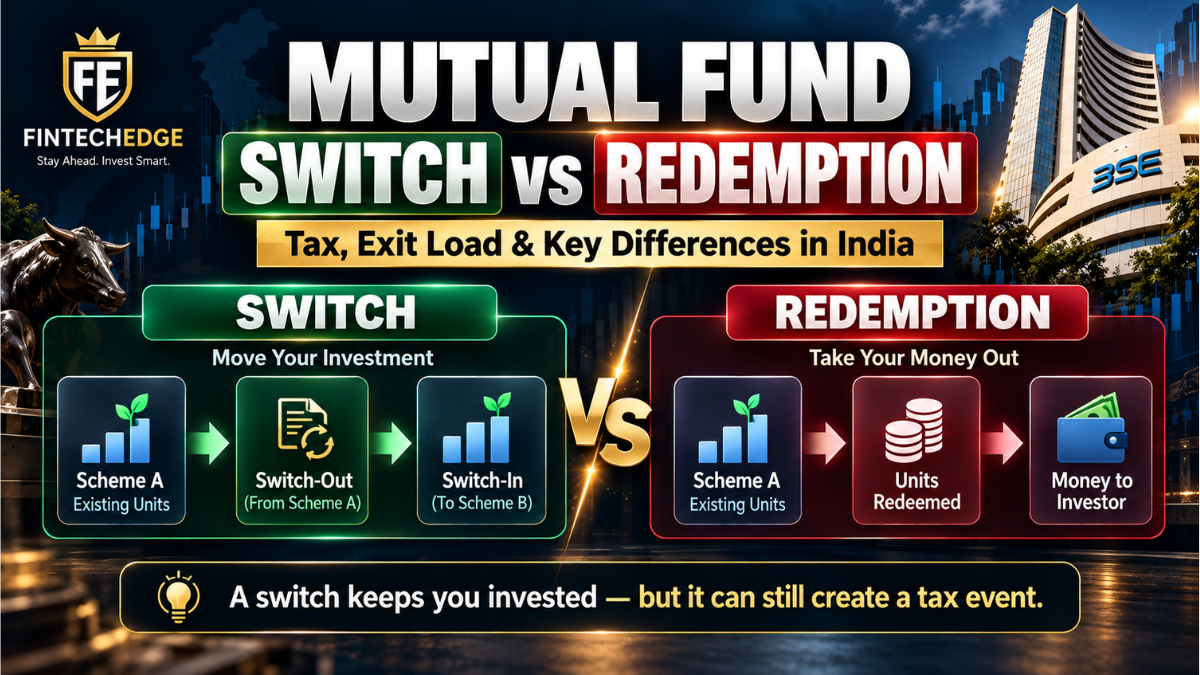
Mutual fund switch vs redemption is an important distinction for Indian investors because both transactions can trigger tax, exit-load and NAV consequences. Many investors assume a mutual fund switch is simply an internal transfer of money from one scheme to another.
In practice, it usually involves two separate legs:
Switch-out = redemption of the existing units
Switch-in = purchase of units in the destination scheme
That distinction matters because a switch can trigger capital gains tax, exit load and applicable-NAV rules even though the investor may never receive the money in their bank account.
The simplest way to remember the difference is:
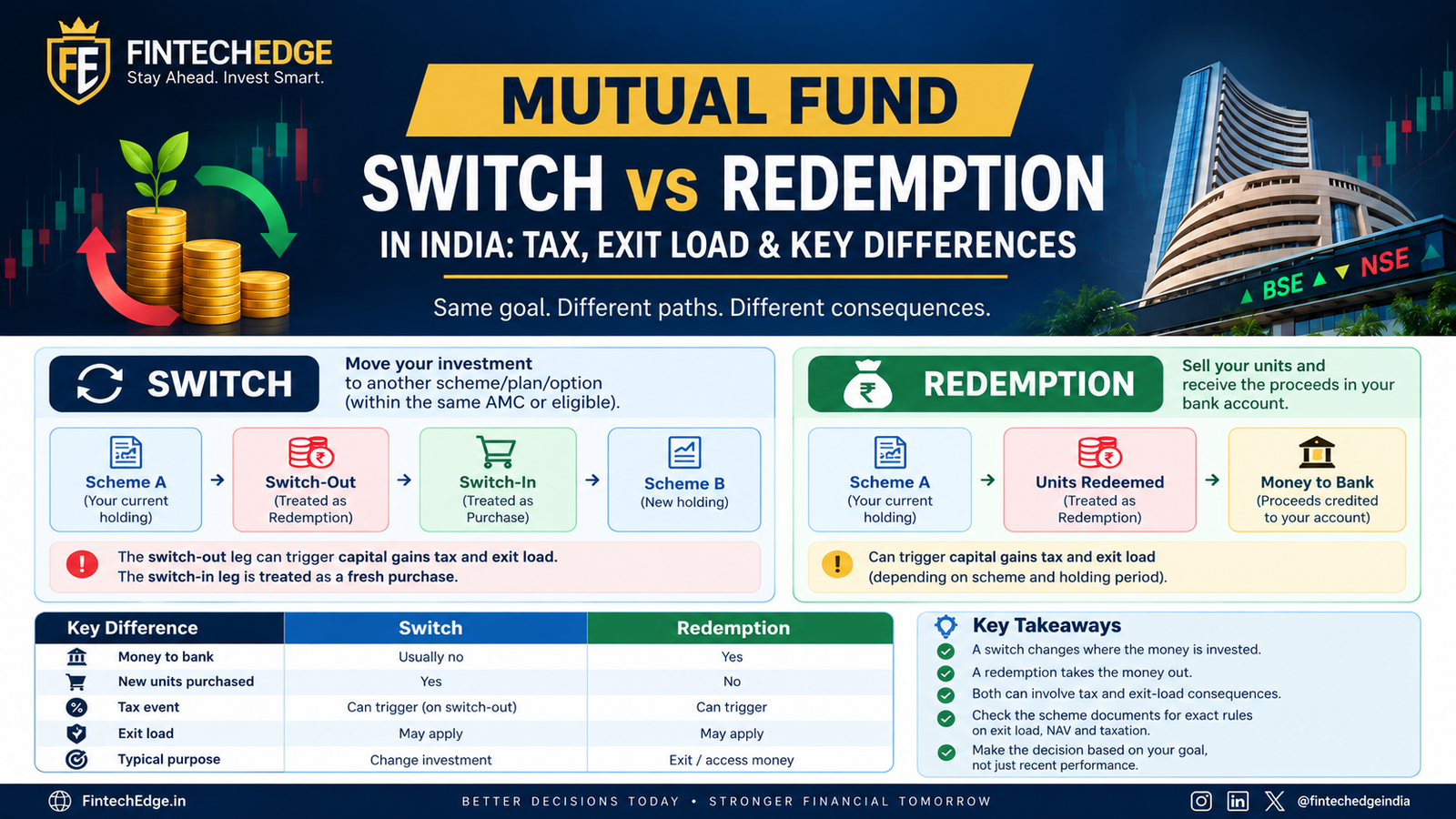
A switch changes where the money is invested. A redemption takes the money out. But both can involve a redemption event.
Quick Summary
- Redemption means selling mutual fund units and normally receiving the proceeds in your registered bank account.
- A switch generally redeems units from one holding and uses the proceeds to purchase another eligible scheme, plan or option.
- The switch-out leg can trigger capital gains tax, just like a normal redemption.
- Exit load may apply to either a switch or redemption depending on the scheme’s rules and holding period.
- A switch should not be assumed to be tax-free simply because the money remains invested.
What Is Mutual Fund Redemption?
A mutual fund redemption means selling some or all of your units back to the mutual fund.
The units are cancelled and the redemption proceeds are normally paid to the investor’s registered bank account.
The amount received depends on the applicable NAV and any exit load that applies.
AMFI describes the redemption or repurchase price as the applicable NAV adjusted for exit load, wherever applicable.
A redemption can also create a capital gain or capital loss for tax purposes depending on:
- the type of mutual fund
- purchase date
- holding period
- purchase cost
- redemption value
- applicable tax rules
What Is a Mutual Fund Switch?
A mutual fund switch generally follows this sequence:
Source Scheme → Switch-Out → Redemption → Switch-In → Fresh Purchase → Destination Scheme
The important point is that a switch is not treated operationally as one seamless movement of units.
AMFI states that switch-out applications are treated as redemption applications, while the switch-in leg is treated as a purchase for applicable-NAV purposes.
That explains why switching can affect:
- taxation
- exit load
- purchase cost
- acquisition date
- holding period
- applicable NAV
Mutual Fund Switch vs Redemption: Quick Comparison
| Factor | Switch | Redemption |
|---|---|---|
| What happens | Existing units are redeemed and proceeds are invested into another eligible holding | Existing units are redeemed |
| Money paid to bank | Usually not as part of the switch process | Normally yes |
| Capital gains possible | Yes, on switch-out | Yes |
| Exit load | May apply | May apply |
| New units purchased | Yes | No |
| NAV treatment | Switch-out and switch-in follow separate rules | Redemption NAV rules apply |
| Typical purpose | Change investment | Withdraw or exit investment |
Is a Mutual Fund Switch Taxable in India?
Yes, an investor-initiated mutual fund switch can create a taxable capital gain.
This is probably the most important point in this article.
Simply moving money from one mutual fund holding into another does not automatically make the transaction tax-neutral.
The switch-out leg involves redemption or transfer of the existing units. If those units have appreciated, that transaction may create taxable capital gains.
AMFI also states that switching between Growth and IDCW options is subject to capital gains tax. It separately recognises tax exemptions for certain scheme or plan consolidations carried out under the regulatory framework, which is why it is better not to claim that every conceivable switch is taxable without exception.
For an ordinary investor voluntarily switching schemes, however, the key assumption should be:
Check the capital-gains consequences before switching.
Tax on Equity-Oriented Mutual Fund Switches
For equity-oriented mutual funds meeting the relevant tax-law conditions, the switch-out leg is taxed in the same way as a qualifying redemption or transfer.
Units held for 12 months or less
The gain is generally treated as a short-term capital gain.
For relevant transfers on or after 23 July 2024, Section 111A provides a tax rate of 20%, subject to the applicable conditions.
Units held for more than 12 months
The gain is generally treated as a long-term capital gain.
For relevant transfers on or after 23 July 2024, eligible LTCG exceeding ₹1.25 lakh in aggregate during the financial year is generally taxed at 12.5%, subject to Section 112A conditions including applicable STT requirements.
Important distinction
Tax is calculated on the capital gain, not on the entire amount switched.
For example:
Purchase cost: ₹3,00,000
Value at switch-out: ₹3,60,000
Potential capital gain: ₹60,000
The relevant tax treatment applies to the gain, subject to the applicable rules—not to the full ₹3.60 lakh transaction value.
Surcharge and health and education cess may also apply depending on the investor’s circumstances.
Tax on Debt-Oriented Mutual Fund Switches
Debt-fund taxation deserves special attention because the rules changed materially in recent years.
Under Section 50AA, units of a specified mutual fund acquired on or after 1 April 2023 can have gains deemed to be short-term irrespective of the actual holding period.
From FY 2025-26, AMFI notes that the revised specified-mutual-fund definition broadly covers:
- mutual funds investing more than 65% of their proceeds in debt and money-market instruments, and
- certain funds investing 65% or more of their proceeds in such specified funds.
For covered holdings:
- the gain is generally treated as short-term
- simply holding the units longer does not turn that gain into LTCG
- the gain is generally taxed at the investor’s applicable slab rate
This treatment applies to the switch-out leg just as it would to a redemption.
What About Gold Funds, International Funds and Other Non-Equity Funds?
Do not assume that every non-equity mutual fund falls under exactly the same tax treatment as a debt fund.
This became particularly important after the revised Section 50AA definition applicable from FY 2025-26.
AMFI notes that the amended definition focuses primarily on debt-oriented funds and qualifying fund-of-funds.
For schemes that are:
- not equity-oriented funds, and
- not covered as specified mutual funds under Section 50AA,
holding-period rules can differ.
For transfers on or after 23 July 2024, AMFI states that such units generally become long-term after:
- more than 12 months for listed units
- more than 24 months for unlisted units
Eligible LTCG is generally taxed at 12.5% without indexation, subject to the applicable provisions.
This area is more scheme-specific than equity-fund taxation.
Before switching a gold fund, international fund, fund-of-funds or another non-equity product, verify the scheme’s exact tax classification.
Does Exit Load Apply on a Mutual Fund Switch?
It can.
Because the switch-out leg involves redemption of the source units, exit load may apply under the source scheme’s terms.
AMFI explains that the redemption/switch-out price includes exit load wherever applicable.
But there is an important nuance:
Do not assume that every switch attracts exit load.
Scheme rules differ.
Some scheme documents explicitly waive exit load for:
- Direct-to-Regular switches
- Regular-to-Direct switches
- switches between particular options
while other schemes can apply the prevailing exit-load structure. Recent scheme documents show both types of treatment.
Therefore, before switching, check:
- current Scheme Information Document
- Key Information Memorandum
- AMC website
- current exit-load schedule
Regular Plan to Direct Plan or Direct Plan to Regular
Direct and Regular plans generally represent different plans of the same underlying scheme.
They commonly share:
- investment objective
- fund manager
- underlying portfolio
But they have different expense structures and therefore different NAVs.
A switch between them should not be treated as merely changing a label. From a tax perspective, switching out of the existing plan can create a capital-gains event.
SEBI-hosted scheme documentation explicitly warns in some cases that investors switching from Regular to Direct may be liable for capital gains tax and, depending on scheme rules, exit load.
Exit-load treatment itself is scheme-specific. Other current scheme documents explicitly waive exit load for Direct ↔ Regular switches.
That distinction is important:
Tax treatment and exit-load treatment are not the same thing.
A scheme may waive an exit load without making the switch tax-free.
Before switching to another scheme or plan, first check whether the destination fund actually fits your goal, horizon and risk profile. Our guide on How to Choose the Best Mutual Fund in India explains that selection framework in detail.
Growth to IDCW or IDCW to Growth
Switching between Growth and IDCW should also not be treated as a purely administrative change.
AMFI currently states that switching units within the same scheme between Growth and the distribution option is subject to capital gains tax.
IDCW stands for:
Income Distribution cum Capital Withdrawal
It replaced the older “Dividend” terminology.
Once again:
The switch-out leg matters for tax purposes even when the investor continues holding the same underlying scheme through another option.
Can You Switch Between Different AMCs?
Usually, a standard mutual-fund switch facility operates between eligible schemes, plans or options within the same mutual fund house.
Moving money from one AMC to another generally involves:
Redeem from AMC A → proceeds settle → make a new purchase in AMC B
That is different from an intra-AMC switch instruction.
Some investment platforms may use convenient language around “switching funds,” but from a transaction and tax perspective, it is important to understand what actually happens underneath.
Applicable NAV on Switch vs Redemption
A switch involves two NAV calculations.
Switch-out
Treated as a redemption.
The redemption-related cut-off and applicable-NAV rules apply.
Switch-in
Treated as a purchase.
The purchase NAV depends on the applicable purchase rules, including realization of funds where relevant.
AMFI’s NAV guidance explicitly treats switch-in as a purchase transaction and switch-out as a redemption transaction.
So the switch-out NAV and switch-in NAV do not necessarily have to be identical or belong to exactly the same valuation point.
Practical Example 1: Redemption
Suppose an investor originally purchased mutual fund units for:
₹2,00,000
The investor later redeems them for:
₹2,60,000
The capital gain is:
₹60,000
That does not automatically tell us the tax payable.
We still need to know:
- fund classification
- purchase date
- holding period
- applicable tax provision
The example simply demonstrates how the gain arises.
Practical Example 2: Switch
Suppose an investor switches:
₹3,00,000
from Scheme A into Scheme B.
The original cost of the units switched out was:
₹2,40,000
Potential capital gain:
₹60,000
The destination investment may receive ₹3 lakh worth of new units, subject to transaction mechanics.
But reinvesting that money does not by itself eliminate the gain created on the redemption of Scheme A.
This is why:
Remaining invested is not the same as avoiding a tax event.
What Happens to the Holding Period After a Switch?
This is another point investors often overlook.
The units acquired in the destination scheme are new units.
Their acquisition date starts from the new allotment.
You generally do not carry the original scheme’s holding period into the newly purchased units.
That means a switch can reset the holding-period clock for the destination investment.
This may matter later when those new units are redeemed or switched again.
When Might Redemption Be Used?
A redemption may be relevant when:
- the investor needs cash
- a financial goal has been reached
- the money is being moved outside mutual funds
- the investor intends to reduce or exit the investment
- portfolio rebalancing requires the money elsewhere
The important question is not whether redemption is “good” or “bad.”
It is:
What is the investor trying to accomplish?
When Might a Switch Be Used?
A switch facility may be used when an investor wants to remain invested while changing the destination of the investment.
Examples can include:
- changing from one eligible scheme to another within an AMC
- changing investment strategy
- moving between Direct and Regular plans where permitted
- moving between Growth and IDCW options where available
But operational convenience does not automatically mean tax efficiency.
A switch may still involve:
- capital gains tax
- exit load
- a fresh purchase price
- a new holding period
If the destination is an index fund or ETF, do not compare only recent returns or expense ratios. Metrics such as tracking difference and tracking error help show how closely the fund follows its benchmark. Read our guide on Tracking Error vs Tracking Difference
Mutual Fund Switch vs Redemption: Which Should You Use?
There is no universally superior transaction.
The difference starts with the objective.
Redemption may fit the transaction when:
You actually want the money outside the mutual fund.
Switch may fit the transaction when:
You want to change where the money is invested while remaining within eligible mutual-fund holdings.
But before switching, ask whether there is a genuine investment reason for doing so.
Switching simply because another fund recently performed better can create tax and transaction consequences without necessarily improving the portfolio.
Common Mistakes Investors Make
1. Assuming a Switch Is Tax-Free
This is the biggest misconception.
A switch-out can create a taxable capital gain even when the money immediately moves into another mutual fund.
2. Ignoring Exit Load
Tax and exit load are separate issues.
A transaction could:
- have tax but no exit load
- have both
- have neither, depending on the circumstances
Check the actual scheme terms.
3. Switching Because Another Fund Recently Performed Better
Recent performance alone is rarely a sufficient reason to change funds.
Before switching, revisit:
- financial goal
- fund category
- investment strategy
- risk
- portfolio role
- cost
FintechEdge’s guide on How to Choose the Best Mutual Fund in India explains this selection framework in more detail.
4. Forgetting the Holding-Period Reset
The destination units are newly acquired units.
Their tax holding period begins again from their acquisition date.
5. Confusing an Intra-AMC Switch With Moving Between AMCs
A switch facility within one fund house and redeeming from one AMC to invest in another are not operationally identical.
Understanding the underlying transaction prevents tax surprises.
FintechEdge 10-Point Switch or Redemption Checklist
Before submitting either transaction, ask:
- Why am I making this transaction?
- Do I need cash, or do I want to remain invested?
- What capital gain or loss will the transaction create?
- Which tax category does this fund fall under?
- What is my holding period?
- Does exit load apply?
- What NAV and cut-off rules apply?
- Does the destination fund actually fit my financial goal?
- Will the destination units restart my holding period?
- Have I checked the current SID, KIM and AMC disclosures?
If you cannot answer several of these questions, it is worth understanding the transaction more fully before proceeding.
Frequently Asked Questions
Is switching mutual funds taxable in India?
A normal investor-initiated switch can create a taxable capital gain because the switch-out leg is treated as a redemption or transfer of the original units.
The actual tax depends on the type of fund, acquisition date, holding period and applicable tax rules.
Does mutual fund switching attract exit load?
It can.
A switch-out may attract exit load under the source scheme’s terms.
However, some schemes waive exit load for specific types of switches, including certain Direct/Regular or option changes.
Always check the current scheme documents.
Is switching from Regular to Direct taxable?
It can create capital gains tax because the existing Regular-plan units are switched out and new Direct-plan units are acquired.
Do not confuse an exit-load waiver with a tax exemption.
Is Growth to IDCW switching taxable?
AMFI states that switching between Growth and IDCW within a scheme is subject to capital gains tax.
Can I switch from one AMC to another?
Usually not through a standard single switch instruction.
Moving between different AMCs generally involves redeeming from the first fund house and making a new purchase in the second.
Does a mutual fund switch reset the holding period?
For the newly acquired destination units, the holding period normally begins from their fresh acquisition date.
The original holding period does not simply carry forward to the new units.
Is switching better than redemption?
Neither is universally better.
Redemption is generally used when you want the money out of the fund.
A switch is generally used when you want to redirect the investment into another eligible holding.
Tax, exit load, suitability and the reason for making the transaction matter more than the label.
What Is the Difference Between Switch-Out and Switch-In?
Switch-out is the redemption leg of the transaction.
Switch-in is the fresh purchase leg.
The two legs follow their respective redemption and purchase NAV rules.
Final Takeaway
The most important distinction is not whether the money reaches your bank account.
It is what happens to the existing mutual fund units. With a redemption, the units are sold and the money normally comes back to you.
With a switch, those units are still redeemed—but the proceeds are then used to buy another eligible mutual fund holding.
That means a switch can still involve:
- capital gains tax
- exit load
- fresh NAV
- new cost basis
- new holding period
So before switching funds, do not ask only:
“Which fund should I move to?”
Also ask:
“What will selling my existing units trigger?”
That question can prevent unnecessary tax, costs and poorly timed performance-chasing.
Sources & References
- AMFI — Tax Regime for Mutual Funds
- AMFI — Applicable NAV for Switching of Units
- AMFI — NAV / Redemption Price / Exit Load
- SEBI / relevant official scheme documents for Direct–Regular switch treatment
That would materially improve trust.
This article is for educational and informational purposes only and does not constitute investment advice, trading advice or a recommendation to buy or sell any security.
Our content is written for educational purposes and focuses on clarity, evidence, risk awareness and practical decision-making.