Stop Loss Triggered but Not Executed? SL vs SL-M Explained
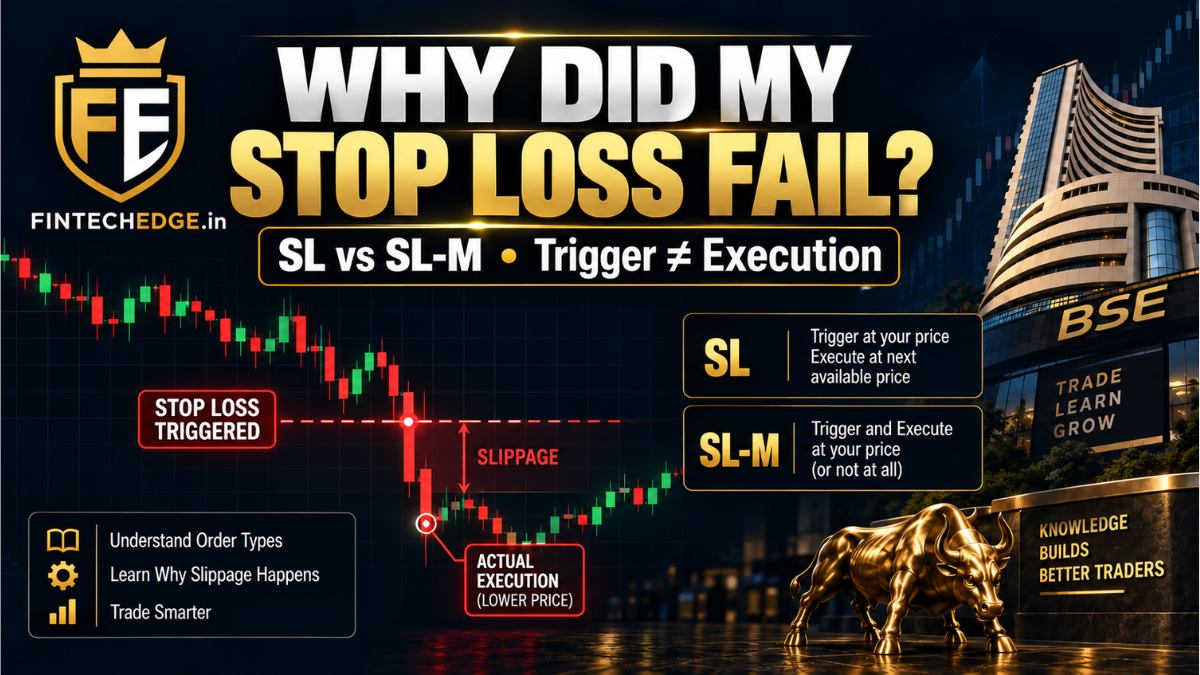
Stop loss triggered but not executed? This can happen when the trigger condition is met but the resulting order does not get filled. A stop-loss trigger activates the order, but execution still depends on the order type, market liquidity, available prices and exchange rules. You placed a stop-loss. Price reached your trigger. But when you checked your position, the trade was still open.
For many traders, that feels like the stop-loss “failed.”
In reality, the problem is usually more mechanical: triggering a stop-loss and executing the trade are two different events.
When the trigger condition is met, the stop-loss order becomes active. Whether it actually gets filled depends on the order type, available liquidity, price movement and exchange rules.
That distinction is one of the most important things to understand about stop-loss orders.
Quick Summary
- A stop-loss being triggered does not automatically mean the trade has been executed.
- An SL order becomes an active limit order after the trigger condition is met.
- An SL-M order becomes a market order after triggering and prioritizes execution over price control.
- SL orders can remain pending if the market moves beyond the limit price before a match is available.
- Gaps, low liquidity and fast-moving markets can all affect stop-loss execution.
- SL-M can reduce non-execution risk, but the actual fill price may be significantly different from the trigger price.
- Exchange and segment rules can also affect which stop-loss order types are available.
What Happens When a Stop-Loss Is Triggered?
A stop-loss order is not the same as an immediately active buy or sell order.
On NSE, stop-loss orders are kept in a separate stop-loss book until the specified trigger condition is reached. Once that happens, the order is released into the regular order book for matching.
That means there are two separate stages:
Stage 1: Trigger
The market reaches or crosses the trigger price.
Stage 2: Execution
The resulting order has to find a matching buyer or seller.
This is why:
Trigger ≠ Execution
A stop-loss can be triggered correctly and still remain unfilled.
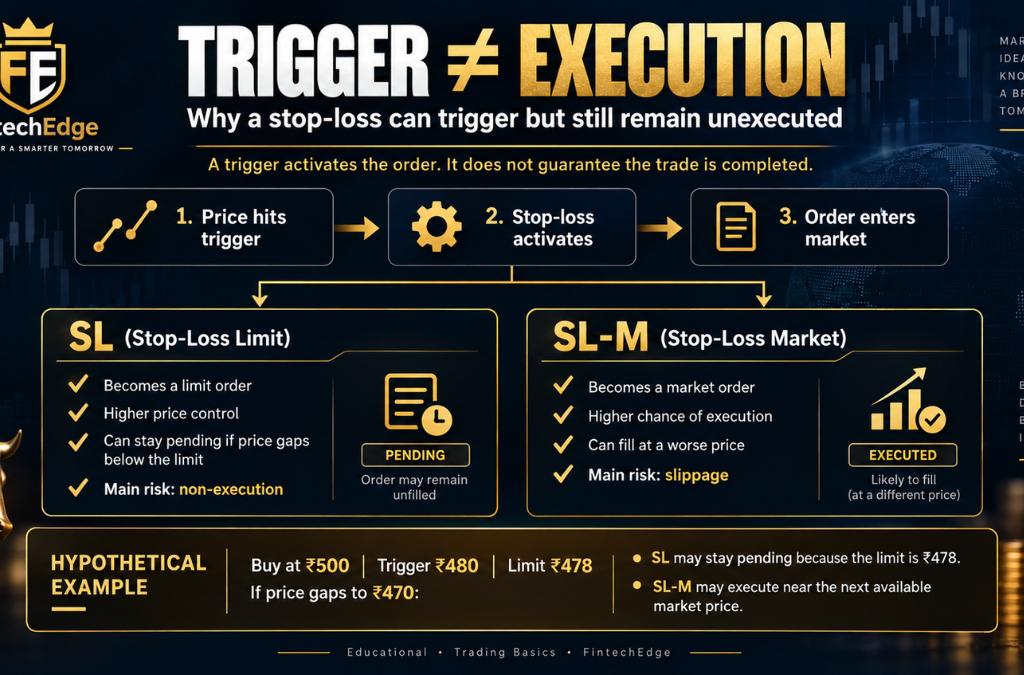
Trigger Price vs Limit Price
These two prices serve different purposes.
The trigger price decides when the stop-loss becomes active.
The limit price decides the worst price at which an SL-limit order is allowed to execute.
For example, imagine you hold a stock trading near ₹500 and place a sell SL order with:
- Trigger price: ₹480
- Limit price: ₹478
If the market reaches ₹480, the stop-loss condition is activated.
The order then enters the market as a sell limit order. It can execute at ₹480, ₹479, ₹478.50 or ₹478, depending on available buyers.
But it will not execute below ₹478.
That last point is exactly why an SL order can remain pending.
Why Can a Stop-Loss Be Triggered but Not Executed?
There are several common reasons.
1. Price Gaps Beyond the Limit
Suppose the stock is trading at ₹482 and suddenly jumps directly to ₹470.
Your trigger at ₹480 has been crossed, so the stop-loss activates.
But your sell limit is ₹478.
If buyers are available only around ₹470, your order cannot sell because you told the exchange not to accept anything below ₹478.
The order remains pending.
2. Fast-Moving Markets
Even without a full price gap, markets can move very quickly.
By the time a stop-loss activates and reaches the active order book, the available bids may already be below your limit.
That becomes more likely during:
- major news events
- sharp index moves
- earnings announcements
- high-volatility sessions
3. Low Liquidity
Liquidity matters enormously.
If there are not enough buyers or sellers near your limit price, an order may be partially filled or remain open.
This can be particularly relevant in:
- thinly traded stocks
- less-liquid derivatives
- deep out-of-the-money options
4. The Limit Price Itself Blocks the Trade
This is not a malfunction.
The entire purpose of a limit price is to prevent execution beyond a specified level.
So the same feature giving you price protection can also create execution risk.
5. Order Queue Position
Indian exchanges generally use price-time priority for matching.
If many other orders are already waiting at the same price, they may be matched before yours.
That can delay or partially limit execution even when the price appears available.
Example: A Stop-Loss That Fails to Exit
Consider a hypothetical example.
You buy a stock at ₹500.
You place:
Trigger: ₹480
Limit: ₹478
Under normal conditions, price falls gradually:
₹485 → ₹482 → ₹480 → ₹479 → ₹478
Your stop triggers at ₹480.
If sufficient buyers are available, the order could execute somewhere between ₹480 and ₹478.
Now consider a very different move:
₹482 → ₹470
Your trigger condition has been crossed.
But the market is already below ₹478.
Because your limit order refuses to sell below ₹478, the trade may remain open.
This is a classic example of:
Stop-loss triggered, but not executed.
SL vs SL-M: What Is the Real Difference?
| Factor | SL (Stop-Loss Limit) | SL-M (Stop-Loss Market) |
|---|---|---|
| After trigger | Becomes an active limit order | Becomes an active market order |
| Price control | Higher | Low |
| Execution likelihood | Can remain unfilled | Usually higher |
| Slippage risk | Limited by limit price | Can be significant |
| Pending-order risk | Higher | Lower |
| Main trade-off | Price control vs non-execution | Execution priority vs uncertain price |
Zerodha’s current documentation similarly explains that an SL order becomes a limit order after triggering, while market-type stop-loss execution sacrifices price control in favor of a higher likelihood of getting filled.
Neither order type is automatically “better.”
They manage different risks.
Can SL-M Execute Far Away From the Trigger?
Yes.
This is one of the most important misunderstandings about stop-loss market orders.
Suppose your SL-M trigger is ₹480.
Once triggered, the order becomes a market order.
If the order book is liquid, you might be filled near ₹480.
But if the market gaps or available bids are much lower, execution could happen at ₹475, ₹470 or another available price.
That difference between the expected price and the actual execution price is called slippage.
So SL-M does not guarantee:
- your trigger price
- your preferred price
- a maximum loss
It mainly prioritizes getting the trade executed at the best available market price.
What Happens During a Gap Down?
Gap-downs make the difference between SL and SL-M particularly clear.
Suppose a stock closes at ₹500.
You hold an SL order with:
Trigger: ₹480
Limit: ₹478
The next morning, bad news causes the stock to open directly at ₹450.
The trigger condition is crossed immediately.
But your sell-limit price is still ₹478.
If the market is trading around ₹450, there may be no buyer willing to pay ₹478.
Your SL order can therefore remain pending.
With a market-style stop-loss, the order would seek the best available market price after activation. That increases the likelihood of an exit but may mean selling much lower than ₹480.
This is why a stop-loss should not be thought of as insurance against every possible price move.
Why Did My Stop-Loss Trigger When the Chart Didn’t Touch It?
This is another common complaint:
“My chart never touched my trigger price, so why was the order activated?”
The reason is that the chart you see may not visually display every trade that occurred on the exchange.
Broker charting systems can display snapshots or sampled price data, while multiple transactions may occur between those displayed points.
Zerodha specifically notes that a valid exchange price can briefly exist and trigger an order even if that individual trade is not visible in the chart snapshot.
The important distinction is:
The exchange determines whether the trigger condition occurred — not the appearance of the chart candle.
Can an SL Order Be Rejected After Triggering?
Yes, in some cases.
This is especially relevant in derivatives.
NSE uses a mechanism called Limit Price Protection (LPP) in applicable F&O contracts. Its purpose is to prevent orders from being placed at extreme prices far away from prevailing market levels.
NSE states that a triggered stop-loss order may be rejected during LPP validation if its limit price falls outside the permitted range. It also notes that keeping an appropriate difference between the trigger price and limit price can help reduce such rejections.
This is different from a normal unfilled SL order.
There are therefore at least two different situations traders should distinguish:
Triggered but pending:
The order entered the market but did not find a suitable match.
Triggered but rejected:
The exchange did not accept the resulting order because it failed an exchange-level validation such as LPP.
Always check the order status and rejection reason before assuming what happened.
Why SL-M May Not Be Available Everywhere
SL-M availability is not universal across Indian markets.
Exchange rules differ by segment and instrument, and brokers must follow those restrictions.
For example, Zerodha currently states that SL-M orders cannot be placed for index option derivative contracts because exchanges have discontinued them. Market and SL-M restrictions can also apply to certain illiquid options.
BSE has also discontinued SL-M orders across several of its segments, including equity and derivatives.
Because these rules can change, traders should always check the latest exchange or broker documentation rather than assuming that an order type available in one segment will be available in another.
Common Stop-Loss Mistakes
Several mistakes create unnecessary confusion.
Setting Trigger and Limit Too Close
A very tight gap leaves little room for normal market movement.
If the market moves quickly, the price may pass both levels before the order can match.
Thinking the Trigger Price Is the Exit Price
It is not.
The trigger price only determines when the stop-loss becomes active.
Assuming Trigger Means Filled
Always check the order book.
A triggered order can still be:
- open
- partially filled
- rejected
- fully executed
Ignoring Liquidity
An order behaves very differently in a highly liquid index future compared with a thinly traded stock or option contract.
Assuming Stop-Loss Orders Last Forever
Regular stop-loss orders may be valid only for the trading session, depending on the order and broker setup.
For example, Zerodha states that ordinary stop-loss orders remain valid only for the trading day, while GTT orders operate differently and can remain active for longer.
Ignoring Current Exchange Rules
Order availability, price-protection rules and validation conditions can change.
An article, YouTube video or trading tutorial from several years ago may no longer reflect current exchange rules.
How Traders Can Reduce Stop-Loss Execution Problems
No method can completely remove execution risk.
But understanding the mechanics can reduce avoidable surprises.
Know Which Order Type You Are Using
Before placing the trade, understand whether the order becomes:
- a limit order
- or a market order
after triggering.
Understand the Trigger-Limit Relationship
If using SL-limit, recognize that the limit price controls the acceptable execution range.
Too little room can increase the chance of the market moving past your order.
Check Liquidity
Bid-ask spreads and market depth matter.
The less liquid the instrument, the greater the possibility of delayed execution or slippage.
Expect Gap Risk
Stop-loss orders cannot guarantee protection against overnight price gaps.
This is especially relevant around:
- results
- corporate announcements
- major global events
- regulatory news
Verify the Order Status
Do not assume your position is closed simply because a trigger notification appeared.
Check whether the order is:
- executed
- pending
- partially executed
- rejected
Check Current Exchange Rules
This is particularly important in derivatives, where exchange-level protections and order restrictions may apply.
FintechEdge View
A stop-loss is an execution instruction, not an insurance policy.
It helps define how an order should react when price reaches a specified level, but it cannot guarantee that liquidity will exist exactly where you want it or that the market will move smoothly through your stop.
The most important lesson is simple:
Triggering, execution and execution price are three different things.
SL orders offer greater price control but introduce the possibility of non-execution.
SL-M orders prioritize execution but expose the trader to greater price uncertainty and slippage where they are permitted.
Understanding those trade-offs is far more important than assuming one stop-loss type is always safer than the other.
Frequently Asked Questions
Can a stop-loss order fail?
A stop-loss can trigger without fully executing. This is most common with SL-limit orders when the market moves beyond the limit price or there is insufficient liquidity.
Why was my stop-loss triggered but not executed?
The trigger condition may have been met, but the resulting order may not have found a matching buyer or seller within your specified limit price.
What is the difference between SL and SL-M?
An SL order becomes a limit order after triggering. An SL-M order becomes a market order after triggering. SL provides more price control, while SL-M generally prioritizes execution.
Does SL-M guarantee the trigger price?
No. The actual execution price depends on available market liquidity after the trigger condition is reached.
What happens if price gaps below my stop-loss?
An SL-limit order may remain unfilled if the market gaps below the specified limit price. A market-style stop-loss may execute at the next available price, which could be significantly lower than the trigger.
Why did my stop trigger when the chart did not show that price?
Exchange trades can occur briefly without every individual tick appearing on a displayed chart. Your stop-loss responds to valid exchange price data rather than the visual appearance of the chart alone.
Is SL-M available for options in India?
Not in every case. For example, SL-M orders have been discontinued for index option derivative contracts, and other restrictions may apply depending on the exchange, segment, instrument and broker.
This article is for educational and informational purposes only and does not constitute investment advice, trading advice or a recommendation to buy or sell any security.
Our content is written for educational purposes and focuses on clarity, evidence, risk awareness and practical decision-making.