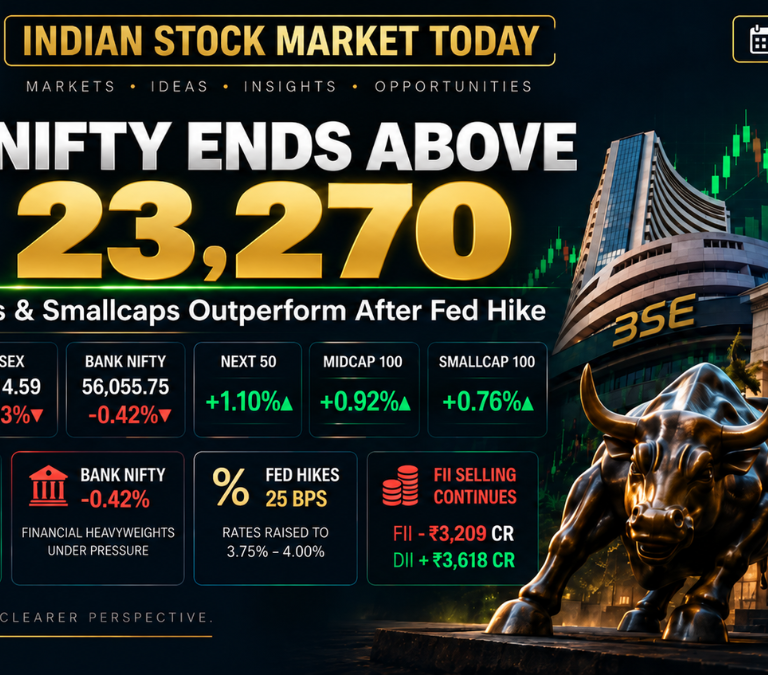
Indian Stock Market Today: Nifty Ends at 23,346 as Smallcaps Surge 1.74%, FIIs Turn Buyers

Quick Summary
- Nifty 50 rose 0.33% to 23,346.40, while Sensex ended almost flat at 74,294.96.
- Broader markets strongly outperformed: Nifty Next 50 and Midcap 100 gained 1.24%, while Smallcap rose 1.74%.
- Bank Nifty recovered 0.54%, reversing the previous session’s decline.
- FIIs turned net buyers at ₹600 crore, while DIIs bought ₹1,020 crore.
- The Bank of Japan raised its benchmark rate to 1.25%, the highest level in 31 years.
- Crude oil eased from recent highs, providing some relief to India’s inflation and currency backdrop.
Indian Market Performance — 18 September 2026
Daily change in key Indian equity indices
Indian Stock Market Today: Nifty Ends at 23,346 as Smallcaps Surge 1.74%, FIIs Turn Buyers
Indian equities ended Friday’s session with a mixed headline performance but much stronger activity beneath the large-cap benchmarks.
The Nifty 50 gained 0.33% to close at 23,346.40, while the Sensex slipped 0.03% to 74,294.96. Bank Nifty returned to positive territory, rising 0.54% to 56,358.70.
The more important development was in the broader market. The Nifty Next 50 and Nifty Midcap 100 both gained 1.24%, while the Smallcap index surged 1.74%. That marked a second consecutive session in which broader-market participation was substantially stronger than the headline indices.
Institutional flows also improved: FIIs were net buyers of ₹600 crore, while DIIs bought ₹1,020 crore, breaking the recent pattern in which foreign selling had been offset primarily by domestic institutions.
Indian Market Performance — 18 September 2026
| Index | Close | Change |
|---|---|---|
| Nifty 50 | 23,346.40 | +0.33% |
| Sensex | 74,294.96 | -0.03% |
| Bank Nifty | 56,358.70 | +0.54% |
| Nifty Next 50 | 72,025.40 | +1.24% |
| Nifty Midcap 100 | 62,191.25 | +1.24% |
| Nifty Smallcap | 19,875.70 | +1.74% |
Sources: NSE market data | FintechEdge Research.
Broader Markets Outperform Again
For a second consecutive session, the strongest part of the market was outside the headline benchmarks.
The Nifty gained only 0.33%, but Next 50, midcaps and smallcaps rose between 1.24% and 1.74%.
This matters because the size of the gap is too large to dismiss as routine noise.
Earlier in the week, market gains had often been driven by a relatively small group of heavyweight stocks. Thursday began to show better participation, and Friday extended that improvement across a wider part of the market.
That does not confirm that the recent correction is over.
But it does show that market breadth has improved, which is a more useful signal than the Nifty’s modest 76-point rise alone.
Reuters also described Friday’s session as one in which bargain buying and easing oil prices supported equities, even though the benchmarks remained under pressure on a weekly basis.
Bank Nifty Returns to Positive Territory
Bank Nifty gained 0.54%, reversing Thursday’s 0.42% decline.
That is relevant because banking weakness had limited the benchmarks in the previous session.
On Friday, financials no longer acted as the same drag, allowing the improvement in broader markets to translate more effectively into overall market strength.
The combination of:
stronger broader markets + recovering banks + positive institutional buying
made Friday’s internal structure more constructive than the nearly flat Sensex suggests.
FIIs Turn Net Buyers, DIIs Continue to Add
One of the more interesting developments came from institutional flows.
For 18 September 2026:
- FII: +₹600 crore
- DII: +₹1,020 crore
Both foreign and domestic institutions were therefore net buyers in the cash market.
That differs from the previous few sessions, when FIIs were selling while DIIs absorbed much of the pressure.
It would be premature to conclude that foreign flows have decisively reversed after one positive session.
But the change is worth tracking because foreign flows have been one of the key headwinds for Indian equities during the recent period of high global yields, elevated oil prices and rupee weakness.
Crude Oil Eases From Recent Highs
Oil prices eased toward the end of the week after having surged above $100 per barrel during the recent geopolitical disruption.
Reuters reported that oil retreated as supply concerns moderated, providing some breathing room for India’s currency and inflation outlook.
For India, lower crude is generally helpful because it can reduce pressure on:
- the import bill;
- current-account balances;
- inflation;
- and demand for US dollars.
The rupee still finished the week under pressure at around ₹95.88 per dollar, showing that the currency backdrop remains fragile despite some relief from oil.
Fed and BOJ Hikes Fail to Trigger a Fresh Sell-Off
Global central banks remained a major part of the market backdrop.
The Federal Reserve had already raised rates by 25 basis points earlier in the week, while on Friday the Bank of Japan raised its benchmark rate to 1.25%, its highest level in 31 years.
Yet Indian broader markets remained resilient.
That should not be interpreted as investors simply “ignoring” central banks.
A more useful interpretation is that some of the near-term tightening had already been anticipated, and investors are now increasingly focused on:
- how much further rates may rise;
- how long rates stay elevated;
- and how quickly inflation responds.
In Japan, the yen actually weakened after the BOJ decision because markets judged the accompanying guidance less aggressive than some had expected.
That illustrates an important point: markets often react more to expectations and future guidance than to the headline rate decision itself.
Sector Rotation Remains Active
Friday’s strength was not evenly distributed.
Metals, realty, financials and several broader-market pockets performed well, while IT remained under pressure.
The useful takeaway is not the performance of every individual sector.
It is that leadership continued rotating across the market rather than remaining concentrated in one defensive area.
That rotation contributed to the stronger performance in midcaps and smallcaps.
NSE IPO Fully Subscribed on Day Two
The National Stock Exchange of India’s roughly $2.3 billion IPO was fully subscribed on its second day, supported by strong institutional and non-institutional demand.
Qualified institutional buyers and non-institutional investors drove much of the demand, while the retail portion was relatively less subscribed at that stage.
The response is notable because the offer came during a volatile period for Indian equities.
It suggests strong investor interest in the exchange itself even while the secondary market has been dealing with high oil prices, tightening monetary conditions and foreign outflows.
The IPO should not, however, be used as a direct explanation for the day’s index movement.
Stocks in Focus
Adani Ports, Adani Enterprises and Bharti Airtel were among the stronger large-cap names during the session.
On the weaker side, TCS and several Tata-group stocks remained under pressure, with Tata-group companies collectively losing significant market value amid continuing uncertainty around the group’s holding-company developments.
The individual stock moves were important, but they were secondary to the broader theme of improving participation across midcaps and smallcaps.
What to Watch Next
Broader-market participation:
After two consecutive sessions of stronger midcap and smallcap performance, the key question is whether this participation continues.
FII flows:
Friday’s ₹600 crore of foreign buying is encouraging, but several more sessions would be needed before treating it as a meaningful change in trend.
Bank Nifty:
Financials returned to positive territory on Friday. Continued participation from banks would make any market recovery broader and more sustainable.
Crude oil:
Further easing from recent highs would improve India’s inflation, currency and import-cost backdrop.
USD/INR:
The rupee remains close to 96 per dollar despite some relief from crude.
Global rates:
Markets will continue assessing how much further the Fed, BOJ and other central banks may tighten policy.
NSE IPO:
The market will now turn toward final subscription details and the scheduled September 24 debut.
FintechEdge View
Friday’s Nifty gain of 0.33% understates what happened beneath the surface.
Smallcaps gained 1.74%, Next 50 and midcaps rose 1.24%, Bank Nifty returned to positive territory, and both FIIs and DIIs were net buyers.
That combination points to better participation and slightly improved risk appetite compared with the beginning of the week.
However, there is an important counterpoint.
Reuters data show that the Nifty and Sensex still completed a sixth consecutive weekly decline, their longest weekly losing streak since 2020.
So the correct interpretation is not that the broader correction has definitively ended.
Instead, the market finished the week with healthier internal participation, while the bigger macro challenges—high global rates, elevated oil prices and currency pressure—remain unresolved.
That distinction is worth preserving.
This article is for educational and informational purposes only and does not constitute investment advice, trading advice or a recommendation to buy or sell any security.
Our content is written for educational purposes and focuses on clarity, evidence, risk awareness and practical decision-making.