Growth vs IDCW in Mutual Funds: What’s the Difference and Which Option Fits Your Goal?
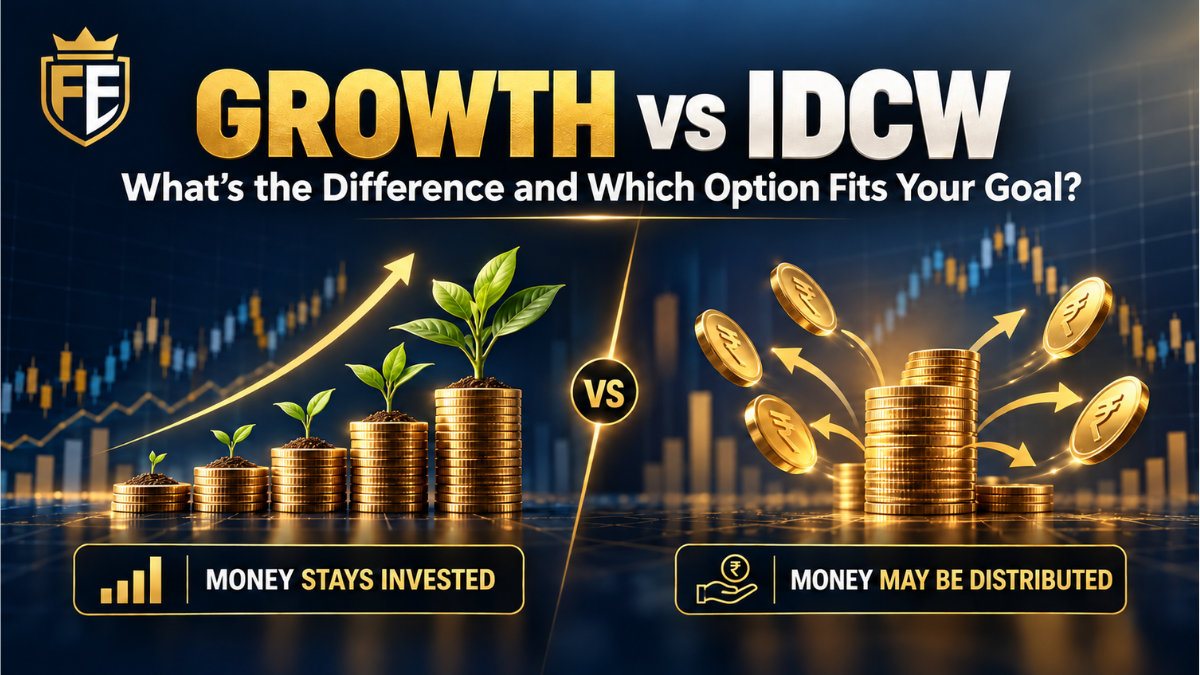
Growth vs IDCW is an important choice for mutual fund investors because both options use the same underlying scheme but handle returns differently. Two investors buy the same mutual fund scheme.
One selects Growth.
The other selects IDCW.
The underlying portfolio may be the same, but the way returns are handled is different.
Growth keeps income and gains invested within the scheme. IDCW may distribute part of the scheme’s available distributable amount to investors when declared.
One point should be clear from the beginning:
IDCW is not guaranteed income and should not be treated like interest from a fixed deposit.
Understanding Growth vs IDCW is therefore less about asking which one is universally better and more about understanding what happens to the money under each option.
Quick Summary
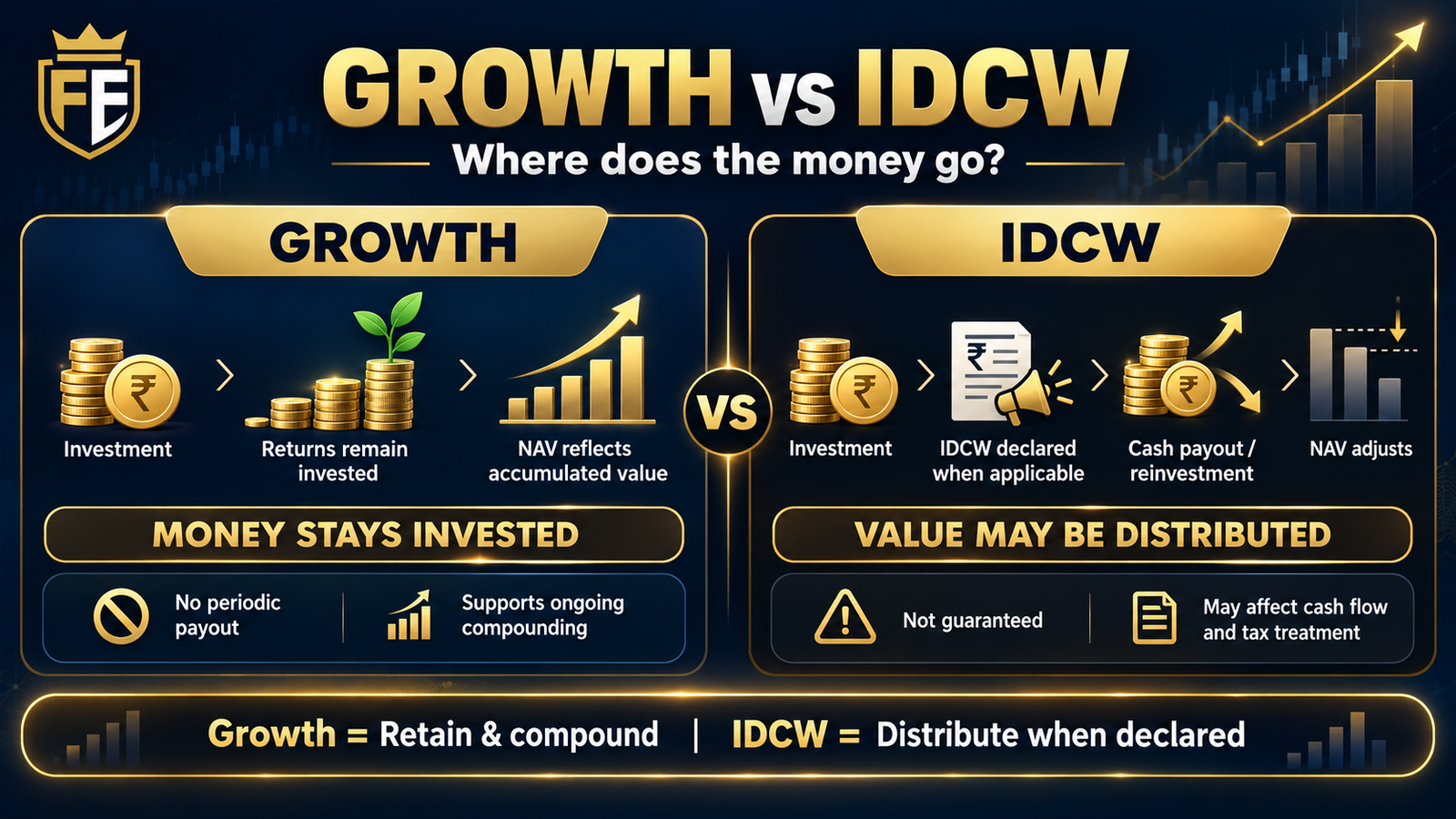
- Growth keeps income and gains invested within the mutual fund scheme.
- IDCW may distribute a portion of the scheme’s available distributable surplus when declared.
- IDCW is not guaranteed income and may include amounts from the equalization reserve.
- After an IDCW payout, the scheme’s NAV generally adjusts downward to reflect the distribution.
- Growth and IDCW can have different cash-flow, compounding and tax implications.
What Is the Growth Option?
Under the Growth option, the scheme does not make IDCW distributions.
Income and gains attributable to the units remain invested in the scheme and are reflected in its NAV. Current SEBI-filed scheme documents describe Growth this way: income remains invested and is reflected in the NAV rather than being distributed.
Conceptually:
Investment
↓
Scheme earns/grows
↓
No IDCW payout
↓
Value remains reflected in NAV
Growth does not mean the investment will always rise.
The NAV can still increase or decrease depending on how the underlying portfolio performs.
How Does Growth Work?
Suppose an investor puts ₹1,00,000 into the Growth option of a mutual fund.
If the value of the scheme increases over time, that increase remains within the investment rather than being periodically distributed.
This allows the accumulated value to continue participating in future returns.
The investor generally realises the capital gain when units are eventually redeemed or sold, subject to the tax rules applicable at that time.
The key idea is:
Growth keeps the value inside the investment.
That supports continued compounding, but it does not guarantee that Growth will produce a superior outcome in every situation.
What Is IDCW?
IDCW stands for:
Income Distribution cum Capital Withdrawal
It replaced the older mutual-fund terminology commonly referred to as the “Dividend” option.
The name matters because an IDCW payout should not be interpreted as a free additional return generated on top of an unchanged investment value.
SEBI-filed scheme documents state that IDCW can be distributed from available distributable surplus and may include amounts from the equalization reserve, which forms part of the sale price representing realised gains.
So:
IDCW can involve distribution of value already forming part of the investor’s mutual-fund investment.
Why Was “Dividend” Renamed IDCW?
The older word Dividend could create the impression that a mutual fund payout was similar to a dividend paid by a company.
That comparison can be misleading.
A company dividend is paid from a company’s distributable profits to shareholders.
A mutual fund IDCW distribution operates within the NAV and distributable-surplus framework of the scheme.
The term Income Distribution cum Capital Withdrawal communicates more clearly that the amount distributed may not represent only fresh income generated by the scheme.
It may also involve amounts represented through the equalization reserve.
How Does IDCW Payout Work?
When IDCW is declared:
- a record date is determined
- eligible investors receive the declared distribution
- the scheme’s NAV adjusts after the payout
Current SEBI-filed scheme documents state that the NAV falls to the extent of the IDCW payout and applicable statutory levy, if any.
Consider a simplified example.
Suppose:
NAV before IDCW = ₹20
and the scheme declares:
IDCW = ₹1 per unit
After the distribution, the NAV would generally adjust downward broadly to reflect the amount distributed, subject to applicable statutory adjustments.
The important lesson is:
IDCW does not create additional money from nowhere.
The distribution comes from value that forms part of the scheme.
What Is IDCW Reinvestment?
Some schemes offer an IDCW Reinvestment facility in addition to IDCW Payout.
Under this arrangement:
IDCW is declared
↓
NAV adjusts
↓
Declared amount is used to purchase additional units
Current scheme documents commonly provide both IDCW Payout and IDCW Reinvestment options.
This is still different from Growth.
Under Growth, there is no IDCW declaration.
Under IDCW Reinvestment, a distribution event occurs first, after which the amount is reinvested into new units.
That distinction can also matter for taxation.
Growth vs IDCW: Key Differences
| Factor | Growth | IDCW |
|---|---|---|
| What happens to income/gains | Remain invested | May be distributed |
| Cash payout | No IDCW payout | Possible under IDCW Payout |
| Compounding | Value remains invested | Payout removes some value from the scheme |
| NAV after IDCW event | No IDCW adjustment | Generally adjusts downward |
| Income certainty | No periodic payout | IDCW is not guaranteed |
| Tax event | Typically arises on redemption/sale | IDCW distribution may create tax liability |
| Primary structural use | Accumulation | Possible cash distribution |
The simplest distinction is:
Growth retains value inside the scheme. IDCW may distribute part of that value.
Growth vs IDCW: Simple Example
Suppose two investors each invest ₹1,00,000 in the same mutual fund scheme.
Investor A — Growth
No IDCW distribution is made.
The entire value remains invested in the scheme.
Investor B — IDCW Payout
The investor receives distributions when IDCW is declared.
Each distribution is accompanied by an adjustment in the scheme’s NAV.
Investor B now has:
- remaining investment value
- cash received through IDCW
A fair comparison therefore cannot look only at the remaining NAV.
It must consider:
Remaining investment value + IDCW received
and, where relevant, applicable tax consequences.
Neither option automatically creates a higher total economic return.
Why IDCW Is Not “Extra Return”
This is one of the most common misunderstandings.
Suppose an investor receives ₹5,000 through IDCW.
It may feel like an additional ₹5,000 earned on top of the investment.
But that is not the right way to interpret it.
The scheme’s NAV generally adjusts after the distribution.
So the investor has effectively received part of the investment value as cash while the remaining investment value is correspondingly adjusted.
A useful way to think about it is:
IDCW changes where part of the value sits — inside the fund or in the investor’s hands.
It should not be viewed as a bonus added on top of an unchanged investment.
Does IDCW Reduce NAV?
Generally, yes.
NAV represents the value of the scheme’s net assets per unit.
When value is distributed out of the scheme, the NAV must reflect that reduction.
Current SEBI-filed scheme documents explicitly state that NAV will be adjusted to the extent of the IDCW distribution and statutory levy, if applicable.
The NAV may not always move by a perfectly identical amount in every practical situation because statutory and operational adjustments can also apply.
But the underlying principle remains the same:
Money distributed out of the scheme is no longer part of the scheme’s NAV.
Is IDCW Guaranteed?
No.
There is no assurance or guarantee regarding:
- whether IDCW will be declared
- how much will be declared
- how frequently it will be declared
- whether previous payout patterns will continue
Current scheme documents state that IDCW depends on the availability of distributable surplus and the decision of the Trustee.
Therefore, IDCW should not be treated as:
- fixed interest
- guaranteed monthly income
- pension-like income
- assured cash flow
Growth vs IDCW and Compounding
Under Growth, gains remain invested.
That allows future returns to operate on the accumulated investment value.
Under IDCW Payout, part of the value leaves the scheme whenever a distribution occurs.
That reduces the amount remaining inside the fund to participate in future compounding.
However, this does not mean Growth will always produce a better final after-tax outcome.
The result can depend on:
- scheme performance
- holding period
- tax treatment
- timing and size of IDCW declarations
- what the investor does with IDCW proceeds
So the distinction is structural, not a promise of superior return.
Growth vs IDCW: Tax Treatment
Taxation is another important difference.
Growth
Under Growth, tax generally becomes relevant when units are redeemed or sold and capital gains are realised.
IDCW
IDCW distributions are generally taxable in the investor’s hands under applicable tax law.
TDS may also apply in certain circumstances.
The older Dividend Distribution Tax (DDT) framework should not be used to explain current IDCW taxation.
Because tax rules can change and also depend on investor circumstances, this article deliberately avoids quoting specific tax rates.
Always verify the current tax rules applicable at the time of the transaction.
Growth vs IDCW Reinvestment: Are They the Same?
No.
Even though the money may ultimately remain invested under both options, the mechanics differ.
Growth
No IDCW declaration occurs.
The value simply remains in the scheme.
IDCW Reinvestment
An IDCW distribution is declared.
The NAV adjusts.
The distribution amount is then reinvested into additional units.
That means IDCW Reinvestment can create transaction and tax consequences that do not occur in exactly the same way under Growth.
Therefore:
IDCW Reinvestment should not be treated as merely another name for Growth.
Growth vs IDCW for Long-Term Investors
An investor focused primarily on long-term capital accumulation may prefer a structure where value remains invested rather than being periodically distributed.
Growth structurally does that.
Income and gains continue to remain within the scheme rather than requiring the investor to decide what to do with each payout.
However, this does not mean Growth is automatically appropriate for every long-term investor.
The choice still depends on:
- financial objective
- cash-flow needs
- tax circumstances
- portfolio strategy
- investment horizon
Growth vs IDCW for Investors Seeking Cash Flow
Some investors may be attracted to IDCW because it can produce cash distributions.
But IDCW has important limitations:
- payout amount is not guaranteed
- payout frequency is not guaranteed
- NAV adjusts after distribution
- tax consequences may apply
- past payout history does not guarantee future distributions
Therefore, IDCW should not be treated as a guaranteed-income product.
If an investor specifically wants a planned withdrawal of a predefined amount, Systematic Withdrawal Plan (SWP) is a different mechanism that can be evaluated separately.
Growth vs IDCW vs SWP
| Mechanism | What happens |
|---|---|
| Growth | Value remains invested |
| IDCW | Scheme may declare a distribution |
| SWP | Investor instructs periodic withdrawals |
The most important distinction is control.
IDCW
The scheme/Trustee determines whether and how much IDCW is declared, subject to available distributable surplus and applicable rules.
SWP
The investor chooses a withdrawal amount and frequency, subject to the scheme’s terms and sufficient units/value.
So:
IDCW is declaration-driven. SWP is investor-instruction-driven.
Common Growth vs IDCW Mistakes
1. Thinking IDCW Is Free Extra Income
The NAV adjusts after distribution.
The payout is not an addition on top of an unchanged investment value.
2. Assuming IDCW Is Guaranteed
IDCW depends on distributable surplus and Trustee decisions.
3. Ignoring the NAV Adjustment
Looking only at the cash payout without considering the remaining NAV creates a misleading picture.
4. Treating IDCW Reinvestment as Growth
The mechanics differ because IDCW involves a distribution event followed by reinvestment.
5. Ignoring Tax
IDCW distributions can create tax consequences even when the money is reinvested.
6. Choosing IDCW Because of Past Payout Frequency
Past declarations do not guarantee future distributions.
7. Confusing IDCW With Company Dividends
Mutual fund IDCW operates differently and may include value from equalization reserve.
FintechEdge Growth vs IDCW Decision Guide
Use this simple framework.
Want the investment value to remain inside the scheme?
Growth may align more closely with that objective.
Want possible distributions when the scheme declares them?
IDCW may be the relevant option.
Need predictable periodic withdrawals?
IDCW is not guaranteed.
Consider withdrawal mechanisms separately.
Comparing tax outcomes?
Check current tax rules and your individual circumstances.
And remember:
Choosing Growth or IDCW is separate from choosing the mutual fund itself.
For that broader decision, see How to Choose the Best Mutual Fund in India.
Practical FintechEdge Example
Suppose Investor A and Investor B each invest the same amount in the same mutual fund scheme.
Investor A chooses Growth.
Investor B chooses IDCW Payout.
Over time:
Investor A
The entire value continues to remain invested in the scheme.
No IDCW payout occurs.
Investor B
IDCW may be declared periodically.
Cash is received when declared.
The NAV adjusts after the distribution.
A proper comparison must therefore include:
Investor A: Remaining investment value
versus
Investor B: Remaining investment value + IDCW cash received
Tax can further affect the final outcome.
Because actual market returns and future IDCW declarations are unknown, neither option can be declared the automatic winner.
If several IDCW distributions occur on different dates, investor-level return measurement may also involve multiple dated cash flows.
For that concept, see:
CAGR vs XIRR: Which Return Metric Should Mutual Fund Investors Use?
Frequently Asked Questions
What is Growth option in mutual funds?
Under the Growth option, income and gains attributable to the units remain invested in the scheme and are reflected in the NAV instead of being distributed through IDCW.
What is IDCW in mutual funds?
IDCW stands for Income Distribution cum Capital Withdrawal.
It is an option under which a mutual fund scheme may distribute part of its available distributable surplus when declared.
Is IDCW the same as the old Dividend option?
IDCW replaced the older “Dividend” terminology.
The newer name better reflects that the distribution may include amounts represented through the equalization reserve and should not be interpreted as a free bonus.
Is IDCW guaranteed?
No.
There is no guarantee regarding the amount, frequency or continuation of IDCW distributions.
Does NAV fall after IDCW payout?
Generally, yes.
The NAV adjusts to reflect the IDCW distribution and applicable statutory levy, if any.
Is Growth better than IDCW?
Neither is universally better.
Growth keeps value invested, while IDCW can distribute value when declared.
The appropriate option depends on the investor’s objective, cash-flow needs and tax circumstances.
Is IDCW taxable?
Generally, IDCW distributions are taxable in the investor’s hands under applicable tax law, and TDS may apply in certain cases.
Current rules should be verified before making a decision.
Is IDCW Reinvestment the same as Growth?
No.
Growth has no IDCW declaration event.
IDCW Reinvestment involves a distribution being declared and then reinvested into additional units.
Can IDCW be paid from investor capital?
IDCW may be distributed from available distributable surplus, which can include amounts held in the equalization reserve. Current scheme documents explicitly state that such amounts form part of investor capital representing realised gains.
Which option supports uninterrupted compounding?
Growth structurally keeps income and gains invested within the scheme, so the accumulated value remains invested.
IDCW Payout removes some value from the scheme whenever a distribution occurs.
That is a structural difference, not a guarantee that Growth will always produce a better final result.
Final Takeaway
The easiest way to understand Growth vs IDCW is to ask one question:
Does the value stay inside the mutual fund, or can part of it be distributed?
With Growth:
Value remains invested.
With IDCW:
Part of the scheme’s value may be distributed when declared.
IDCW is not guaranteed income.
It is not a free return added on top of an unchanged NAV.
And IDCW Reinvestment is not mechanically identical to Growth.
The most useful framework is:
Growth → Retain & compound
IDCW → Distribute when declared
The right choice depends on what the investor is trying to achieve, not on which option appears to have paid more cash in the past.
Sources & References
- SEBI-filed Scheme Information Documents — Growth and IDCW mechanics Securities and Exchange Board of India
- SEBI-filed Scheme Information Documents — IDCW Payout and Reinvestment options Securities and Exchange Board of India
- AMFI-filed scheme documentation — Growth and IDCW definitions AMFI India
- Income Tax Department / current tax guidance for applicable IDCW and capital-gains taxation
This article is for educational and informational purposes only and does not constitute investment advice, trading advice or a recommendation to buy or sell any security.
Our content is written for educational purposes and focuses on clarity, evidence, risk awareness and practical decision-making.