CAGR vs XIRR: Which Return Metric Should Mutual Fund Investors Use?
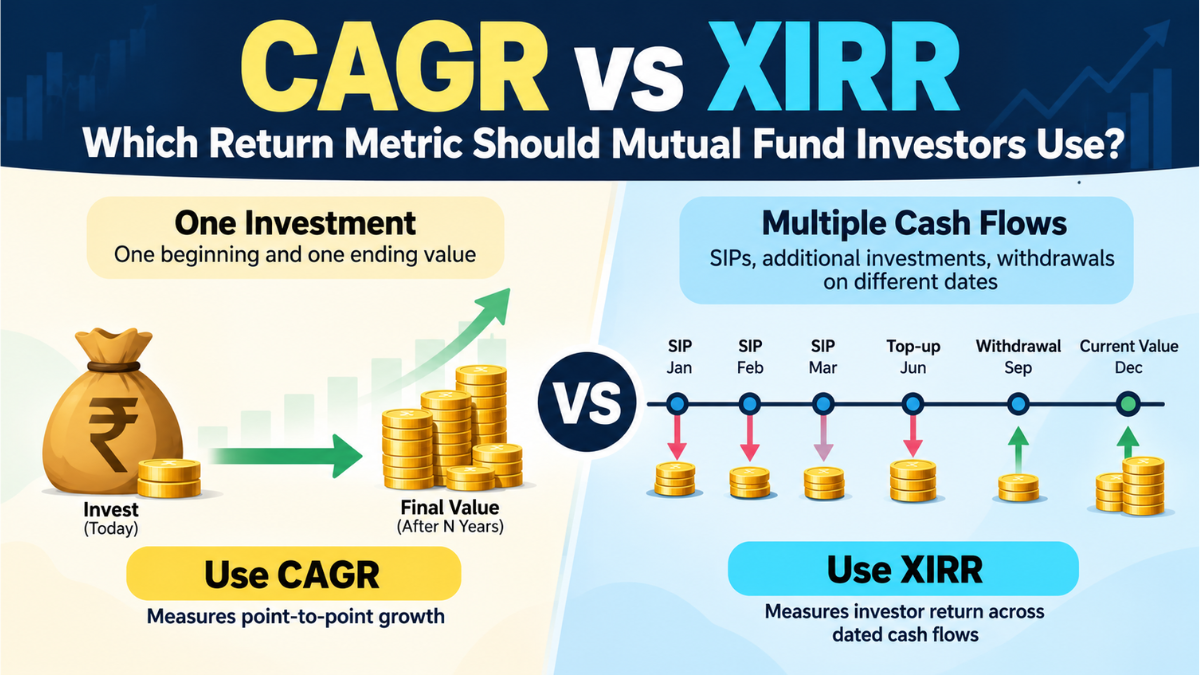
CAGR vs XIRR is a common source of confusion for mutual fund investors because fund factsheets and portfolio apps often show different return metrics. A mutual fund factsheet may show a 5-year CAGR, while your investment app shows an XIRR for the same fund.
Both numbers can be correct because they answer different questions.
The simple rule is:
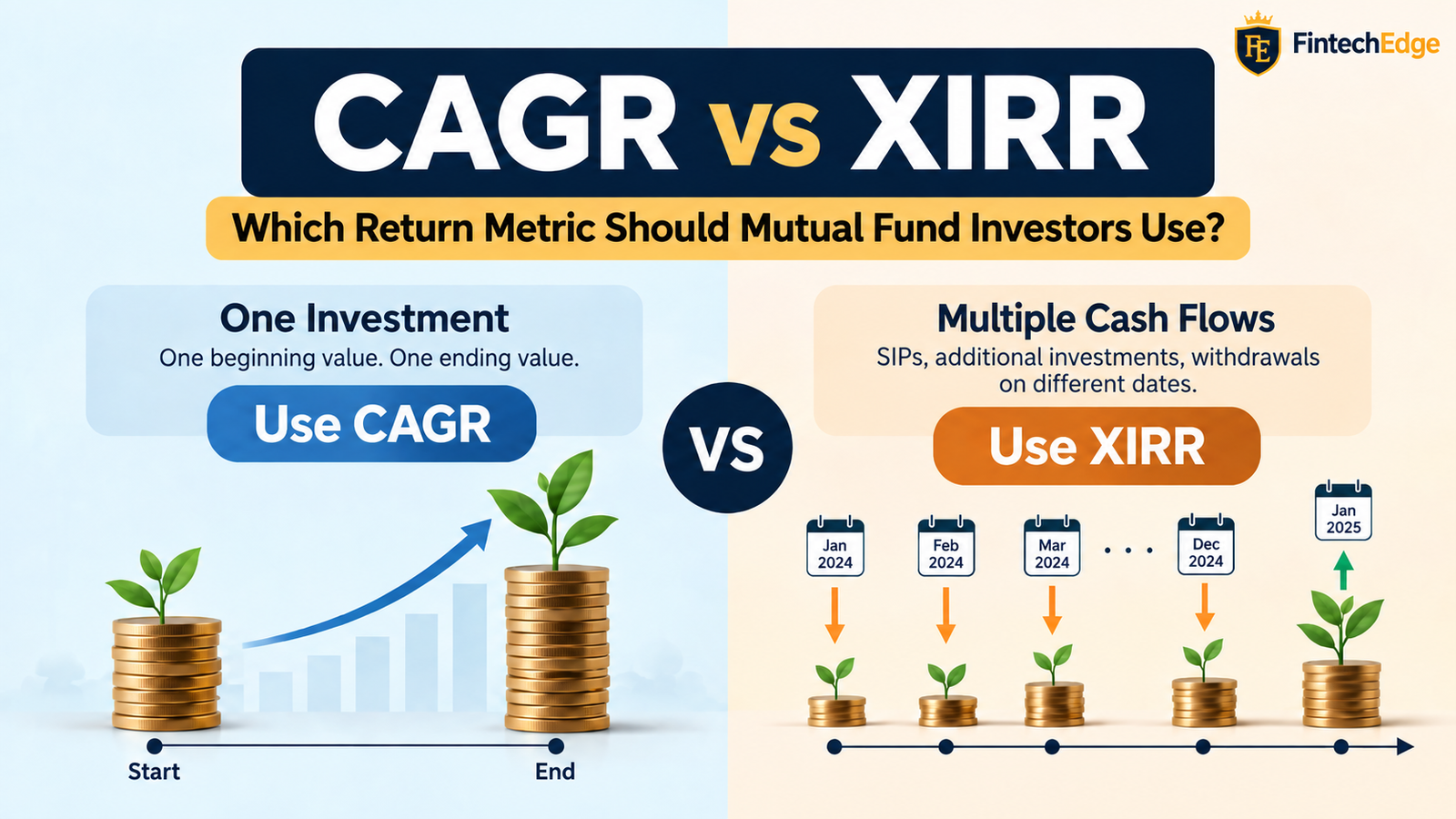
One investment with one beginning and one ending value → CAGR
Multiple cash flows on different dates → XIRR
Put differently:
CAGR measures point-to-point growth. XIRR measures the return on your actual dated cash flows.
Understanding that distinction makes it much easier to interpret mutual fund returns correctly.
Quick Summary
- CAGR measures annualised point-to-point growth between a beginning value and an ending value.
- XIRR accounts for multiple cash flows and the actual dates on which they occur.
- CAGR is generally suitable for a single lump-sum investment with no intermediate cash flows.
- XIRR is generally more appropriate for SIPs, additional investments, withdrawals and other dated cash flows.
- Neither CAGR nor XIRR predicts future returns; they measure historical performance using different approaches.
What Is CAGR?
CAGR stands for Compound Annual Growth Rate.
It represents the annualised rate at which an investment would have needed to grow at a constant compounded rate to move from its starting value to its ending value over a given period.
The formula is:
CAGR = (Ending Value / Beginning Value)^(1/n) − 1
Where:
- Beginning Value = initial investment
- Ending Value = final investment value
- n = number of years
The important point is that CAGR is a smoothed annualised return.
It does not mean the investment actually earned the same return every year.
For example, a fund could rise sharply one year, fall the next year and rise again later. CAGR compresses that uneven path into one annualised rate.
CAGR Example
Suppose an investor puts ₹1,00,000 into a mutual fund.
After four years, the investment is worth ₹1,50,000.
The calculation is:
Step 1
₹1,50,000 ÷ ₹1,00,000 = 1.5
Step 2
1.5^(1/4) ≈ 1.1067
Step 3
1.1067 − 1 = 0.1067
So:
CAGR ≈ 10.67% per year
That means ₹1 lakh growing to ₹1.5 lakh in four years is equivalent to compounding at roughly 10.67% annually.
It does not mean the fund delivered exactly 10.67% in each of those four years.
What Is XIRR?
XIRR stands for Extended Internal Rate of Return.
It calculates a single annualised return for multiple cash flows that occur on different dates.
That makes XIRR particularly useful for:
- monthly SIPs
- additional lump-sum investments
- irregular investments
- partial withdrawals
- systematic withdrawal plans
- portfolios with several transaction dates
XIRR considers two things:
- how much money moved
- when that money moved
That timing matters because money invested earlier has more time to grow than money invested later.
How Does XIRR Work?
Each transaction is recorded as a cash flow with a corresponding date.
Typically:
- money invested = negative cash flow
- money received or portfolio value = positive cash flow
XIRR then finds the annualised return at which the present value of all those cash flows balances to zero.
Microsoft describes XIRR as the internal rate of return for cash flows that do not necessarily occur at regular intervals.
Consider this example:
| Date | Cash Flow |
|---|---|
| 1 Jan 2026 | -₹10,000 |
| 1 Feb 2026 | -₹10,000 |
| 1 Mar 2026 | -₹10,000 |
| 1 Jan 2027 | ₹35,000 |
In Excel or Google Sheets:
=XIRR(B2:B5,A2:A5)
For these hypothetical cash flows, the result is approximately:
18.28% per year
The total gain is only:
₹35,000 − ₹30,000 = ₹5,000
or about 16.7% absolute return.
But the XIRR is higher because all ₹30,000 was not invested for a full year.
Microsoft also states that XIRR requires at least one positive and one negative cash flow.
CAGR vs XIRR: Key Differences
The CAGR vs XIRR comparison becomes clearer once you look at how each metric handles cash flows and timing.
| Factor | CAGR | XIRR |
|---|---|---|
| Cash-flow pattern | Single beginning and ending value | Multiple cash flows |
| Intermediate dates | Not considered | Actual dates are considered |
| Best suited for | Lump-sum investment | SIPs and irregular investments |
| Withdrawals | Poor fit | Can accommodate them |
| Complexity | Simple | More complex |
| Investor-specific | Less | More |
| Typical use | Point-to-point growth | Personal portfolio return |
The core distinction is:
CAGR describes how an investment value grew.
XIRR describes what an investor earned based on when money actually entered and left the portfolio.
Why CAGR Is Not Suitable for SIP Returns
For SIP investors, the CAGR vs XIRR distinction matters because each instalment enters the market on a different date.
Suppose you invest ₹10,000 every month for 12 months.
The January instalment has been invested for almost a full year.
The December instalment has been invested for only about one month.
If you simply compare:
₹1,20,000 invested → current portfolio value
you are treating every instalment as if it had been invested for the same amount of time.
That is not true.
CAGR cannot properly account for those different investment dates.
XIRR can.
It evaluates each instalment separately based on its actual date.
That is why XIRR is generally the more appropriate return measure for SIP portfolios.
Same Amount, Different Cash Flows
Consider two investors.
Both invest a total of ₹1,20,000 during 2026.
Both have ₹1,35,000 on 1 January 2027.
Investor A
Invests ₹1,20,000 on 1 January 2026.
Investor B
Invests ₹10,000 on the first day of every month from January to December.
Both investors made:
₹15,000
in rupee terms.
Both also show:
12.5% absolute return
if you simply compare total invested with final value.
But their annualised returns are not the same.
Investor A
Because the entire ₹1.20 lakh was invested for one full year:
Annualised return = 12.5%
Investor B
Because the money entered gradually throughout the year:
XIRR ≈ 23.75%
The same ₹15,000 gain was earned with less capital exposed for the full year.
That is why cash-flow timing can materially change the annualised return.
CAGR vs Absolute Return
Absolute return measures the total percentage gain or loss without considering time.
The formula is:
Absolute Return = (Ending Value − Initial Investment) / Initial Investment × 100
Suppose an investment gains 20%.
That sounds useful until you ask:
Did it earn 20% in:
- one year?
- three years?
- five years?
Those are very different outcomes.
A 20% gain over five years corresponds to a CAGR of only about 3.71% per year.
So:
- Absolute return = total gain or loss
- CAGR = annualised point-to-point growth
- XIRR = annualised return across dated cash flows
CAGR vs IRR vs XIRR
These terms are related but not identical.
CAGR
Best suited to one starting value and one ending value.
IRR
Used for multiple cash flows that occur at regular intervals.
Microsoft notes that Excel’s IRR function assumes cash flows occur at regular intervals such as monthly or annually.
XIRR
Used when cash flows occur on actual dates that may not be evenly spaced.
That makes XIRR more flexible for real-world investment portfolios where transaction dates often vary.
When Should You Use CAGR?
CAGR may be appropriate for:
- a single lump-sum mutual fund investment
- index growth over a period
- point-to-point fund performance
- business or revenue growth
- an investment with no intermediate deposits or withdrawals
CAGR becomes less useful when multiple cash flows enter or leave the investment.
When Should You Use XIRR?
XIRR is generally more useful for:
- SIPs
- irregular investments
- additional lump-sum investments
- partial withdrawals
- SWPs
- portfolios with multiple transaction dates
- calculating your actual investor experience
XIRR can also incorporate withdrawals and redemptions as dated cash flows. If you’re unclear about how these transactions work, see our guide to Mutual Fund Switch vs Redemption.
Can CAGR and XIRR Be the Same?
Yes.
If there is only:
- one initial investment
- one final value
- no intermediate cash flows
then CAGR and XIRR can be effectively the same.
Once you introduce:
- additional investments
- SIP instalments
- withdrawals
- irregular cash flows
XIRR can diverge materially from CAGR.
Why Your Portfolio XIRR May Differ From a Fund’s CAGR
This confuses many investors. The CAGR vs XIRR difference also explains why your personal portfolio return may not match the return shown in a fund factsheet.
A fund’s published CAGR generally measures the fund’s performance over a specified period.
Your XIRR measures your own investment experience.
Suppose a fund reports a 5-year CAGR.
But you:
- began investing only 18 months ago
- invested monthly through SIPs
- added an extra lump sum
- withdrew some money later
Your investment timing is completely different from the fund’s published 5-year point-to-point return.
Therefore:
Fund return and investor return are not always the same thing.
A difference between the fund CAGR and your portfolio XIRR is not necessarily an error.
They may simply be measuring different things.
Is a Higher XIRR Always Better?
Not automatically.
A higher XIRR indicates a stronger historical money-weighted return over that measurement period.
But it should still be interpreted alongside:
- asset class
- investment risk
- holding period
- volatility
- cash-flow pattern
- market conditions
A high XIRR over a short period may not carry the same significance as a similar figure sustained over a much longer period.
There is also no universal number that makes an XIRR “good.”
Expected returns differ across asset classes and risk levels.
Returns should therefore be one part of fund evaluation, not the entire process.
Historical return is only one part of evaluating a scheme. Our guide on How to Choose the Best Mutual Fund in India explains the wider framework, including goals, risk, category, costs and portfolio characteristics.
For index funds and ETFs, headline return alone is not enough. Tracking Error vs Tracking Difference explains how to assess how closely a passive fund follows its benchmark.
Can XIRR Be Negative?
Yes.
A negative XIRR means the investor’s annualised money-weighted return over the measured period is negative.
In simple terms, the pattern of your investments and current value results in a negative annualised return.
This can happen after market declines or over short periods.
A negative XIRR does not by itself tell you whether an investment is permanently impaired.
It simply describes the historical return over the period being measured.
Common Mistakes When Using CAGR and XIRR
1. Using CAGR for SIP Performance
CAGR does not properly account for the different dates of each SIP instalment.
For SIPs, XIRR is generally more appropriate.
2. Assuming CAGR Is the Actual Return Every Year
CAGR smooths the entire period into one annualised figure.
Actual yearly returns may be much higher or lower.
3. Treating XIRR as a Forecast
XIRR measures historical investor return.
It does not predict what the investment will earn in the future.
4. Using the Wrong Cash-Flow Signs
When calculating XIRR:
- investments are generally negative
- withdrawals and final value are generally positive
Incorrect signs can produce errors or misleading results.
5. Comparing XIRRs Over Very Different Periods
A 6-month annualised XIRR and a 10-year XIRR should not be treated as equally meaningful.
Short-term annualised returns can be highly volatile.
6. Ignoring Additional Investments or Withdrawals
Every relevant cash flow should be included.
Leaving out a top-up, withdrawal or redemption can distort the result.
FintechEdge Return Metric Decision Guide
Use this simple framework:
One investment and no intermediate transactions?
Use CAGR
Multiple investments or withdrawals?
Use XIRR
Only want total gain or loss without considering time?
Use Absolute Return
Comparing a fund’s historical point-to-point performance?
CAGR may be appropriate
Measuring your own SIP portfolio return?
XIRR is generally more appropriate
Practical FintechEdge Example
Consider an investor who:
- starts a monthly SIP
- adds an extra lump sum after six months
- later withdraws part of the investment
CAGR cannot accurately represent this investment experience because there is no single initial investment amount.
Different amounts entered at different times, and money was also withdrawn.
XIRR is a better framework because every cash flow can be recorded with its actual date:
- each SIP instalment
- additional lump sum
- withdrawal
- remaining portfolio value
The calculation then produces one annualised money-weighted return for that investor’s actual experience.
Frequently Asked Questions
What is CAGR in mutual funds?
CAGR is the annualised rate at which an investment would have needed to compound to grow from its beginning value to its ending value over a specified period.
It smooths uneven yearly returns into one figure.
What is XIRR in mutual funds?
XIRR is an annualised return measure for multiple cash flows that occur on specific dates.
It is commonly useful for SIPs, additional investments and withdrawals.
Which is better for SIP: CAGR or XIRR?
XIRR is generally more appropriate because each SIP instalment is invested on a different date.
CAGR does not account for those separate cash-flow timings.
Can CAGR and XIRR be the same?
Yes.
With one initial investment and one final value, they can be effectively identical.
Once multiple cash flows appear, the two can differ.
Why is my XIRR different from the fund’s CAGR?
The fund’s CAGR measures point-to-point fund performance over a chosen period.
Your XIRR measures your personal investment cash flows and dates.
They are measuring different things.
Can XIRR be negative?
Yes.
A negative XIRR means the annualised money-weighted return over the period is negative.
Is a higher XIRR always better?
Not necessarily.
It should be considered alongside the investment period, risk, volatility, asset class and market environment.
Does XIRR include withdrawals?
Yes.
Withdrawals can be recorded as positive cash flows on their transaction dates.
What is the XIRR formula in Excel?
The syntax is:
=XIRR(values, dates, [guess])
For example:
=XIRR(B2:B5,A2:A5)
Microsoft describes XIRR as the IRR for cash flows occurring on irregular dates.
What is a good XIRR in mutual funds?
There is no universal “good XIRR.”
A meaningful return depends on:
- asset class
- risk
- holding period
- market environment
- investment strategy
Comparing an equity fund XIRR with a debt-fund XIRR without considering risk and category can be misleading.
Final Takeaway
CAGR and XIRR are not competing return metrics.
They solve different problems. Understanding CAGR vs XIRR helps you choose the right return metric for the way you actually invest.
Use CAGR when you want to measure how one investment grew from a beginning value to an ending value.
Use XIRR when your investment includes multiple dated cash flows such as SIPs, additional investments or withdrawals.
The simplest rule to remember is:
One investment → CAGR
Multiple dated cash flows → XIRR
Once you understand that distinction, the different return numbers shown on mutual fund factsheets and portfolio dashboards become much easier to interpret.
Sources & References
- Microsoft Support — XIRR function and irregular cash-flow calculations
- Microsoft Support — IRR function and regularly spaced cash flows.
- FintechEdge internal guides on mutual-fund selection, switching/redemption and tracking metrics.
This article is for educational and informational purposes only and does not constitute investment advice, trading advice or a recommendation to buy or sell any security.
Our content is written for educational purposes and focuses on clarity, evidence, risk awareness and practical decision-making.