Indian Stock Market Today: Nifty Falls 0.76% as RBI Turns More Hawkish
Quick Summary
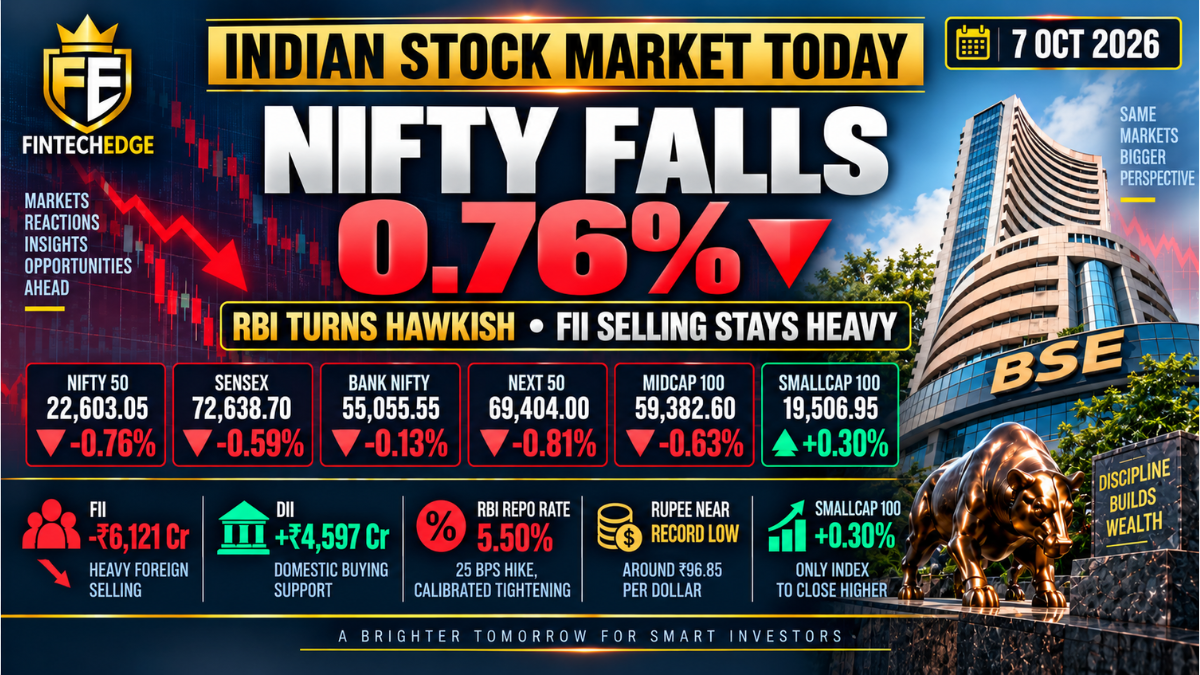
- Nifty 50 fell 0.76% to 22,603.05, while Sensex declined 0.59% to 72,638.70.
- RBI raised the repo rate by 25 bps to 5.50% and shifted its policy stance to calibrated tightening.
- Bank Nifty slipped only 0.13%, showing relative resilience despite the tighter policy backdrop.
- Nifty Next 50 fell 0.81% and Midcap 100 lost 0.63%, while Smallcap 100 gained 0.30%.
- FII/FPI sold ₹6,121.37 crore, while DIIs bought ₹4,596.57 crore in the broader NSE+BSE+MSEI capital-market data.
- The rupee remained close to record lows, while elevated oil prices and global yields stayed key macro pressures.
- Metals, real estate and autos were among the weaker sectors as markets adjusted to the RBI’s tighter stance.
Indian Market Performance — 7 October 2026
Daily change in key Indian equity indices
Indian Stock Market Today: Closing Summary
Indian equities snapped a two-session rebound on 7 October 2026 after the Reserve Bank of India raised the repo rate by 25 basis points to 5.50% following the broad market rally seen on 6 October and shifted its policy stance from neutral to calibrated tightening.
The Nifty 50 fell 0.76% to 22,603.05, while the Sensex declined 0.59% to 72,638.70. Bank Nifty was relatively resilient, slipping only 0.13%, while the broader market was mixed. The Nifty Next 50 fell 0.81%, the Midcap 100 lost 0.63%, but the Smallcap 100 bucked the trend with a 0.30% gain.
The market reaction reflected more than the rate hike itself. Reuters reported that the RBI delivered its first rate increase since February 2023 and moved to a tighter policy stance as inflation risks remained elevated amid high oil prices and tighter global monetary conditions.
Indian Market Performance
| Index | Close | Change |
|---|---|---|
| Nifty 50 | 22,603.05 | -0.76% |
| Sensex | 72,638.70 | -0.59% |
| Bank Nifty | 55,055.55 | -0.13% |
| Nifty Next 50 | 69,404.00 | -0.81% |
| Nifty Midcap 100 | 59,382.60 | -0.63% |
| Nifty Smallcap 100 | 19,506.95 | +0.30% |
The session was clearly weaker at the headline level, but the internal picture was not uniformly negative.
Bank Nifty held up much better than the Nifty 50, while smallcaps were the only one of the six tracked indices to finish higher.
That divergence matters because it shows the market was not experiencing a broad-based risk-off move across every segment.
RBI Raises Repo Rate to 5.50%
The RBI policy decision was the dominant market event.
The central bank raised the repo rate by 25 basis points to 5.50%, its first increase since February 2023. More importantly, the Monetary Policy Committee shifted its stance from neutral to calibrated tightening.
The move was broadly expected, but the change in stance signalled that inflation control has become a more immediate policy priority.
Reuters reported that the central bank highlighted risks from high oil prices and tighter global financial conditions, even as domestic growth remained resilient.
For equity markets, that matters because higher rates can affect:
- borrowing costs;
- corporate profitability;
- household consumption;
- valuation multiples;
- and liquidity conditions.
The more important signal was therefore not simply the 25-bps increase, but the RBI’s willingness to maintain a tighter policy bias.
That changes the market backdrop from one of rate stability to one where investors must consider the possibility of further tightening if inflation or external pressures remain elevated.
Why the Policy Stance Matters
The RBI’s move to calibrated tightening changes how investors interpret the next few policy meetings.
A single rate hike is manageable if growth remains strong. A sequence of rate increases, however, can gradually raise financing costs across the economy.
That matters especially for rate-sensitive sectors such as autos, real estate, consumer finance and highly leveraged businesses.
Reuters reported that auto, FMCG and real-estate indices declined, while metals also saw sharper losses during the session.
At the same time, the RBI raised its growth forecast for fiscal 2027 to 7.1%, suggesting that the central bank still sees domestic economic momentum as resilient even while tightening policy.
That creates a more complex setup for markets:
growth remains supportive, but the cost of capital is starting to move higher.
Bank Nifty Shows Relative Resilience
One of the more interesting features of the session was the behaviour of banking stocks.
Bank Nifty fell only 0.13%, substantially less than the Nifty 50’s 0.76% decline.
Reuters reported that financials and banks pared their earlier losses after the RBI decision, while private banks and PSU banks showed relative strength. Analysts noted that banks could receive some support because lending rates can reprice faster than deposit costs, while the absence of additional aggressive liquidity tightening eased concerns around funding costs.
This does not mean the rate hike is automatically positive for banks.
Higher rates can also slow credit demand and increase funding costs over time.
But today’s price action suggests the market viewed the policy outcome as manageable for the banking sector, at least in the near term.
That is why Bank Nifty’s relative resilience is more informative than the headline rate-hike narrative alone.
Rupee Remains Under Pressure
The rupee weakened even after the RBI raised rates. The rupee weakness also follows the pressure seen earlier this month as global yields and foreign selling weighed on Indian equities.
Reuters reported that the currency fell nearly 0.5% to ₹96.8450 per dollar, moving close to its record low of ₹96.96.
That is important because one of the reasons tighter monetary policy can help a currency is by improving the relative attractiveness of domestic assets.
But the rupee remains under pressure from several external forces:
- elevated oil prices;
- high US Treasury yields;
- dollar strength;
- and persistent foreign equity outflows.
The RBI has already been intervening in the foreign-exchange market.
India’s foreign-exchange reserves fell for a fourth consecutive week to $734.6 billion, down roughly $50 billion from the September peak, partly reflecting dollar sales and FX operations aimed at smoothing the rupee’s decline.
This makes currency stability an important part of the market story.
The rate hike did not immediately reverse rupee weakness, which suggests external pressures remain significant.
FIIs Sell ₹6,121 Crore, DIIs Buy ₹4,597 Crore
Institutional flows remained another headwind.
According to the official broader NSE+BSE+MSEI capital-market data you provided for 7 October 2026:
- FII/FPI: -₹6,121.37 crore
- DII: +₹4,596.57 crore
Domestic institutions again absorbed a large portion of foreign selling, but their buying was not enough to fully offset FII outflows.
That is important because foreign selling remains one of the more persistent pressures on Indian equities.
The pattern has become familiar:
FIIs sell, while DIIs provide partial support.
Domestic institutional demand can reduce the severity of declines, but sustained foreign outflows can still affect market sentiment, the rupee and large-cap liquidity.
Smallcaps Buck the Broader Decline
The resilience in smallcaps contrasts with the broad sell-off seen on 28 September, when large caps, midcaps and smallcaps were all under pressure.
The Nifty Next 50 fell 0.81% and the Midcap 100 declined 0.63%, but the Smallcap 100 gained 0.30%.
That stands out because smallcaps had led the rally in the previous session and still managed to hold positive territory
This suggests the session was not a complete withdrawal from risk.
Some smaller stocks continued to attract buying interest even as large-cap benchmarks reacted negatively to the RBI decision.
Still, one positive smallcap session should not be overinterpreted.
Smallcaps remain more volatile and can reverse quickly if broader risk sentiment deteriorates.
Metals, Realty and Autos Stay Weak
Sectoral weakness was concentrated in several rate-sensitive and cyclical areas.
Reuters reported:
- Metals: -2.3%
- Real estate: -1.8%
- Autos: -1.6%
- FMCG: -0.9%
Metals were hit by weaker global prices and a firmer dollar, while real estate and autos are naturally sensitive to higher borrowing costs.
This fits the policy backdrop.
When rates rise, sectors dependent on consumer financing, housing demand or leverage can face greater valuation and earnings pressure.
At the same time, the weakness was not uniform across the entire market, which again explains why Bank Nifty and smallcaps performed relatively better.
Oil and Global Yields Remain Important Headwinds
The external macro backdrop remains difficult.
Brent crude rose back above $100 per barrel, while global yields remain elevated. Reuters reported Brent around $102 per barrel during the session amid continuing geopolitical supply risks.
High oil matters for India because it can:
- worsen the import bill;
- increase inflation pressure;
- weigh on the rupee;
- and complicate monetary policy.
At the same time, high US yields make dollar assets relatively more attractive and can add pressure on emerging-market capital flows.
These external forces help explain why the RBI is tightening despite otherwise resilient domestic growth.
What to Watch Next
RBI guidance
The rate hike is now known. The next question is whether the RBI signals further tightening in coming meetings.
Rupee
The currency remains near record lows. Continued weakness would keep imported inflation and RBI intervention in focus.
FII flows
Foreign selling remains heavy. Any sustained moderation in FII outflows would improve the market backdrop.
Brent crude
Oil above $100 remains a major macro risk for India.
Banks
Bank Nifty held up relatively well today. Whether that resilience continues will be important for the headline indices.
Smallcaps
Smallcaps bucked the broader decline. Continued resilience would suggest risk appetite has not completely faded.
FintechEdge View
The Indian stock market today reacted not just to the RBI’s 25-bps rate hike, but to a broader shift in the policy environment.
The move to calibrated tightening signals that inflation and external risks have moved higher on the central bank’s priority list.
That matters for equities because the market is now dealing with several pressures at once: higher domestic rates, a weak rupee, elevated oil prices, high global bond yields and persistent FII selling.
Yet the session was not uniformly weak.
Bank Nifty fell only 0.13%, while the Smallcap 100 gained 0.30%. That divergence suggests the market is still differentiating between sectors rather than moving into a broad risk-off phase.
For now, the more important question is not whether today’s decline marks another leg lower, but whether the RBI’s tighter stance, rupee weakness and foreign selling continue to reinforce one another over the coming sessions.
Sources & References
- Indian shares decline as RBI rate hike signals tighter policy Reuters
- RBI raises repo rate to 5.50%, first hike since February 2023 Reuters
- India’s FX reserves fall for fourth week as rupee pressure continues Reuters
- India bank liquidity surplus likely to decline by financial year-end Reuters
This article is for educational and informational purposes only and does not constitute investment advice, trading advice or a recommendation to buy or sell any security.
Our content is written for educational purposes and focuses on clarity, evidence, risk awareness and practical decision-making.