Indian Stock Market Today: Nifty Falls 1.56% as Banks and Broader Market Slide
Quick Summary
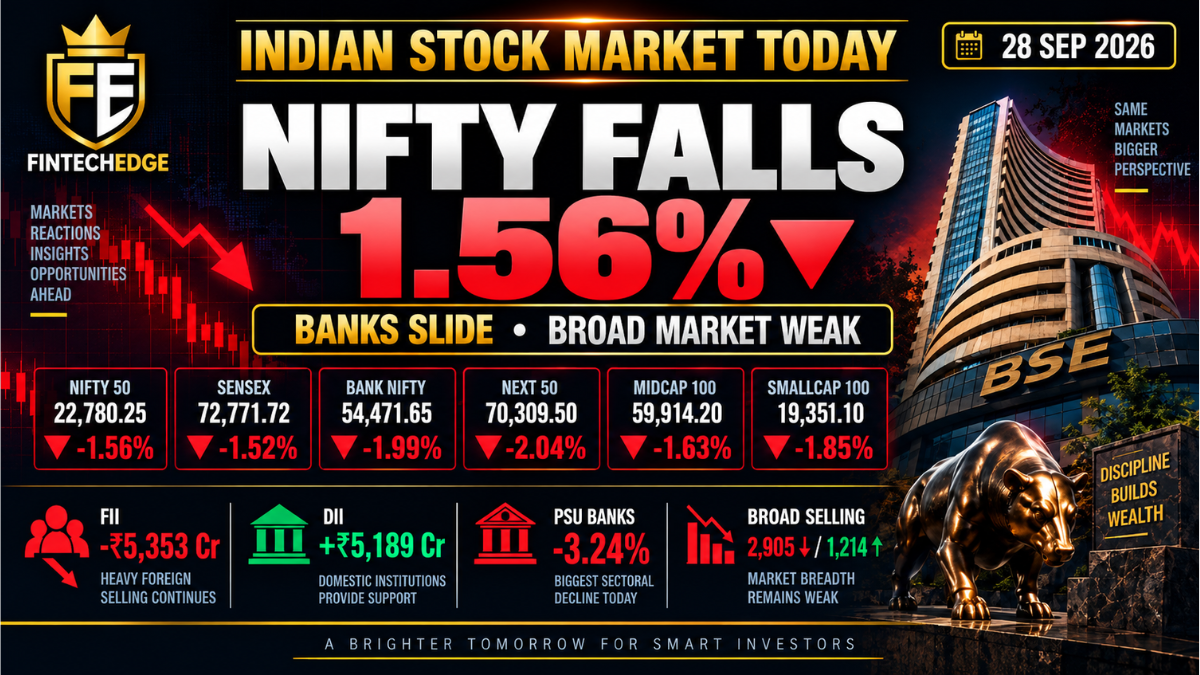
- Nifty 50 fell 1.56% to 22,780.25, while Sensex dropped 1.52% to 72,771.72.
- Bank Nifty declined 1.99%, while Nifty Next 50 fell 2.04%.
- Midcap 100 lost 1.63% and Smallcap declined 1.85%, confirming broad-market weakness.
- PSU banks were among the weakest areas, with the sector falling around 3.2%.
- FIIs sold ₹5,353.22 crore, while DIIs bought ₹5,189.02 crore.
- Higher crude, elevated global yields and geopolitical uncertainty added to the pressure.
Indian Market Performance — 28 September 2026
Daily change in key Indian equity indices
Indian Stock Market Today: Nifty Falls 1.56% as Banks and Broader Market Slide
Indian equities sold off sharply on 28 September 2026, with the Nifty 50 dropping below 22,800 and the Sensex losing more than 1,100 points.
The weakness was broad-based. All major market segments closed lower, while PSU banks were among the hardest hit. Moneycontrol reported all sectoral indices ended in the red, with the PSU Bank index down 3.24%.
The market also remained sensitive to global factors. Oil prices rose on renewed US-Iran tensions, while elevated global bond yields continued to pressure risk appetite. Reuters reported Indian shares fell to near six-month lows as the diplomatic stalemate raised concerns over energy supply.
Indian Market Performance
| Index | Close | Change |
|---|---|---|
| Nifty 50 | 22,780.25 | -1.56% |
| Sensex | 72,771.72 | -1.52% |
| Bank Nifty | 54,471.65 | -1.99% |
| Nifty Next 50 | 70,309.50 | -2.04% |
| Nifty Midcap 100 | 59,914.20 | -1.63% |
| Nifty Smallcap | 19,351.10 | -1.85% |
Sources: NSE market data | FintechEdge Research.
Broad-Market Selling Deepens
The most important feature of today’s session was not simply the fall in the Nifty.
Every major segment weakened at the same time.
Large caps fell sharply, Bank Nifty lost nearly 2%, the Next 50 dropped more than 2%, and both midcaps and smallcaps suffered heavy losses.
That makes today’s move different from a normal sector rotation.
When large caps, midcaps and smallcaps all fall together, it usually signals broader risk reduction rather than investors merely moving from one part of the market to another.
Moneycontrol’s market statistics showed 694 NSE advances against 2,582 declines, reinforcing the same message.
So today’s session should be described as a broad risk-off move.
Banks and PSU Banks Lead the Weakness
Financial stocks amplified the decline.
Bank Nifty fell 1.99%, while the Nifty PSU Bank index dropped 3.24%, making it the weakest major sector in the session.
That matters because financials carry significant weight in both the Nifty and Sensex.
When banks fall sharply, the headline indices often struggle to stabilise even if a few individual stocks remain resilient.
The weakness was also visible outside PSU banks, with private-bank and financial shares under pressure during the session.
Crude Oil Adds to Macro Pressure
Oil was another important pressure point.
Reuters reported that crude prices rose after US-Iran peace talks hit a deadlock, raising concerns around supply through the Strait of Hormuz.
For India, the significance is straightforward.
Higher crude can increase:
- the import bill;
- inflation pressure;
- current-account stress;
- demand for US dollars;
- and pressure on the rupee.
That makes Indian equities particularly sensitive to sudden oil-price spikes.
I am deliberately not using an exact crude-price level here, because the price source you are tracking differs from the Brent quote reported by Reuters today.
The important verified point is the direction:
crude moved higher and added pressure to the Indian market.
US-Iran Tensions Remain a Global Risk
The renewed geopolitical tension mattered because it affected energy markets directly.
For FintechEdge, we do not need to speculate about political motives.
The market transmission is enough:
geopolitical uncertainty → higher oil risk → inflation pressure → higher yields → weaker risk appetite.
That is the part relevant to Indian investors.
US Yields Keep Financial Conditions Tight
Global bond yields also remained a headwind.
Higher US Treasury yields can make dollar-denominated fixed-income assets more attractive relative to emerging-market equities.
That matters because it can:
- strengthen the dollar;
- increase global borrowing costs;
- reduce foreign risk appetite;
- and pressure emerging-market capital flows.
Reuters specifically highlighted elevated global bond yields as another factor weighing on Indian equities. Reuters
FII Selling Continues, DIIs Offset Much of the Outflow
Institutional flow data for 28 September is now available.
- FII net selling: ₹5,353.22 crore
- DII net buying: ₹5,189.02 crore
This is an important signal.
Foreign investors sold heavily, but domestic institutions absorbed almost the entire outflow.
That support may have limited some of the downside, but it was not enough to prevent the broad decline.
For comparison, on 25 September:
- FIIs sold ₹3,693.93 crore;
- DIIs bought ₹2,838.17 crore.
So both foreign selling and domestic buying intensified today.
IT Shows Relative Resilience
IT was one of the least weak sectors.
Moneycontrol showed Nifty IT down only 0.26%, significantly better than the broader market.
That does not mean IT was strong.
It simply means the sector held up better than banks, energy, telecom and several cyclical segments.
This is a useful secondary observation, not the main story.
What to Watch Next
The next few sessions should clarify whether today’s weakness becomes another leg lower or begins to stabilise.
Market breadth:
A healthier session would need more stocks participating on the upside.
Banks:
Financials and PSU banks were major drags today, so stabilisation here would matter for the indices.
FII flows:
Foreign selling above ₹5,000 crore remains significant.
Crude oil:
Any further rise in oil would remain a negative for inflation, the rupee and domestic sentiment.
US Treasury yields:
Elevated yields continue to tighten global financial conditions.
US-Iran developments:
Any diplomatic change could quickly influence energy prices and market sentiment.
FintechEdge View
Today’s session was a broad risk-off move rather than a narrow correction.
Nifty fell 1.56%, Bank Nifty lost almost 2%, the Next 50 fell more than 2%, and both midcaps and smallcaps declined sharply.
At the same time, crude moved higher, global bond yields remained elevated, and FIIs sold more than ₹5,000 crore.
Domestic institutions provided substantial support, but the selling pressure was too broad for that support to reverse the session.
The more important signal now is not whether the Nifty posts one positive day.
A healthier recovery would require better breadth, stabilization in banks, reduced FII selling and some easing in external pressures from oil and global yields.
This article is for educational and informational purposes only and does not constitute investment advice, trading advice or a recommendation to buy or sell any security.
Our content is written for educational purposes and focuses on clarity, evidence, risk awareness and practical decision-making.