Indian Stock Market Today: Nifty Rebounds 0.34% but Logs Seventh Straight Weekly Loss
Quick Summary
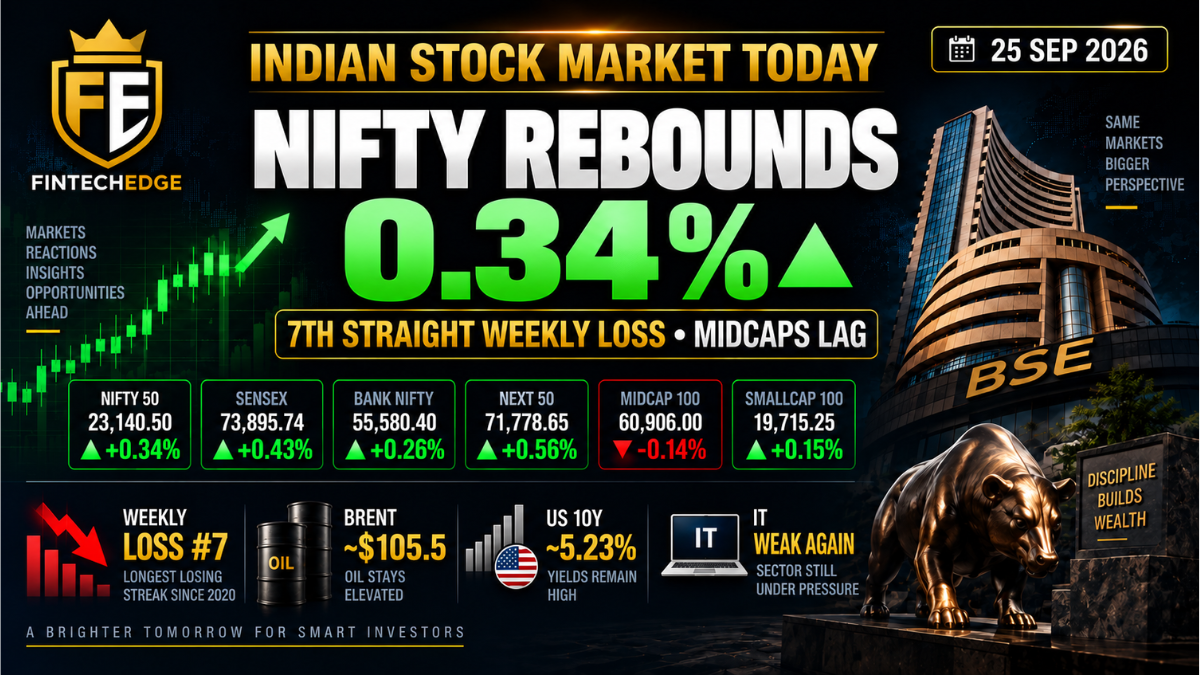
- Nifty 50 gained 0.34% to 23,140.50, while Sensex rose 0.43% to 73,895.74.
- Bank Nifty added 0.26%, while Nifty Next 50 gained 0.56%.
- Broader participation remained uneven: Midcap 100 fell 0.14%, while Smallcap gained only 0.15%.
- Nifty and Sensex completed a seventh consecutive weekly decline, their longest losing streak since 2020.
- Elevated crude oil and global bond yields remained important macro headwinds.
- IT continued to lag, extending its recent run of sector weakness.
Indian Market Performance — 25 September 2026
Daily change in key Indian equity indices
Indian Stock Market Today: Nifty Rebounds 0.34% but Logs Seventh Straight Weekly Loss
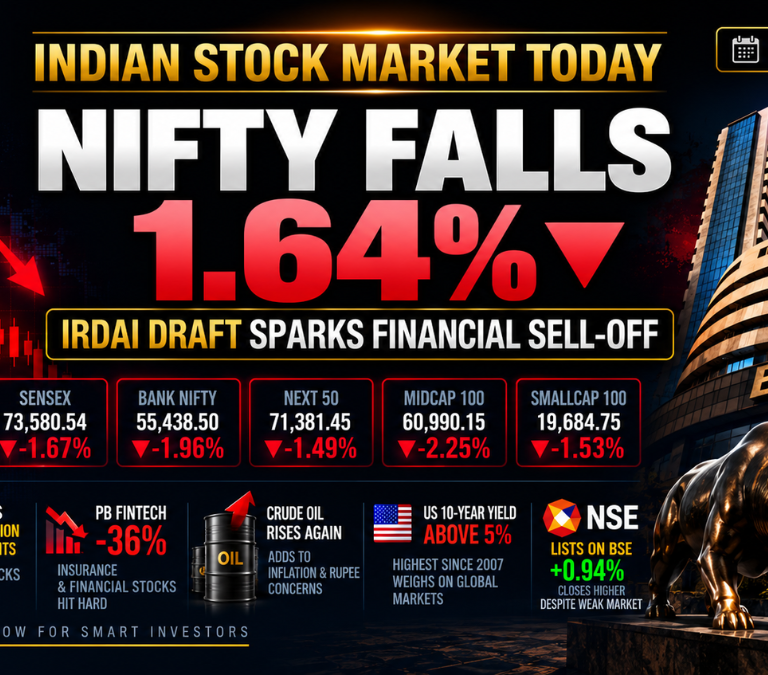
Indian equities recovered modestly on 25 September 2026, a day after the sharp financial-sector sell-off triggered by concerns around IRDAI’s proposed insurance-distribution reforms.
The Nifty 50 gained 0.34% to close at 23,140.50, while the Sensex rose 0.43% to 73,895.74. Bank Nifty added 0.26%, and the Nifty Next 50 advanced 0.56%.
The recovery, however, was uneven. The Nifty Midcap 100 fell 0.14%, while the Smallcap index gained only 0.15%.
More importantly, Friday’s positive close did not prevent another negative week. The Nifty and Sensex completed their seventh consecutive weekly decline, their longest losing streak since 2020. Reuters reported that Nifty lost about 0.9% for the week and Sensex around 0.5%.
That makes Friday’s move better described as a relief rebound after Thursday’s sharp fall, rather than evidence that the broader correction has decisively ended.
Indian Market Performance — 25 September 2026
| Index | Close | Change |
|---|---|---|
| Nifty 50 | 23,140.50 | +0.34% |
| Sensex | 73,895.74 | +0.43% |
| Bank Nifty | 55,580.40 | +0.26% |
| Nifty Next 50 | 71,778.65 | +0.56% |
| Nifty Midcap 100 | 60,906.00 | -0.14% |
| Nifty Smallcap | 19,715.25 | +0.15% |
Sources: NSE market data | FintechEdge Research.
Benchmarks Recover, but Broader Participation Remains Uneven
Friday’s headline indices looked better after Thursday’s severe decline.
The Nifty, Sensex, Bank Nifty and Next 50 all finished higher.
But the Midcap 100 remained in negative territory and Smallcap barely advanced.
That divergence matters.
Thursday’s sell-off had spread across large caps, financials, midcaps and smallcaps. A stronger recovery would ideally have shown all of those segments rebounding together.
Instead, Friday’s structure suggests selective buying returned to larger stocks while risk appetite in the broader market remained cautious.
That makes the session more consistent with a relief rebound than a clean change in trend.
Seven Straight Losing Weeks Put Friday’s Bounce in Perspective
The most important signal from Friday is actually the weekly one.
Despite the positive close, Nifty and Sensex still ended lower for the week, completing seven consecutive weekly declines.
Reuters described it as the benchmarks’ longest weekly losing run since 2020.
Periods of seven straight weekly declines are unusual.
But that does not automatically mean the market must now rebound.
A prolonged decline can create oversold conditions and encourage bargain buying, but oversold markets can remain weak for longer than expected.
That is why the source video’s “high probability bounce” thesis should not become a FintechEdge conclusion.
The more defensible observation is:
The market has been under sustained pressure for an unusually long period, while Friday produced only the first modest attempt at recovery after Thursday’s sharp fall.
Crude Oil Remains a Macro Headwind
This is where the Claude draft needed its biggest correction.
Oil should not be presented as the main positive catalyst today.
Reuters reported that high oil prices remained one of the reasons Indian equities recorded another weak week, as elevated energy costs continued to feed concerns around inflation, yields and monetary policy.
For India, expensive crude matters through several channels:
- a larger import bill;
- higher inflation risk;
- pressure on the current account;
- greater dollar demand;
- and pressure on domestic bond yields.
Earlier in the week, falling crude had provided some relief.
By Friday, that relief was much less convincing.
So the better interpretation is that Indian equities managed a modest rebound despite an uncomfortable oil backdrop.
US Treasury Yields Keep Global Financial Conditions Tight
The bond-market backdrop also remains difficult.
Long-dated US Treasury yields have climbed sharply as markets reassess how far the Federal Reserve may need to tighten policy.
Higher US yields matter for India because they can make US fixed income relatively more attractive, strengthen the dollar and place additional pressure on emerging-market capital flows.
This is particularly relevant after the heavy foreign selling seen in Indian equities over recent sessions.
So even though Friday’s Nifty close was positive, the external environment remains far from supportive.
IT Extends Its Weak Run
Information technology remained a notable weak spot.
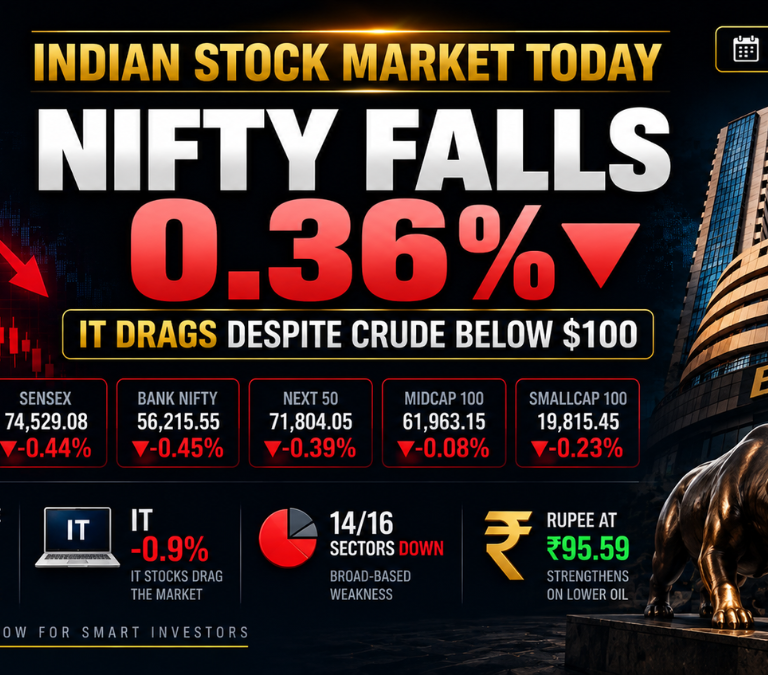
The Nifty IT index fell for a sixth consecutive session, with the sector down more than 4% over that period. Infosys and TCS were among the major drags.
The continued weakness is linked to worries that:
- higher US interest rates;
- persistent inflation;
- and slower corporate technology spending
could affect demand for Indian IT-services companies.
This is now a recurring market theme rather than a one-session anomaly.
It also explains why stronger US technology shares do not automatically translate into gains for Indian IT exporters.
PB Fintech Attempts a Partial Rebound
PB Fintech also remained in focus after Thursday’s extraordinary fall.
The stock rebounded about 4% in early trade after crashing 36% in the previous session following IRDAI’s proposed changes to insurance-distribution commissions.
But the underlying issue remains unresolved.
Brokerages have already cut estimates because the proposed rules could materially affect revenue and earnings if implemented close to their current form.
So Friday’s recovery should be viewed as a partial bounce after an extreme decline, not evidence that the regulatory risk has disappeared.
Previous-Session FII/DII Context
Confirmed September 25 cash-market institutional-flow data was not available at the time of finalisation.
The latest confirmed figures remain for 24 September:
- FII: -₹5,027 crore
- DII: +₹4,301 crore
Those figures belong to Thursday’s session.
They should not be presented as September 25 data.
The broader takeaway is simply that heavy foreign selling remains one of the issues to watch, particularly while US yields stay elevated.
What to Watch Next
The next few sessions should answer several important questions.
Can broader markets participate?
Midcaps remained negative on Friday. A healthier recovery would ideally include midcaps and smallcaps.
Does the seven-week losing streak finally end?
One positive session is not enough. Sustained follow-through matters more.
What happens to oil?
Persistent crude prices above $100 would continue to complicate India’s inflation and rate outlook.
Do US yields ease?
High global bond yields remain a major external headwind.
Does IT stabilise?
Six consecutive weak sessions make the sector’s behaviour increasingly relevant.
How does the IRDAI consultation evolve?
PB Fintech and insurance-linked stocks remain sensitive to any clarification or revision.
FintechEdge View
Friday’s recovery was useful, but it should be kept in perspective.
Nifty rose 0.34% and Sensex gained 0.43%, yet midcaps remained weak, IT continued to struggle and the global rates and energy backdrop remained challenging.
Most importantly, Indian benchmarks still completed a seventh consecutive losing week.
That means Friday’s move is better classified as a relief rebound inside a still-fragile market environment rather than confirmation that the broader correction has ended.
The next stronger signal would be a combination of:
better market breadth + easing global yields + softer oil + reduced foreign selling.
Until then, the market remains in a transition phase rather than a clearly established recovery.
This article is for educational and informational purposes only and does not constitute investment advice, trading advice or a recommendation to buy or sell any security.
Our content is written for educational purposes and focuses on clarity, evidence, risk awareness and practical decision-making.