Indian Stock Market Today: Nifty Falls 1.64% as IRDAI Draft Sparks Financial Sell-Off
Quick Summary
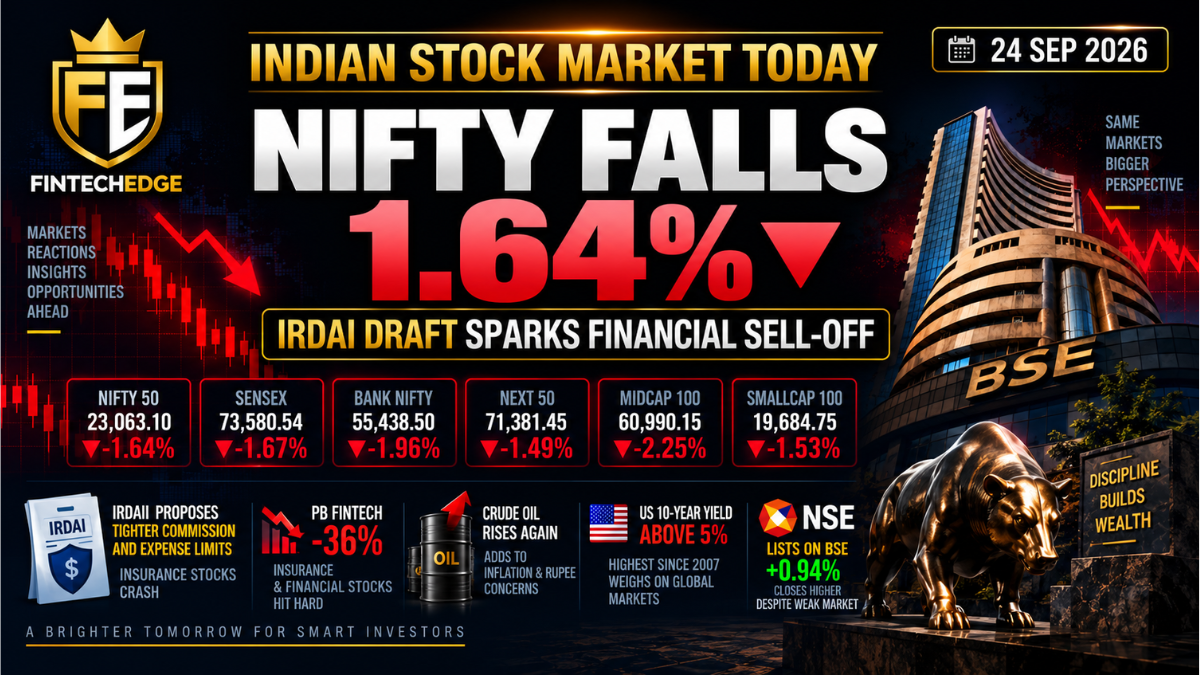
- Nifty 50 fell 1.64% to 23,063.10, while Sensex dropped 1.67% to 73,580.54.
- Bank Nifty declined 1.96%, making financials one of the weakest parts of the market.
- Broader markets also sold off: Midcap 100 fell 2.25%, Next 50 lost 1.49%, and Smallcap declined 1.53%.
- IRDAI proposed tighter commission and expense limits for insurance distribution; the measures are still under consultation.
- PB Fintech fell about 36% as insurance-distribution stocks were sharply repriced.
- FIIs sold ₹5,027 crore, while DIIs bought ₹4,301 crore.
Indian Market Performance — 24 September 2026
Daily change in key Indian equity indices
Indian Stock Market Today: Sensex Drops 1,248 Points as Insurance Stocks Crash
Indian equities suffered a sharp, broad-based sell-off on 24 September 2026, with insurance and financial stocks at the centre of the decline after the Insurance Regulatory and Development Authority of India (IRDAI) proposed significant changes to insurance-distribution economics.
The Nifty 50 fell 1.64% to 23,063.10, while the Sensex dropped 1.67% to 73,580.54. Bank Nifty underperformed, falling 1.96% to 55,438.50.
The weakness spread beyond financials. The Nifty Midcap 100 declined 2.25%, Nifty Next 50 fell 1.49%, and Smallcap lost 1.53%, confirming that Thursday’s move was not a narrow sector-specific correction.
The most dramatic reaction came in insurance-distribution stocks. PB Fintech, parent of Policybazaar, plunged about 36% after IRDAI’s consultation paper proposed tighter commission structures and expense limits. It is important to stress that these are proposals under consultation, not final regulations.
At the same time, FIIs sold ₹5,027 crore of Indian equities while DIIs bought ₹4,301 crore, and global pressure remained elevated as US Treasury yields stayed above 5% and oil prices moved higher again.
Indian Market Performance — 24 September 2026
| Index | Close | Change |
|---|---|---|
| Nifty 50 | 23,063.10 | -1.64% |
| Sensex | 73,580.54 | -1.67% |
| Bank Nifty | 55,438.50 | -1.96% |
| Nifty Next 50 | 71,381.45 | -1.49% |
| Nifty Midcap 100 | 60,990.15 | -2.25% |
| Nifty Smallcap | 19,684.75 | -1.53% |
Sources: NSE market data | FintechEdge Research.
Why IRDAI’s Draft Hit Insurance Stocks
The biggest domestic trigger was IRDAI’s consultation paper on insurance distribution.
The regulator proposed changes to commission structures, distribution economics and expense limits, including tighter caps across several categories of insurance products. The aim is to improve transparency, reduce mis-selling and reshape how distributors and intermediaries are compensated.
The important distinction is:
IRDAI has proposed changes. It has not yet implemented final rules.
The market nevertheless reacted aggressively because distributors and insurers with high dependence on commission income could see material pressure on revenue and profitability if the proposed framework is implemented largely as written.
PB Fintech was hit hardest, falling roughly 36% by the close. HDFC Life, ICICI Prudential Life and other insurance-linked names also saw sharp declines.
This was not a routine sector move. It was a sharp repricing of businesses exposed to insurance-distribution economics.
Financials Drag the Benchmarks Lower
The impact did not remain confined to insurance companies.
Bank Nifty fell 1.96%, reflecting weakness across the broader financial complex.
Part of this came from concerns around bancassurance and distribution-linked economics, while part was simply the spillover from a severe sector shock into financial sentiment more broadly.
Because financials carry substantial weight in the Nifty and Sensex, their weakness amplified the benchmark decline.
The market therefore faced two layers of pressure:
insurance-specific repricing → broader financial weakness → benchmark drag
That was the core domestic mechanism behind Thursday’s fall.
Broader Markets Also Sell Off
The decline spread well beyond insurance and large-cap financials.
The Nifty Midcap 100 dropped 2.25%, underperforming the Nifty itself. Smallcap fell 1.53%, while Next 50 lost 1.49%.
That matters because it shows the session evolved into a genuine broad-market sell-off rather than remaining an isolated regulatory shock.
Today is therefore one of those sessions where broader-market performance deserves more explanation than usual.
The useful takeaway is simple:
Selling pressure broadened across market-cap segments rather than staying confined to one sector.
FIIs Sell ₹5,027 Crore, DIIs Buy ₹4,301 Crore
Institutional flows were particularly important today.
- FII: -₹5,027 crore
- DII: +₹4,301 crore
Foreign selling was materially heavier than in several recent sessions.
Domestic institutions absorbed a large portion of the selling, but not enough to prevent a broad decline.
The pattern is notable because persistent FII outflows combined with elevated global yields can keep pressure on Indian equities even when DIIs remain strong buyers.
One day does not define a trend, but today’s foreign outflow is large enough to monitor closely.
Oil and US Yields Add Macro Pressure
Two global factors made the domestic shock harder to absorb.
First, crude oil moved higher again after several sessions of relief. Higher oil is negative for India because it can increase:
- import costs;
- inflation pressure;
- current-account pressure;
- and demand for US dollars.
Second, the US 10-year Treasury yield remained above 5%, a level that continues to tighten global financial conditions and make US fixed income more competitive relative to emerging-market assets.
These factors did not cause today’s sell-off—the IRDAI-related shock was the main domestic catalyst—but they added pressure to an already weak session.
NSE Lists Positive Despite Weak Market
The National Stock Exchange of India also made its BSE debut today.
The IPO had been subscribed about 5.7 times, following strong institutional demand.
Despite the weak market backdrop, NSE managed to finish its first trading day modestly above its issue price.
That is noteworthy because it shows the stock attracted enough demand to hold up even during one of the market’s weakest sessions in recent weeks.
The listing should still be treated as a separate company-specific event rather than as a driver of the broader index move.
Stocks in Focus
PB Fintech was the standout loser, plunging about 36% after the IRDAI consultation paper raised concerns about commission economics.
HDFC Life and ICICI Prudential Life also fell sharply as investors reassessed the potential impact of the proposed framework on insurers and distribution channels.
NSE, meanwhile, ended its debut session modestly above the issue price despite the broader market sell-off.
These stock moves were all relevant, but the biggest story remained the sector-wide regulatory repricing in insurance and financials.
What to Watch Next
IRDAI consultation process:
The key question is how much of the proposed commission and expense framework survives after industry feedback.
Insurance stocks:
PB Fintech, HDFC Life, ICICI Prudential Life and other exposed names may remain volatile as investors estimate earnings impact.
FII flows:
Today’s ₹5,027 crore foreign outflow was large enough to matter.
Crude oil:
A sustained rise would worsen India’s inflation and external-balance outlook.
US yields:
The 10-year Treasury yield remaining above 5% will continue to influence emerging-market flows.
NSE trading:
The exchange’s early post-listing behaviour will remain in focus after a positive debut during a weak market session.
FintechEdge View
September 24 was not a routine correction.
A regulatory consultation paper triggered a sharp repricing across insurance and distribution-linked financial businesses, and the shock quickly spread into broader financials and the wider market.
That explains why the Midcap 100 fell even more than the Nifty, while FIIs sold more than ₹5,000 crore in the cash market.
At the same time, it is important not to overstate the regulatory certainty.
IRDAI’s framework is still a consultation proposal. The final shape of the rules may change after stakeholder feedback.
That means the market is currently pricing a potentially significant regulatory change before the final outcome is known.
For investors, the next useful signal is not whether the market bounces tomorrow, but whether the proposed economics are materially revised—and whether heavy foreign selling persists.
This article is for educational and informational purposes only and does not constitute investment advice, trading advice or a recommendation to buy or sell any security.
Our content is written for educational purposes and focuses on clarity, evidence, risk awareness and practical decision-making.