Indian Stock Market Today: Sensex Jumps 564 Points as Crude Falls, Midcaps Lag

Quick Summary
- Sensex gained 0.76% to 74,858.99, while Nifty 50 rose 0.28% to 23,414.30.
- Broader markets cooled: Midcap 100 fell 0.28%, Smallcap slipped 0.07%, and Nifty Next 50 was nearly flat.
- Brent crude fell toward roughly $101–102 per barrel, providing some relief to India’s inflation and currency backdrop.
- Bank Nifty gained a modest 0.20%.
- The rupee closed slightly stronger at ₹95.8150 per US dollar.
- The NSE IPO attracted about $10 billion in bids, roughly 5.7 times the shares on offer.
Indian Market Performance — 21 September 2026
Daily change in key Indian equity indices
Indian Stock Market Today: Sensex Jumps 564 Points as Crude Falls, Midcaps Lag
Indian benchmark indices ended higher on 21 September 2026, but the session was driven more by a return to large-cap buying than by broad market strength.
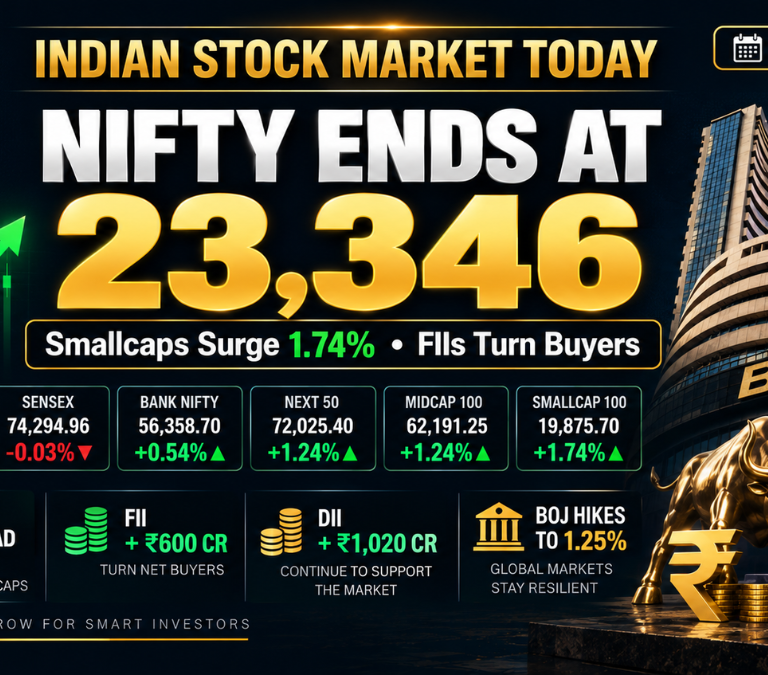
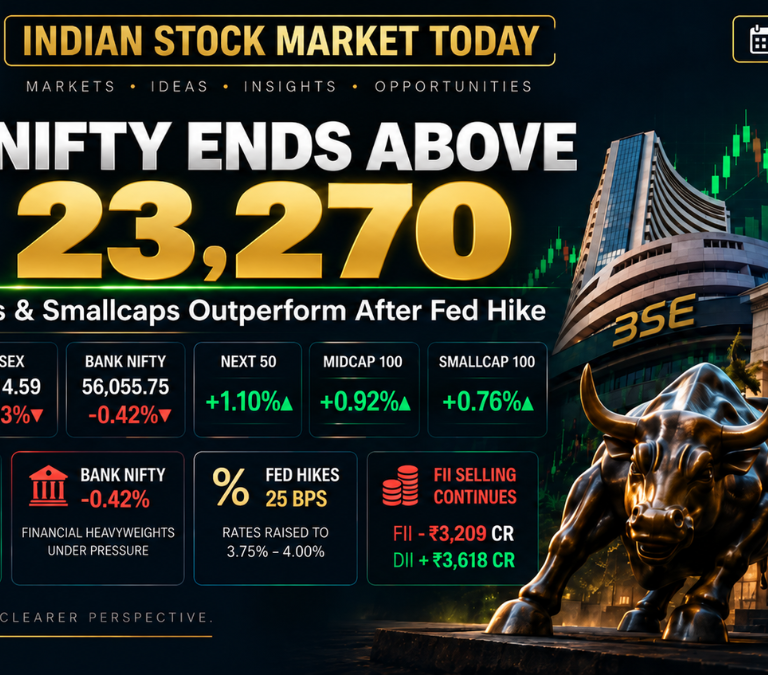
The Sensex rose 0.76% to 74,858.99, while the Nifty 50 gained 0.28% to close at 23,414.30. Bank Nifty added 0.20%.
The broader market, however, moved in the opposite direction. The Nifty Midcap 100 fell 0.28%, the Smallcap index slipped 0.07%, and the Nifty Next 50 was nearly unchanged at +0.08%.
That made Monday’s session a clear reversal from the previous two trading days, when midcaps and smallcaps had led the recovery.
Falling crude oil prices provided some macro relief, while bargain buying returned to heavyweight stocks after the Nifty completed six consecutive losing weeks — its longest such streak since 2020.
Indian Market Performance — 21 September 2026
| Index | Close | Change |
|---|---|---|
| Nifty 50 | 23,414.30 | +0.28% |
| Sensex | 74,858.99 | +0.76% |
| Bank Nifty | 56,470.65 | +0.20% |
| Nifty Next 50 | 72,083.95 | +0.08% |
| Nifty Midcap 100 | 62,013.10 | -0.28% |
| Nifty Smallcap | 19,861.50 | -0.07% |
Sources: NSE market data | FintechEdge Research.
Why Falling Crude Helped Indian Equities
The strongest macro support came from lower crude oil prices.
Brent crude slipped toward the $101–102 per barrel area as supply concerns eased and markets reacted to signs of possible diplomatic progress around geopolitical tensions.
For India, cheaper crude matters because the country imports a large share of its energy requirements.
Lower oil can reduce pressure on:
- the import bill;
- current-account balances;
- inflation;
- and demand for US dollars.
That does not solve India’s macro challenges overnight, but it removes some of the pressure that had been weighing on equities and the rupee earlier in the month.
Large Caps Lead While Midcaps and Smallcaps Cool
The most interesting feature of Monday’s session was the change in market leadership.
The Sensex advanced 0.76%, while the Nifty gained only 0.28%.
At the same time, the Midcap 100 fell 0.28%, Smallcap slipped 0.07%, and the Next 50 was almost unchanged.
That is a clear reversal from Thursday and Friday, when broader-market indices had significantly outperformed the large-cap benchmarks.
The useful interpretation is that investors rotated back toward larger, more liquid stocks after the recent correction.
Reuters also described Monday’s gains as being supported by bargain buying following a prolonged six-week decline.
This does not necessarily mean last week’s broader-market recovery has ended.
But it does show that the buying pattern changed.
Bargain Buying After Six Consecutive Losing Weeks
Monday’s rise also needs to be viewed in the context of the preceding decline.
The Nifty had just completed six consecutive weekly losses, its longest such streak since 2020.
After a decline of that duration, some large-cap stocks naturally begin to attract bargain buyers as valuations and positioning reset.
That appears to have been part of Monday’s move.
However, a single positive session does not reverse a six-week trend.
The more important question is whether large-cap buying develops into sustained participation or remains a short-term recovery from oversold conditions.
Sector and Stock Highlights
Sector participation was reasonably positive, with 12 of 16 major sectors ending higher, even though midcaps and smallcaps underperformed.
Large-cap names such as HCL Technologies performed strongly, while other select heavyweights and pharma names also supported the market. HCL Tech rose more than 3% during the session, outperforming several technology peers.
The important point is not the performance of every individual stock.
It is that large-cap buying was strong enough to lift the Sensex meaningfully even while broader indices cooled.
Rupee Gets Some Relief as Oil Falls
The rupee closed at ₹95.8150 per US dollar, marginally stronger than the previous close of 95.8725.
Lower crude oil prices helped reduce some import-related dollar demand, while IPO-linked portfolio inflows also provided support.
However, appreciation remained limited by continued dollar demand from importers.
The currency is therefore seeing some relief, but remains close to historically weak levels.
NSE IPO Closes With Strong Demand
The National Stock Exchange of India’s IPO closed with strong demand.
Reuters reported roughly 502.7 million shares bid for against 88.6 million available, equivalent to about 5.7 times subscription. Including anchor investors, total bids were worth around ₹964.8 billion, or roughly $10 billion, at the top of the price band.
That is notable because the offering attracted significant demand despite:
- six weeks of market weakness;
- high crude prices earlier in the month;
- tightening global monetary conditions.
The demand signals continued confidence in India’s capital-market infrastructure.
It should not, however, be treated as the reason for Monday’s equity-market gains.
Global Markets
Global equities were broadly positive as technology and AI-linked optimism supported sentiment, while lower oil prices helped bond markets.
For Indian investors, the most relevant global signals were:
- easing crude;
- relatively supportive risk sentiment;
- and continued uncertainty around the future path of US interest rates.
There is no need to overextend this section with individual US stock moves.
What to Watch Next
Large-cap leadership:
The key question is whether Monday’s shift toward large caps continues or whether midcaps and smallcaps regain leadership.
Crude oil:
Further easing from the $101–102 area would improve India’s inflation, currency and import-cost backdrop.
USD/INR:
The rupee closed at ₹95.8150, but remains close to the ₹96 region.
NSE IPO listing:
The market will now watch final allocation details and the stock’s debut after the heavily subscribed issue.
FII/DII data:
The final September 21 institutional cash-market figures were not available at the time of finalisation. They should be added only after confirmation.
Global rates:
Expectations around additional Fed and European rate increases remain an important external variable.
FintechEdge View
Monday’s market was best understood as a rotation back toward large caps rather than a broad-based rally.
The Sensex significantly outperformed the Nifty, while midcaps and smallcaps slipped after leading the market late last week.
Lower crude helped improve the macro backdrop, and six consecutive losing weeks likely created room for selective bargain buying in heavyweight stocks.
But the internal picture was more mixed than the Sensex’s 564-point gain suggests.
For the next phase of the recovery to become more convincing, it would be healthier to see large-cap strength accompanied by renewed participation from midcaps and smallcaps rather than leadership simply rotating between different parts of the market.
This article is for educational and informational purposes only and does not constitute investment advice, trading advice or a recommendation to buy or sell any security.
Our content is written for educational purposes and focuses on clarity, evidence, risk awareness and practical decision-making.