Indian Stock Market Today: Nifty Falls 0.36% as IT Drags Despite Crude Below $100
Quick Summary
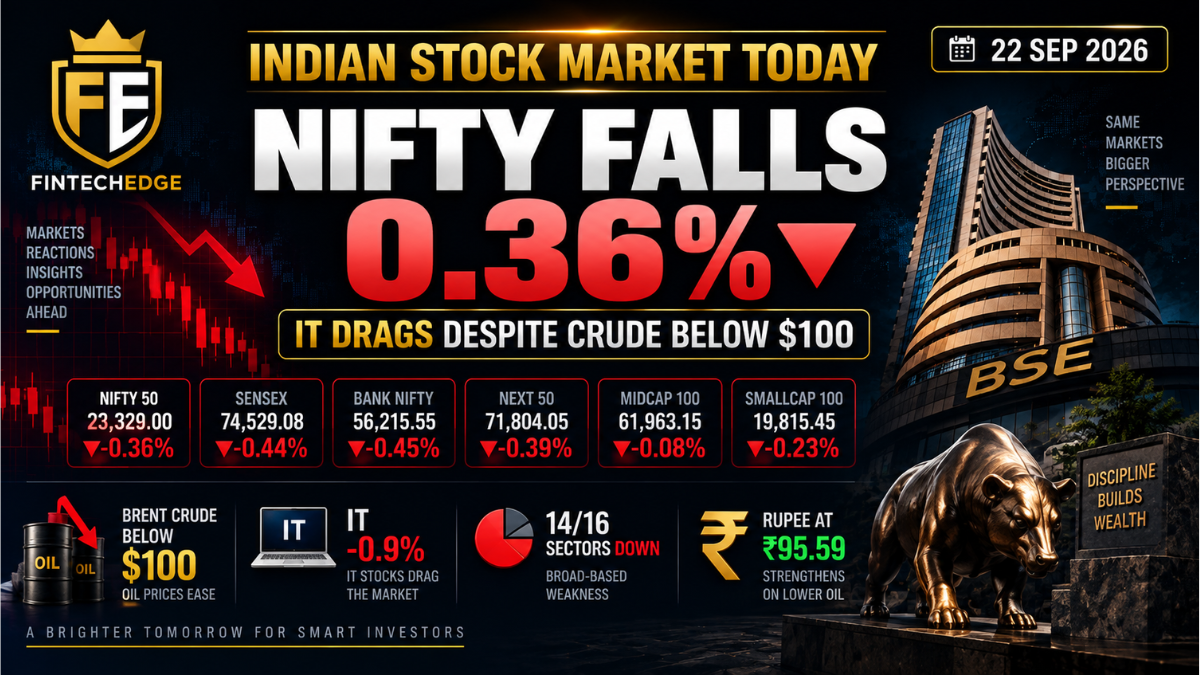
- Nifty 50 fell 0.36% to 23,329.00, while Sensex declined 0.44% to 74,529.08.
- Bank Nifty dropped 0.45%, while Nifty Next 50 fell 0.39%.
- Nifty IT fell about 0.9%, making technology the clearest sectoral drag.
- Brent crude fell below $100 per barrel, but cheaper oil was not enough to prevent the market from closing lower.
- The rupee strengthened to around ₹95.59 per US dollar.
- Midcap 100 slipped 0.08% and Smallcap declined 0.23%, holding up somewhat better than the benchmarks.
Indian Market Performance — 22 September 2026
Daily change in key Indian equity indices
Indian Stock Market Today: Nifty Falls 0.36% as IT Drags Despite Crude Below $100
Indian equities surrendered early gains and closed lower on 22 September 2026, even as crude oil fell below $100 per barrel and the rupee strengthened.
The Nifty 50 fell 0.36% to 23,329.00, while the Sensex declined 0.44% to 74,529.08. Bank Nifty lost 0.45% to 56,215.55.
The day’s most important drag came from information technology stocks. The Nifty IT index fell about 0.9%, while 14 of 16 major sectors finished lower. At the same time, Brent crude dropped to a two-week low near $98.23 per barrel, a normally supportive development for India.
The contrast made Tuesday’s session more interesting than the headline decline alone: macro conditions improved at the margin, but sector-specific selling was strong enough to overpower that relief.
Indian Market Performance — 22 September 2026
| Index | Close | Change |
|---|---|---|
| Nifty 50 | 23,329.00 | -0.36% |
| Sensex | 74,529.08 | -0.44% |
| Bank Nifty | 56,215.55 | -0.45% |
| Nifty Next 50 | 71,804.05 | -0.39% |
| Nifty Midcap 100 | 61,963.15 | -0.08% |
| Nifty Smallcap | 19,815.45 | -0.23% |
Sources: NSE market data | FintechEdge Research.
Why IT Dragged the Market
Information technology was the clearest source of weakness.
The Nifty IT index fell roughly 0.9%, with names such as HCL Technologies, Tech Mahindra and Infosys among the weaker stocks. Reuters attributed the sector’s weakness to concerns around demand and the earnings outlook.
That move was particularly notable because global technology stocks had just enjoyed a strong session.
The Nasdaq closed at a record high in the previous US session as AI and semiconductor stocks rallied, with chipmakers benefiting from renewed enthusiasm around artificial-intelligence demand.
Indian IT therefore moved in the opposite direction.
That divergence suggests investors were paying more attention to the earnings and demand outlook for Indian IT services companies than to the global AI rally itself.
Crude Falls Below $100, but Indian Stocks Still Decline
The biggest positive macro development was oil.
Brent crude fell to a two-week low, with November futures settling around $98.23 per barrel. The decline followed reports that Iran could reopen the Strait of Hormuz if US military pressure eased, alongside improving Saudi supply routes.
For India, cheaper crude is generally supportive because it can reduce pressure on:
- the import bill;
- domestic inflation;
- the current account;
- and demand for US dollars.
Yet the equity market still finished lower.
That is an important reminder that one supportive macro variable does not necessarily determine the entire market session.
On Tuesday, selling in IT, financials and other sectors outweighed the benefit from cheaper energy.
Early Gains Fade Into the Close
Indian equities had initially opened with support from falling crude and positive global cues.
Those gains did not hold.
Selling intensified as the session progressed, and the benchmarks ended near the weaker part of the day. Reuters reported that IT weakness and broader sectoral selling ultimately outweighed the favourable oil backdrop.
This makes the intraday reversal more meaningful than simply saying the Nifty fell 85 points.
The market was presented with a positive catalyst, responded initially, but could not sustain the move.
Rupee Strengthens as Oil Pressure Eases
The rupee benefited from lower crude.
It closed around ₹95.59 per US dollar, approximately 0.2% stronger on the day. Reuters attributed the move to softer oil prices, portfolio flows and signs of possible RBI support through state-run banks.
The relationship is straightforward.
When oil prices fall, India’s oil-import bill requires fewer dollars at the margin, which can reduce pressure on the currency.
The rupee remains historically weak, but Tuesday’s move was consistent with the improvement in the oil backdrop.
Broader Markets Also Finish Lower
Broader indices were negative, but the declines were relatively contained.
The Nifty Next 50 fell 0.39%, while the Midcap 100 slipped only 0.08% and the Smallcap index declined 0.23%.
There is little value in giving each of these indices a separate explanation today.
The useful takeaway is simply that market weakness was broad, but midcaps and smallcaps held up somewhat better than the main large-cap benchmarks.
Previous-Session FII/DII Context
Confirmed institutional-flow data for 21 September showed:
- FII: -₹576.20 crore
- DII: +₹2,797.27 crore
These are previous-session figures and should not be presented as September 22 flows.
The pattern shows that domestic institutions continued to absorb foreign selling on Monday.
Until today’s final exchange data is available, it is better not to infer whether that pattern continued on Tuesday.
Stocks in Focus
Coal India gained about 3.2% following a Morgan Stanley upgrade, making it one of the clearer company-specific positive stories during an otherwise weak session.
Meesho also attracted buying after brokerage commentary highlighted growth in its user and seller base.
On the weaker side, HCL Technologies, Tech Mahindra and Infosys reflected the broader selling pressure across Indian IT.
The stock-specific moves are useful for context, but they were secondary to the broader sector story.
Global Tech Rallies While Indian IT Lags
The contrast between global and domestic technology stocks deserves attention.
The previous US session saw the Nasdaq close at a record, helped by strong gains in AI-linked and semiconductor stocks. AMD crossed a $1 trillion market value during the rally, while the semiconductor index surged more than 4%.
Indian IT stocks did not participate.
This reinforces an important distinction:
Indian IT revenues depend heavily on enterprise technology spending, client budgets, pricing and outsourcing demand.
That can produce very different share-price behaviour from US chipmakers or AI-platform companies.
What to Watch Next
Nifty IT:
The sector remains one of the clearest sources of weakness. Whether selling stabilises will matter for the headline indices.
Crude oil:
Brent below $100 is a meaningful improvement for India. Whether prices remain below that level matters more than a one-day move.
USD/INR:
The rupee strengthened to around ₹95.59, but remains close to historically weak levels.
September 22 FII/DII data:
Today’s confirmed institutional-flow numbers should be added only once released.
Late-session selling:
The inability to hold early gains suggests investors remain cautious despite the more supportive oil backdrop.
Global technology:
The divergence between strong US AI/chip stocks and weak Indian IT remains worth monitoring.
FintechEdge View
Tuesday’s session shows why market analysis cannot stop at one macro headline.
Crude falling below $100 and a stronger rupee were genuinely positive developments for India, but they did not prevent equities from declining because selling in IT, financials and other sectors was stronger.
The more useful signal was the market’s inability to sustain its early gains.
At the same time, midcaps and smallcaps fell less than the benchmark indices, so the session was not a broad capitulation across every part of the market.
For now, the key question is whether falling oil begins to translate into more durable support for Indian equities—or whether earnings concerns and sector-specific selling continue to dominate.
This article is for educational and informational purposes only and does not constitute investment advice, trading advice or a recommendation to buy or sell any security.
Our content is written for educational purposes and focuses on clarity, evidence, risk awareness and practical decision-making.