Indian Stock Market Today: Nifty Slips 0.28% as Broader Markets Stay Weak
Quick Summary
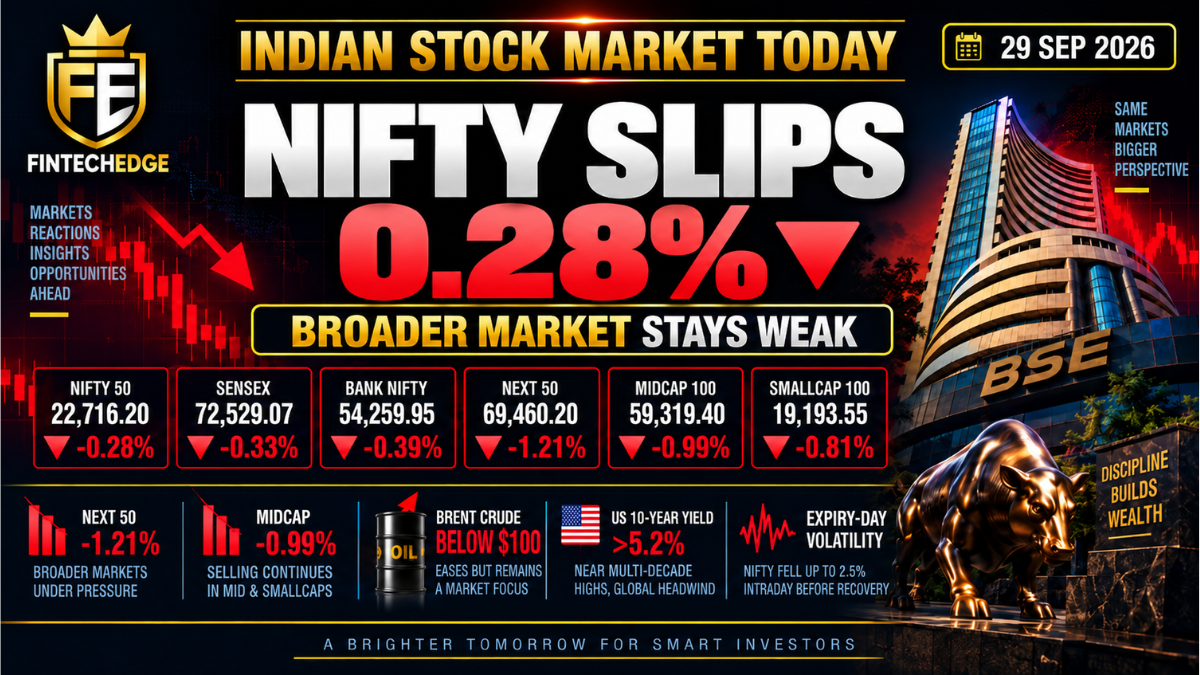
- Nifty 50 fell 0.28% to 22,716.20, while Sensex declined 0.33% to 72,529.07.
- Bank Nifty slipped 0.39%.
- Broader markets were substantially weaker: Next 50 fell 1.21%, Midcap 100 0.99% and Smallcap 0.81%.
- Nifty recovered sharply from its intraday low during a volatile monthly derivatives-expiry session.
- Crude remained an important macro factor, while elevated global yields continued to pressure risk appetite.
- Persistent foreign selling remained an important pressure point for Indian equities.
Indian Market Performance — 29 September 2026
Daily change in key Indian equity indices
Indian Stock Market Today: Nifty Slips 0.28% as Broader Markets Stay Weak
Indian equities ended lower on 29 September 2026, but the relatively small decline in the headline indices masked much deeper weakness across the broader market.
The Nifty 50 closed at 22,716.20, down 0.28%, while the Sensex ended at 72,529.07, lower by 0.33%. Bank Nifty slipped 0.39%.
The picture underneath the benchmarks was considerably weaker. The Nifty Next 50 fell 1.21%, the Nifty Midcap 100 declined 0.99%, and the Nifty Smallcap index lost 0.81%.
The market also experienced substantial intraday volatility during the monthly derivatives-expiry session before recovering much of the decline by the close.
The session was also marked by sharp intraday volatility around the monthly derivatives expiry. By the close, however, the most important signal was the divergence between relatively resilient headline indices and considerably weaker performance across mid- and smaller-cap stocks.
Indian Market Performance
| Index | Close | Change |
|---|---|---|
| Nifty 50 | 22,716.20 | -0.28% |
| Sensex | 72,529.07 | -0.33% |
| Bank Nifty | 54,259.95 | -0.39% |
| Nifty Next 50 | 69,460.20 | -1.21% |
| Nifty Midcap 100 | 59,319.40 | -0.99% |
| Nifty Smallcap | 19,193.55 | -0.81% |
Sources: NSE market data | FintechEdge Research.
Broader Markets Fell Much More Than Nifty
The most useful signal from today’s session was the gap between the headline indices and the broader market.
A 0.28% decline in Nifty looks relatively modest. Sensex and Bank Nifty also finished with contained losses.
But beneath those numbers, the weakness was substantially greater.
The Nifty Next 50 fell 1.21%, more than four times the percentage decline in the Nifty 50. Midcap 100 dropped 0.99%, while Smallcap declined 0.81%. The same divergence was highlighted in the original draft. Pasted text
That changes how the session should be interpreted.
Rather than broad stability, the numbers suggest that large, index-heavy stocks were relatively better supported while selling pressure continued across a much wider group of stocks.
For investors looking at market breadth rather than only the benchmark, today was therefore weaker than the Nifty’s closing percentage suggests.
Expiry-Day Volatility Complicated the Session
Tuesday was also a monthly derivatives-expiry session, which contributed to unusually large intraday swings.
The market saw a much larger intraday decline before recovering substantially toward the close. That recovery is notable, but it should be interpreted cautiously.
Expiry sessions can experience exaggerated intraday swings as traders close, roll over or hedge futures and options positions.
A sharp recovery from the intraday low does not automatically establish that a durable market bottom has formed.
Because of that, the recovery from the intraday low should be treated carefully.
It shows that buyers emerged at lower levels, but one expiry-driven recovery is not enough to establish a durable change in trend.
The more useful signal is whether broader participation improves in subsequent normal trading sessions.
Crude Remains an Important Macro Variable
Oil continued to matter for Indian equities, but today we should be precise about the number.
The relevant market point is broader: oil remains important for India because sustained increases can affect:
- the import bill;
- inflation;
- the current account;
- demand for US dollars;
- the rupee;
- and domestic rate expectations.
The fact that oil eased during the session provided some relief, but crude remains elevated enough to stay relevant to India’s macro outlook.
High Global Yields Remain a Headwind
Global bond yields remain another difficult part of the backdrop.
High US Treasury yields can make dollar-denominated fixed-income assets relatively more attractive and can reduce demand for emerging-market risk.
For India, that can contribute to:
- foreign portfolio outflows;
- a stronger dollar;
- tighter global liquidity;
- and pressure on equity valuations.
Market coverage on Tuesday continued to identify rising US bond yields alongside oil and foreign fund outflows as important pressures on Indian equities.
This remains an ongoing macro constraint rather than a one-day event.
Foreign Selling Remains a Structural Pressure
Foreign institutional selling has also remained a recurring issue through September.
The broader conclusion is enough:
Persistent foreign selling remains one of the pressures preventing a cleaner improvement in market sentiment.
Realty Weakness Stands Out
The weakness was not confined to one market segment.
Realty was among the weaker pockets during the session, while banks and several cyclical areas also remained under pressure.
That matters because rate-sensitive and economically sensitive sectors often provide useful clues about investor risk appetite.
At the same time, some pockets such as pharmaceuticals and metals showed better relative resilience.
But individual sector moves should not distract from the larger message of the day:
the broader market remained substantially weaker than the Nifty 50..
Why the 200-Week Moving Average Is Not the Main Story
A closing move of just -0.28% could make the session appear relatively uneventful.
It was not.
The combination of:
- Next 50 down 1.21%;
- Midcap 100 down 0.99%;
- Smallcap down 0.81%;
- continued foreign selling;
- high global yields;
- and expiry-related volatility
shows that the market beneath the headline benchmark remained fragile.
This is exactly why market breadth and broader indices matter.
A strong index can sometimes hide weakness in the average stock, just as a modest index decline can understate the amount of selling across the wider market.
What to Watch Next
Broader-market participation:
The most important near-term signal is whether the performance gap between Nifty and the Next 50, Midcap and Smallcap indices starts narrowing.
Expiry-day recovery:
Watch whether the rebound from today’s intraday lows receives follow-through in a normal trading session.
Foreign flows:
Persistent FII selling continues to be an important pressure point.
A reduction in foreign outflows would improve the market backdrop.
Global yields:
High Treasury yields continue to keep global financial conditions restrictive.
Crude oil:
Oil remains relevant for India’s inflation, currency and rate outlook, but use the correct benchmark before quoting an exact price.
Sector participation:
A healthier market recovery would ideally involve broader participation rather than support from only a few large-cap names or defensive sectors.
FintechEdge View
The Indian stock market today looked much less weak at the benchmark level than it did underneath the surface.
Nifty declined only 0.28%, but the Nifty Next 50 fell 1.21%, Midcap 100 lost 0.99%, and Smallcap declined 0.81%.
That divergence is the most important signal from the session.
The recovery from the intraday low deserves attention, but because it occurred during monthly derivatives expiry, it should not automatically be interpreted as confirmation of a market bottom.
A more convincing improvement would require better broader-market participation, reduced foreign selling and some easing in the external macro pressures affecting Indian equities.
This article is for educational and informational purposes only and does not constitute investment advice, trading advice or a recommendation to buy or sell any security.
Our content is written for educational purposes and focuses on clarity, evidence, risk awareness and practical decision-making.