Indian Stock Market Today: Nifty Surges 2.40% in Biggest Gain in Seven Months
Quick Summary
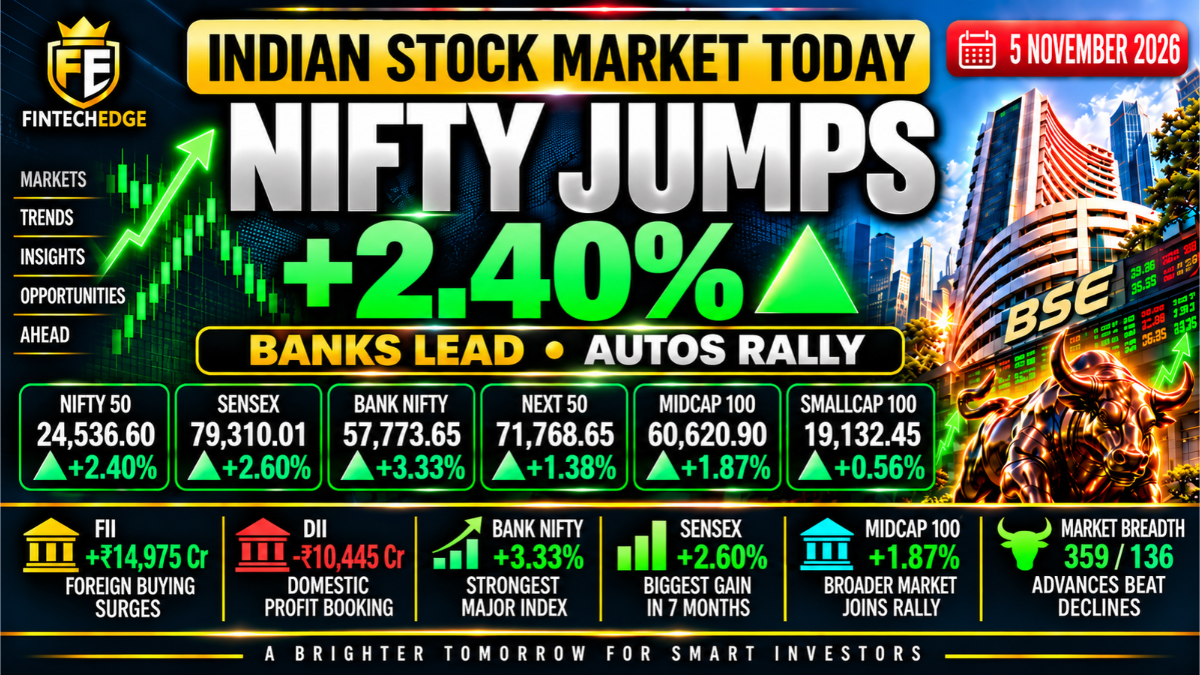
- Nifty 50 jumped 2.40% to 24,536.60, while Sensex surged 2.60% to 79,310.01.
- The benchmarks recorded their biggest single-day gain in seven months and extended the winning streak to six sessions.
- Bank Nifty surged 3.33%, making it the strongest major index tracked by FintechEdge.
- FIIs bought ₹14,975 crore in the stock segment, while DIIs sold ₹10,445 crore.
- Financials and autos led sectoral gains, while 14 of 16 major sectors finished higher.
- Brent crude traded around $96 per barrel after a sharp fall in the previous session, easing India’s macro pressure.
- Midcap 100 gained 1.87%, while Smallcap 100 rose only 0.56%, showing that banks and large caps led the rally.
Indian Market Performance — 5 November 2026
Daily change in key Indian equity indices
Indian Stock Market Today: Closing Summary
Indian stock market today surged on 5 November 2026, with the Nifty 50 jumping 2.40% to 24,536.60 and the Sensex rising 2.60% to 79,310.01 as financials and autos rallied, foreign buying accelerated and lower crude oil improved the macro backdrop. Reuters described it as the benchmarks’ biggest single-day gain in seven months, while the winning streak extended to six sessions. Bank Nifty was the standout index, rising 3.33%.
The scale of today’s move was significant, but the rally was not equally strong across the market. The Midcap 100 gained 1.87% and the Next 50 rose 1.38%, while the Smallcap 100 advanced only 0.56%. Banks and heavyweight large caps therefore did much more of the work than smaller companies.
Indian Market Performance
| Index | Close | Change |
|---|---|---|
| Nifty 50 | 24,536.60 | +2.40% |
| Sensex | 79,310.01 | +2.60% |
| Bank Nifty | 57,773.65 | +3.33% |
| Nifty Next 50 | 71,768.65 | +1.38% |
| Nifty Midcap 100 | 60,620.90 | +1.87% |
| Nifty Smallcap 100 | 19,132.45 | +0.56% |
All six tracked indices closed higher, but Bank Nifty clearly led the session while smallcaps lagged.
That is an important distinction.
The Nifty rose 2.40%, but the Smallcap 100 managed only a 0.56% gain. So although market breadth was positive, the strongest buying remained concentrated in financials, autos and heavyweight large-cap stocks.
Nifty Posts Biggest Gain in Seven Months
The Nifty’s 2.40% rise and the Sensex’s 2.60% gain represented their strongest single-day performance in seven months.
A move of this size in the benchmark indices is unusual on its own. It becomes even more notable because it came on the sixth consecutive positive session.
Several factors aligned:
- financial stocks rallied sharply;
- autos gained strongly;
- foreign institutional buying accelerated;
- crude oil remained far below recent highs;
- and most major sectors participated.
This makes today’s session different from rallies that depend heavily on one heavyweight stock or one narrow sector.
At the same time, it is important not to turn a strong day into a prediction.
Today’s move confirms powerful momentum over the last week. It does not prove that the earlier correction has permanently ended.
Six-Session Rally Takes Benchmarks Up More Than 8%
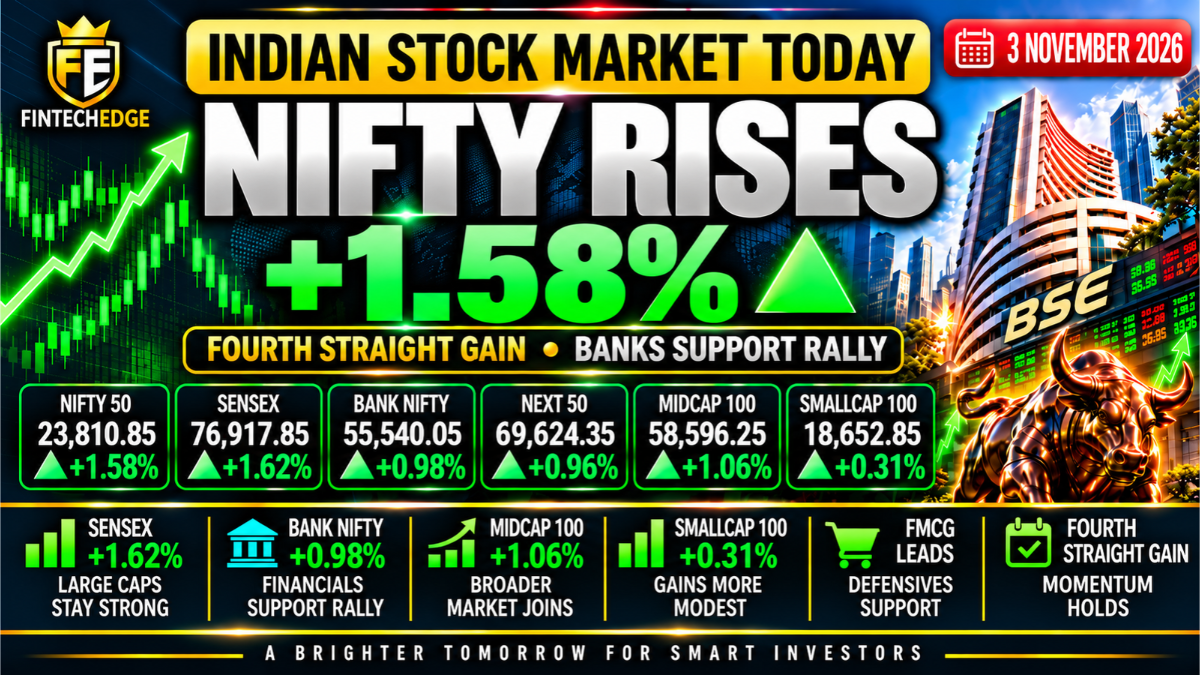
The Nifty and Sensex have now gained more than 8% over six consecutive sessions, marking their longest winning run in about a year. The improvement has built rapidly over the past week. On 3 November, the Nifty had already extended its rally for a fourth consecutive session, while large caps and banks strengthened.
That is a dramatic change from the market environment seen in late October.
Only days ago, Indian equities were dealing with:
- elevated crude oil;
- rising global yields;
- persistent foreign selling;
- weakness in midcaps and smallcaps;
- and concerns about global technology valuations.
Several of those pressures have eased simultaneously.
The recovery has therefore moved beyond a one- or two-day relief rally.
But the speed of the move itself becomes something investors should monitor carefully. An 8%+ rise in six sessions is large, and after such a sharp advance it would not be unusual for markets to pause or consolidate.
That is not a prediction of a reversal. It is simply recognition of how much ground has already been covered.
Bank Nifty Surges 3.33%
Bank Nifty was the clear standout among the major indices, surging 3.33% to 57,773.65.
This matters because banks had lagged several earlier phases of the recovery.
That changed decisively today.
Private banks and PSU banks both strengthened, while Reuters reported gains of around:
- ICICI Bank: +5.3%
- HDFC Bank: +3.2%
Bajaj Finance also gained strongly.
Because financial companies carry substantial weight in the Nifty and Sensex, a broad banking rally has an outsized effect on the headline indices.
This is one reason today’s benchmark gains were so strong.
The participation of banks also makes this rally structurally different from some earlier sessions where one or two heavyweight sectors carried most of the market.
FIIs Buy ₹14,975 Crore as Flow Trend Reverses
Institutional flows produced one of the most important signals of the session.
Your 5 November data shows:
- FII stock purchases: +₹14,975 crore
- DII stock activity: -₹10,445 crore
That is a major reversal from the flow pattern that dominated much of October.
November’s cumulative numbers strengthen that observation:
- FII: +₹32,210 crore
- DII: -₹18,228 crore
During October, the market repeatedly saw the opposite pattern: foreign investors sold heavily while domestic institutions absorbed supply.
Now foreign buying has returned strongly.
The shift is notable because foreign flows can have a particularly strong impact on large-cap stocks, which helps explain why the Nifty, Sensex and Bank Nifty have performed so strongly over the last several sessions.
However, a few days of buying do not establish a long-term trend.
The useful conclusion is narrower:
Foreign institutional behaviour has changed materially in early November compared with October.
Whether that continues will be one of the most important factors to watch.
Autos and Financials Lead Sector Gains
Financials and autos were the clearest sector leaders.
The verified material shows financials gaining around 4% and autos around 4.1%.
The leadership was supported by several large stocks, including Maruti Suzuki and Tata Motors Passenger Vehicles, while Shriram Finance and Bajaj Finance also performed strongly.
Sector breadth was impressive overall.
Fourteen of sixteen major sectors advanced, while realty, PSU banks, consumer durables and IT also posted gains.
This is important because the rally was not restricted to one pocket of the market.
Broad sector participation generally gives a stronger picture of market sentiment than an index gain driven by only a handful of companies.
Crude Oil Falls Sharply
Lower oil remains one of the most important macro improvements for India.
Brent crude was around $96 per barrel on 5 November after falling 8.7% in the previous session to a two-month low.
That is a major change from the $110–$118 range seen recently.
For India, cheaper crude can help through several channels:
- lower imported inflation;
- reduced pressure on the trade deficit;
- a better current-account outlook;
- lower dollar demand from oil importers;
- improved corporate margins;
- and support for the rupee.
This is why crude matters so much to Indian equities.
The correct interpretation, however, is that oil pressure has eased sharply.
It would be premature to assume crude will remain at these levels or continue falling.
This is a significant change from the backdrop seen at the end of October. On 30 October, elevated crude remained one of the major macro risks even as the Nifty finished the month above 23,000.
Rupee Strengthens to Around ₹94.47
The rupee strengthened for a fifth consecutive session to around ₹94.47 per dollar.
The currency has benefited from:
- lower crude oil;
- improving foreign equity flows;
- and better overall risk sentiment.
A stronger rupee is particularly useful for India after the currency pressure seen earlier during the period of high oil and elevated global yields.
It can reduce imported inflation and improve the external backdrop.
Still, the rupee remains highly sensitive to global yields, the dollar, crude oil and foreign capital flows.
IT Gains Despite Global Chip Weakness
Indian IT stocks also gained, rising around 2.4%, even as global semiconductor shares remained under pressure.
This is noteworthy because global technology has recently been one of the most volatile areas of the market.
But the safest interpretation is simply that Indian IT and global chip stocks moved differently today.
It would be too strong to conclude that India has become a permanent “anti-AI trade” or that weakness in global AI stocks will automatically benefit Indian technology services companies.
One session does not establish that relationship.
Midcaps Participate, Smallcaps Lag
The broader market was positive, but participation was uneven.
The Midcap 100 gained 1.87%, while the Smallcap 100 rose only 0.56%.
That is especially notable because smallcaps had been one of the strongest parts of the market on 4 November.
Leadership shifted today.
Banks and large caps took the lead, while smallcaps moved higher but did not keep pace.
Smallcap 100 gained less than one-quarter of the Nifty’s percentage move.
That does not make today a weak smallcap session—the index still closed positive—but it shows where the strongest demand was concentrated.
This distinction matters for investors because portfolio performance can differ considerably from the benchmark when market leadership rotates this quickly.
The leadership has also rotated quickly. On 29 October, the rebound was more evenly distributed across large caps, banks, midcaps and smallcaps.
What Changed Over the Last Six Sessions
The market recovery has been driven by different groups at different stages.
Earlier sessions saw:
- large-cap leadership;
- then improving smallcap and midcap participation;
- then broader sector rotation;
- and now a sharp surge in banks and autos.
At the same time:
- crude has fallen substantially;
- the rupee has strengthened;
- and FIIs have returned as aggressive buyers.
That combination is much more supportive than the environment India faced during large parts of October.
But the current rally has also become very fast.
That makes the next phase more interesting.
The question is no longer whether sentiment has improved—it clearly has.
The question is whether the improvement in flows, oil and sector participation can persist after an 8%+ six-session rally.
What to Watch Next
FII buying
FIIs bought ₹14,975 crore today and have been strong buyers so far in November. Whether this continues could have a major influence on large-cap stocks.
Bank Nifty
Bank Nifty surged 3.33%. Sustained banking strength would continue to support the major indices.
Brent crude
Oil around $96 is materially more favourable for India than recent levels above $110.
Smallcaps
Smallcaps lagged sharply today despite the broad market rally. Whether they catch up will help determine how balanced the next stage of the recovery becomes.
Rupee
The rupee has strengthened for five sessions. Continued currency stability would reinforce the improving macro backdrop.
Pace of the rally
The Nifty and Sensex have gained more than 8% in six sessions. The market has already travelled a significant distance in a short period.
FintechEdge View
The Indian stock market today delivered one of its strongest sessions of 2026.
The Nifty surged 2.40%, Sensex gained 2.60%, and Bank Nifty jumped 3.33%, while financials and autos provided powerful sector leadership.
More importantly, the backdrop that pressured Indian markets through much of October has changed significantly.
Foreign investors are buying again. Crude oil has fallen sharply. The rupee is strengthening. Banks have rejoined the rally. And most sectors are participating.
Those are genuine improvements.
But the benchmarks have now risen more than 8% in only six sessions.
That means the correct conclusion is not that the correction is definitely over or that a new bull market has been confirmed.
The stronger takeaway is that market conditions have improved materially, with foreign flows, lower oil and heavyweight financial-sector strength now supporting the recovery.
Whether those conditions persist will matter much more than trying to predict the next daily move.
Sources & References
- Indian shares log biggest gains in seven months on oil slide, foreign flows — Reuters
- Taking Stock: Fireworks continue on D-Street; Nifty reclaims 24,500, Sensex rallies 2,009 pts — Moneycontrol
- Rupee finds its footing as oil worries cool, traders watch flow momentum — Reuters
- Nifty 50 and broader Indian market index data — NSE India
This article is for educational and informational purposes only and does not constitute investment advice, trading advice or a recommendation to buy or sell any security.
Our content is written for educational purposes and focuses on clarity, evidence, risk awareness and practical decision-making.