Indian Stock Market Today: Nifty Jumps 1.66% but Smallcaps Fall 1.31%
Quick Summary
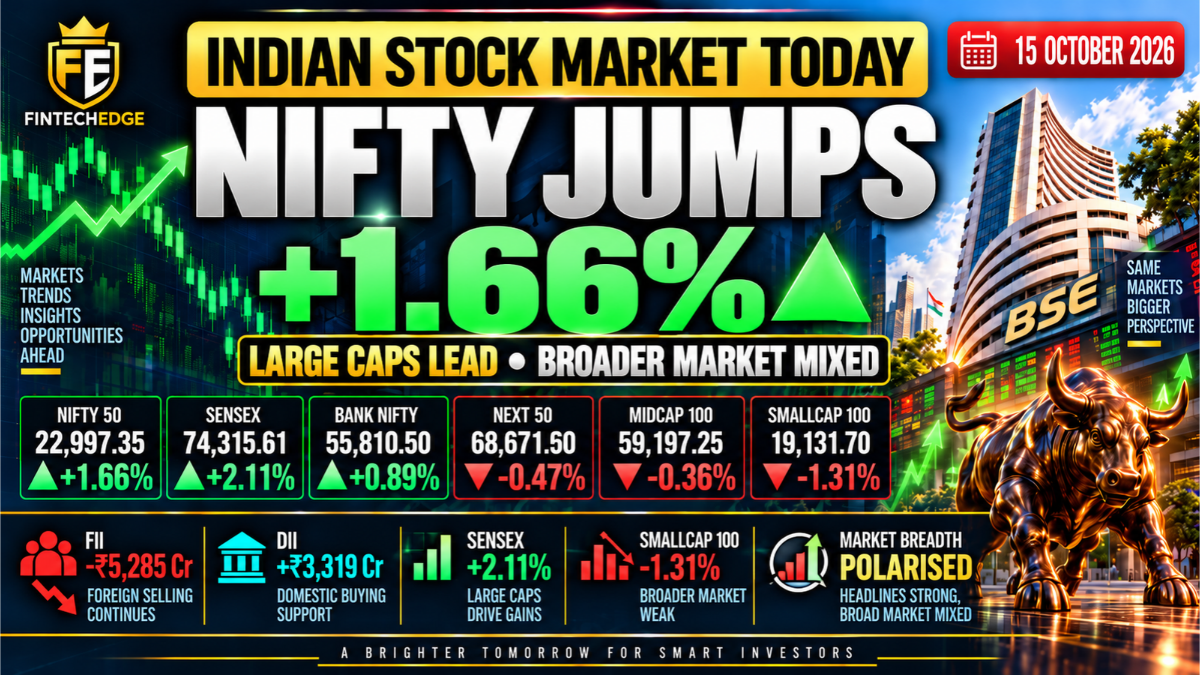
- Nifty 50 rose 1.66% to 22,997.35, while Sensex jumped 2.11% to 74,315.61.
- Bank Nifty gained 0.89%, supported by strength in large private banks.
- The broader market moved the other way: Next 50 fell 0.47%, Midcap 100 declined 0.36%, and Smallcap 100 dropped 1.31%.
- Financials, Reliance, Bharti Airtel and IT were among the main large-cap supports.
- FIIs sold ₹5,285 crore, while DIIs bought ₹3,319 crore in the stock segment.
- The rupee strengthened to around ₹95.06 per dollar, while Brent crude eased to around $104.91 per barrel.
- The session was highly polarised, with strong headline indices but weak broader-market participation.
Indian Market Performance — 15 October 2026
Daily change in key Indian equity indices
Indian Stock Market Today: Closing Summary
Indian equities delivered a strong headline rally on 15 October 2026, but the move was highly polarised.
The Nifty 50 rose 1.66% to 22,997.35, while the Sensex jumped 2.11% to 74,315.61. Bank Nifty also gained 0.89%.
But beneath the headline indices, the picture was very different. The Nifty Next 50 fell 0.47%, the Midcap 100 declined 0.36%, and the Smallcap 100 dropped 1.31%.
That makes today’s session one of the clearest examples of why index performance and overall market breadth are not the same thing.
The benchmark rally was driven mainly by large-cap financials, Reliance Industries, Bharti Airtel and IT, while broader-market participation remained weak. Foreign investors also continued to sell heavily despite the sharp rise in the Nifty and Sensex.
Indian Market Performance
| Index | Close | Change |
|---|---|---|
| Nifty 50 | 22,997.35 | +1.66% |
| Sensex | 74,315.61 | +2.11% |
| Bank Nifty | 55,810.50 | +0.89% |
| Nifty Next 50 | 68,671.60 | -0.47% |
| Nifty Midcap 100 | 59,197.25 | -0.36% |
| Nifty Smallcap 100 | 19,131.70 | -1.31% |
The most important feature of the session was not simply the Nifty’s 1.66% gain.
It was the divergence between strong large-cap benchmarks and weak broader-market indices.
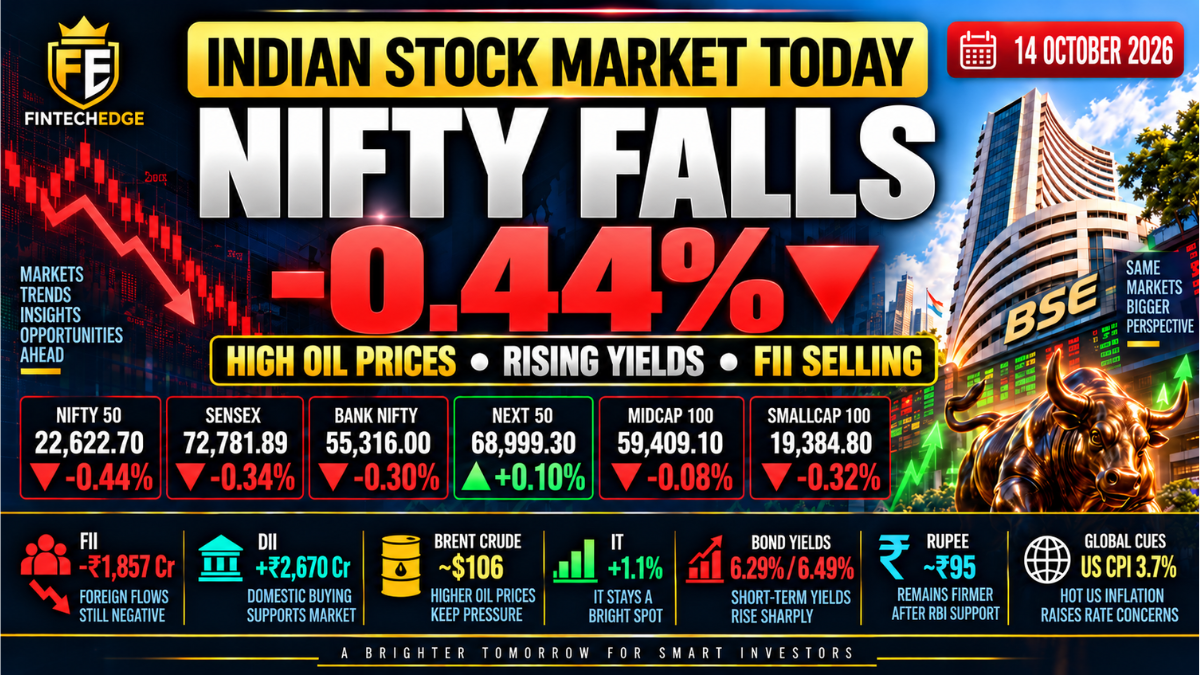
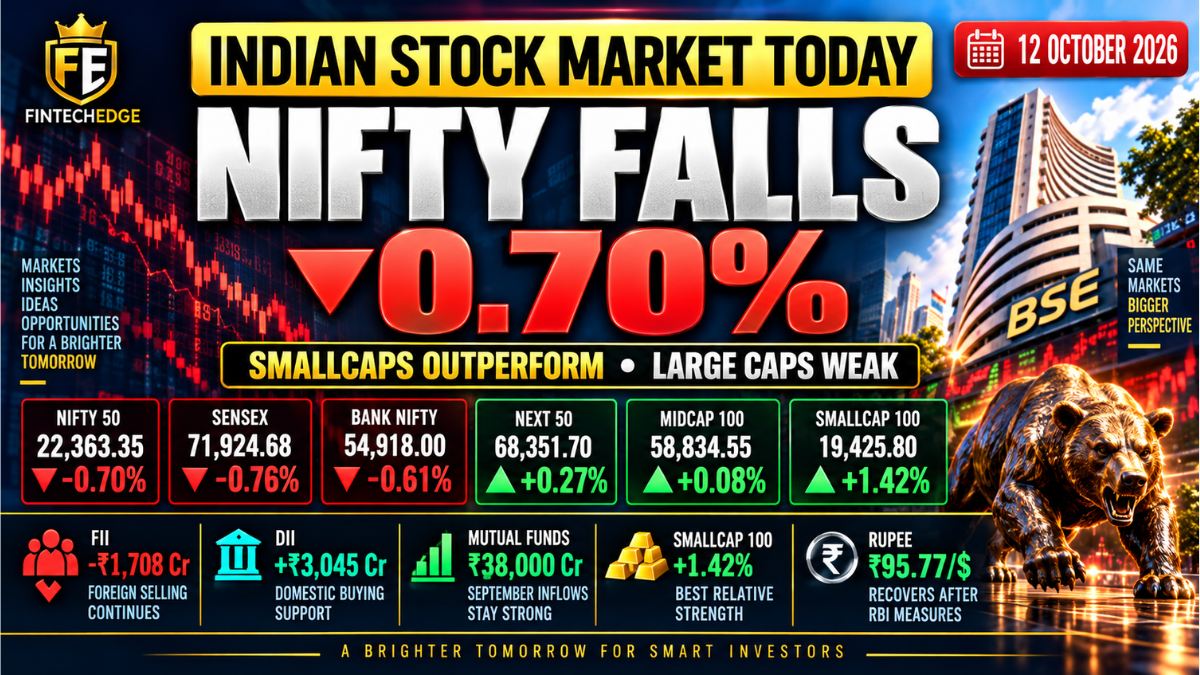
This was very different from the mixed but relatively stable session on 14 October, when the Next 50 and midcaps held up better even as the Nifty declined.
Large Caps Rally While Broader Market Falls
This was clearly a large-cap rally rather than a broad-market rally.
The Sensex gained 2.11%, Nifty rose 1.66%, and Bank Nifty advanced 0.89%.
At the same time:
- Next 50: -0.47%
- Midcap 100: -0.36%
- Smallcap 100: -1.31%
The gap between the Sensex and Smallcap 100 was more than 3 percentage points.
That is significant.
A market can appear very strong when viewed through the Sensex or Nifty while a large number of individual stocks are actually declining.
That is essentially what happened today.
For investors concentrated in large-cap index heavyweights, the session looked strong.
For investors holding midcaps, smallcaps or more diversified portfolios, the experience was very different.
That divergence makes market breadth the most important signal of the day.
India Outperforms as Global AI Trade Comes Under Pressure
Another unusual feature was India’s performance relative to the rest of Asia.
Several Asian technology-heavy markets were under pressure as investors reassessed crowded AI and data-centre trades after hotter US inflation and high borrowing costs raised concerns around valuations and financing conditions.
India moved sharply higher despite that weak regional backdrop.
One possible explanation is that India has less direct exposure to the global semiconductor and AI-infrastructure boom than markets such as South Korea or Taiwan.
That can make India appear relatively defensive when heavily AI-linked markets come under pressure.
But this should not be overstated.
There is not enough evidence to say foreign investors have decisively rotated from AI-heavy markets into India.
In fact, today’s institutional-flow data point in the opposite direction: FIIs remained heavy net sellers.
So the better conclusion is:
India outperformed while the global AI trade weakened, but there is not yet evidence of a confirmed foreign-allocation shift toward Indian equities.
Financials, Reliance and IT Drive the Benchmarks
The rally was concentrated in a handful of heavyweight sectors and companies.
Financials
Large-cap financials were among the strongest contributors.
HDFC Bank and ICICI Bank gained ahead of quarterly results, helping support the Nifty and Sensex.
Because financials carry significant weight in both benchmarks, strong moves in a few large banks can materially lift index performance even when the broader market is weak.
Reliance and Bharti Airtel
Reliance Industries and Bharti Airtel also gained strongly.
Reliance received support after developments around the Jio Platforms IPO, while Bharti Airtel added to the large-cap strength.
Together with financials and IT, these heavyweight names explain much of the gap between benchmark performance and broader-market weakness.
IT
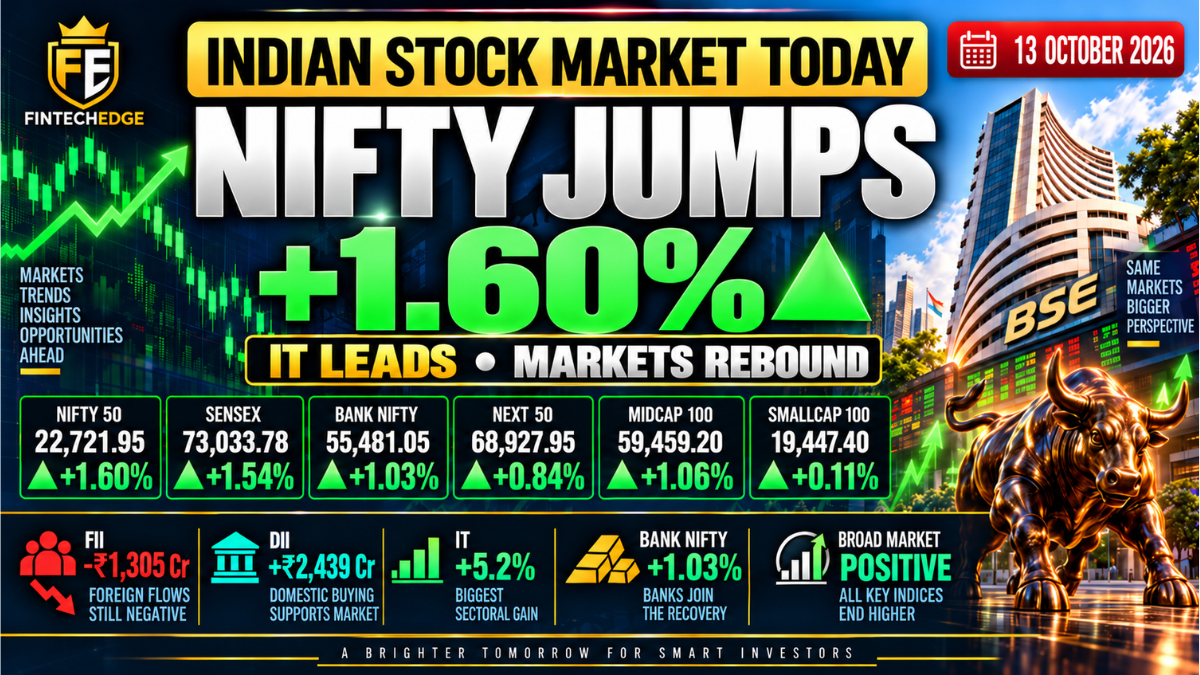
Nifty IT remained strong, extending the recovery seen after recent HCLTech and TCS earnings.
The sector had already delivered a sharp earnings-led rally on 13 October, and strength continued today.
The key distinction, however, is that traditional Indian IT services performed well even while several AI-infrastructure-linked stocks came under pressure.
Traditional IT Rises While AI-Linked Stocks Fall
Today’s technology picture was not uniform.
Traditional Indian IT services continued to perform well, but several stocks linked more directly to AI infrastructure and data-centre investment weakened sharply.
That reflects a broader global reassessment of the AI trade.
After a prolonged period of strong gains, investors are increasingly questioning:
- high valuations;
- capital intensity;
- financing costs;
- and the profitability of AI-related infrastructure spending.
This does not mean the global AI cycle has peaked.
But it does show that investors are becoming more selective.
For Indian markets, that creates an interesting contrast:
software-services companies gained on earnings and company-specific strength, while some AI-infrastructure-linked names sold off with the global trade.
That is a much more precise description than saying “technology stocks rallied.”
FIIs Sell ₹5,285 Crore Despite the Rally
One of the most important contradictions of the day came from institutional flows.
Your 15 October stock-segment data showed:
- FII: -₹5,285 crore
- DII: +₹3,319 crore
So despite the strong Nifty and Sensex rally, FIIs were still substantial net sellers.
This matters because it challenges the idea that foreign money has already returned to India.
The benchmark rally was strong, but foreign investors did not participate on a net basis.
Domestic institutions continued to absorb part of the selling, but DII buying was still smaller than the FII outflow.
That makes the institutional-flow picture weaker than the headline indices suggest.
This is similar to several recent sessions in which domestic buying has supported the market while foreign selling remained persistent.
Smallcaps and Midcaps Lag Sharply
The broad-market weakness deserves as much attention as the large-cap rally.
The Smallcap 100 fell 1.31%, while the Midcap 100 declined 0.36%.
That means the strongest part of the market was concentrated in large, index-heavy stocks.
Smallcaps had shown relative resilience on some recent days, but today that pattern reversed sharply.
This is especially important because narrow rallies can behave differently from broad rallies.
When only a small group of large stocks pushes the indices higher, the headline performance may overstate the underlying strength of the market.
That does not make the Nifty rally meaningless.
But it does mean investors should distinguish between:
- index strength
and - market-wide participation
Today had the first, but much less of the second.
Rupee Strengthens as Oil Eases
The rupee extended its recent recovery and closed around ₹95.06 per dollar.
That reduced some immediate pressure on the macro backdrop.
A firmer rupee can help by reducing:
- imported inflation pressure;
- the domestic cost of crude imports;
- concerns around external financing;
- and some foreign-investor currency risk.
Oil also eased, with Brent around $104.91 per barrel.
That provided some relief compared with the previous session, when crude near $106 was an important concern.
Still, both variables remain volatile.
The rupee has improved after recent RBI measures, but foreign outflows remain large.
And although crude eased today, geopolitical supply risks have not disappeared.
Yes Bank Falls After Supreme Court AT1 Ruling
Yes Bank was one of the most notable stock-specific losers.
The stock fell sharply after the Supreme Court ruled that the bank’s 2020 AT1 bond write-off was illegal.
The write-off involved roughly ₹8,400 crore.
This was a company-specific legal development and should not be interpreted as a wider problem for the banking sector.
In fact, large private banks were among the strongest contributors to today’s benchmark rally.
That contrast reinforces how polarised the session was.
Nestlé India Falls Despite Strong Profit Growth
Nestlé India was another major loser.
The company reported strong headline growth, including a sharp increase in quarterly profit and revenue.
Yet the stock still fell sharply.
Why?
Because markets react not only to whether results are good, but to whether they are better or worse than expectations.
Investors also focused on food inflation and rising input costs, which could put pressure on future margins.
This is a useful reminder:
a company can report strong earnings and still see its share price fall if expectations were even higher.
What to Watch Next
Market breadth
This is the most important short-term signal after today’s session.
If large caps continue rising while midcaps and smallcaps fall, the rally remains narrow.
FII flows
Foreign investors sold ₹5,285 crore today despite the benchmark rally. Whether that selling slows will be important.
Large-bank earnings
HDFC Bank and ICICI Bank have already moved ahead of results. Their earnings could influence Bank Nifty and the broader benchmarks.
Global AI trade
Further weakness in AI and semiconductor stocks could continue affecting Asian markets and Indian AI-infrastructure-linked names.
Rupee
The currency has strengthened for several sessions. Continued stability would reduce one macro pressure.
Brent crude
Oil eased today but remains above $100. Any renewed spike could quickly revive inflation and currency concerns.
FintechEdge View
The Indian stock market today delivered one of the strongest benchmark sessions in recent months, but the headline numbers tell only part of the story.
The Sensex jumped 2.11% and Nifty gained 1.66%, driven by financials, Reliance, Bharti Airtel and IT.
But the Smallcap 100 fell 1.31%, midcaps declined, and the Next 50 also finished lower.
At the same time, FIIs sold ₹5,285 crore.
That combination makes today’s session unusual.
The most reliable reading is not simply that “the market rallied.”
It is that large caps rallied strongly while the broader market weakened.
If broader participation improves in the next few sessions, today’s move would look healthier.
If the gap persists, then investors should continue treating the headline index strength separately from what is happening across the wider market.
Sources & References
- Indian shares post best day in four months as large caps outperform Reuters
- Global markets weaken as AI-linked technology trade comes under pressure Reuters
- Supreme Court rules Yes Bank AT1 bond write-off illegal Reuters
- Nestlé India profit rises but shares fall as expectations and inflation concerns weigh Reuters
- Rupee extends recovery as oil eases and dollar weakens Reuters
This article is for educational and informational purposes only and does not constitute investment advice, trading advice or a recommendation to buy or sell any security.
Our content is written for educational purposes and focuses on clarity, evidence, risk awareness and practical decision-making.