Indian Stock Market Today: Nifty Falls 1.64% as Oil, Yields and FII Selling Hit Markets

Quick Summary
- Nifty 50 fell 1.64% to 22,231.80, while Sensex dropped 1.44% to 71,593.24.
- Broader markets were hit harder: Next 50 fell 2.58%, Midcap 100 lost 2.52%, and Smallcap 100 declined 2.34%.
- Bank Nifty fell 0.98%, showing relative resilience compared with the broader market.
- Brent crude moved above $103 per barrel, adding pressure to India’s inflation and currency backdrop.
- US Treasury yields rose again, while the rupee remained under pressure near record lows.
- FIIs sold ₹12,944 crore, while DIIs bought ₹10,703 crore in the stock segment.
- The market continued to digest the RBI’s tighter policy stance as external macro pressures intensified.
Indian Market Performance — 8 October 2026
Daily change in key Indian equity indices
Indian Stock Market Today: Closing Summary
Indian equities fell sharply on 8 October 2026, extending the decline after the RBI’s rate hike and tighter policy shift.
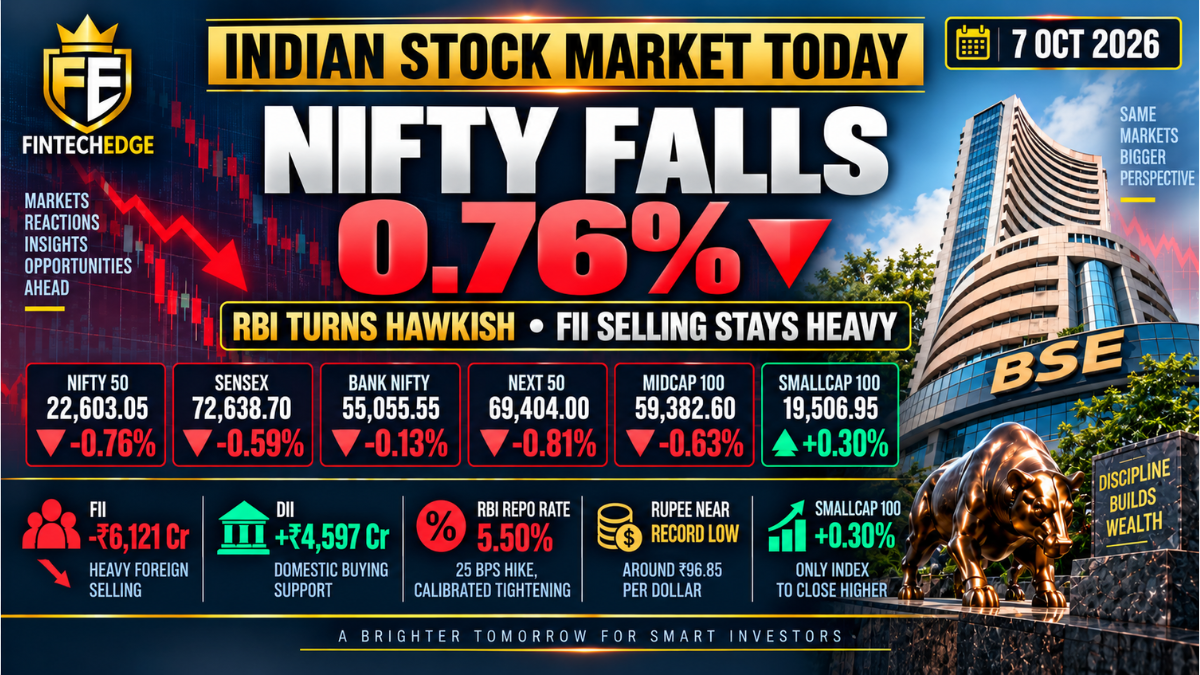
The decline followed the RBI-driven weakness seen on 7 October, when the central bank raised the repo rate to 5.50% and shifted to calibrated tightening.
The Nifty 50 fell 1.64% to 22,231.80, while the Sensex dropped 1.44% to 71,593.24. The weakness was even more severe beneath the headline indices: the Nifty Next 50 fell 2.58%, the Midcap 100 lost 2.52%, and the Smallcap 100 declined 2.34%.
Reuters reported that the Sensex closed at its lowest level in 32 months as surging oil prices, rising global bond yields, a weak rupee and heavy foreign selling intensified pressure on Indian equities.
Indian Market Performance
| Index | Close | Change |
|---|---|---|
| Nifty 50 | 22,231.80 | -1.64% |
| Sensex | 71,593.24 | -1.44% |
| Bank Nifty | 54,515.05 | -0.98% |
| Nifty Next 50 | 67,614.50 | -2.58% |
| Nifty Midcap 100 | 57,882.50 | -2.52% |
| Nifty Smallcap 100 | 19,050.10 | -2.34% |
The broader-market weakness was the most important part of the session.
Bank Nifty fell less than 1%, but the Next 50, midcaps and smallcaps all declined more than 2%. This shows that selling pressure extended well beyond the largest index heavyweights.
Broader Markets Fall More Than the Nifty
The sell-off was much deeper beneath the headline indices. The breadth deterioration was a sharp reversal from the broad rally seen on 6 October, when smallcaps, midcaps and the Next 50 had all outperformed the Nifty.
The Nifty Next 50 fell 2.58%, the Midcap 100 declined 2.52%, and the Smallcap 100 lost 2.34%, compared with the Nifty 50’s 1.64% fall.
Reuters also reported that all 16 major sectoral indices ended lower, while midcaps and smallcaps fell more than 2%.
This matters because a large-cap index can sometimes fall because of weakness in a few heavyweight stocks. Today’s session was different.
Selling spread across a much wider part of the market, indicating a broader reduction in risk appetite.
Bank Nifty’s smaller 0.98% decline was one of the few relative bright spots, but it was not enough to offset weakness elsewhere.
Oil Surge Adds to India’s Macro Pressure
Higher crude oil was one of the clearest external pressures.
Brent crude surged above $103 per barrel during the session as geopolitical and supply concerns intensified. Reuters reported Brent rising as high as roughly $103.73 before paring some gains.
For India, elevated oil matters because the country imports a large share of its energy requirements.
Higher crude can increase pressure on:
- the import bill;
- inflation expectations;
- the current account;
- the rupee;
- and domestic interest-rate expectations.
This is particularly important now because the RBI has already moved toward a tighter policy stance. The renewed oil and yield pressure echoes the macro-driven weakness seen on 1 October, when elevated global yields and foreign selling also weighed on Indian equities.
A renewed rise in oil therefore adds another layer of difficulty to the domestic macro environment.
That does not mean higher crude automatically guarantees further RBI tightening, but it does increase the inflation and currency risks that policymakers must monitor.
Global Bond Yields Rise Again
Global bond yields also moved higher.
Reuters reported US Treasuries weakening for a second consecutive session as rising oil prices revived inflation concerns.
The rise matters for Indian equities because high developed-market yields can:
- make dollar-denominated fixed-income assets more attractive;
- put pressure on emerging-market currencies;
- reduce foreign appetite for equities;
- and increase valuation pressure on risk assets.
Wall Street also weakened as oil and Treasury yields climbed, showing that the pressure was not limited to India.
For Indian markets, higher global yields therefore added another headwind to an already difficult domestic setup.
FIIs Sell ₹12,944 Crore, DIIs Buy ₹10,703 Crore
Institutional flows were another major signal.
Your 8 October stock-segment data showed:
- FII: -₹12,944 crore
- DII: +₹10,703 crore
Domestic institutions again provided substantial buying support, but even that was not enough to fully offset the scale of foreign selling.
This matters because persistent FII outflows have become one of the more consistent pressures on Indian equities.
Reuters reported that foreign investors have continued reducing exposure to India, with cumulative outflows reaching record levels for the year.
The pattern remains familiar:
FIIs are selling aggressively, while DIIs are absorbing a significant portion of that supply.
Domestic support can soften the decline, but when foreign selling reaches this scale, broader market pressure can still remain significant.
RBI Tightening Remains Part of the Backdrop
The market is also still adjusting to the RBI’s 25-basis-point rate hike to 5.50% and its shift to calibrated tightening.
Reuters reported that the rate hike alone is unlikely to be enough to reverse the scale of foreign capital outflows facing India.
That is important because today’s decline should not be explained by the RBI in isolation.
The market was dealing with several pressures at once:
- tighter domestic monetary policy;
- higher oil prices;
- rising global bond yields;
- currency weakness;
- and heavy foreign selling.
The RBI’s stance forms part of that environment, but the external backdrop was equally important today.
Rupee Remains Under Pressure
The rupee also remained close to record lows.
Reuters reported that the currency weakened to around ₹96.78 per dollar, with higher oil adding to the pressure created by capital outflows and the post-RBI policy repositioning.
This matters because a weaker rupee can make imported goods more expensive, including crude oil.
That creates a difficult feedback loop:
higher oil pressures the rupee, and a weaker rupee makes imported oil more expensive in domestic currency terms.
This can add to imported inflation and complicate the RBI’s job further.
The currency therefore remains one of the most important macro variables to watch alongside oil and bond yields.
Metals and Realty Lead Sectoral Weakness
Sectoral weakness was widespread.
Metals, real estate and other cyclical and rate-sensitive sectors were among the weakest parts of the market.
The transcript highlighted especially sharp losses in metals and real estate, while Reuters confirmed broad weakness across Indian sectors.
This fits the macro backdrop.
Higher rates tend to increase financing costs for rate-sensitive sectors, while rising global yields and a stronger dollar can also weigh on commodity-related shares.
The key point, however, is broader than any one sector:
today’s weakness was widespread rather than isolated.
What to Watch Next
Brent crude
Oil above $100 remains a major macro risk for India. Further gains would keep inflation, currency and external-balance concerns in focus.
US Treasury yields
Higher global yields are increasing pressure on emerging-market assets. Any further rise would remain negative for risk sentiment.
FII flows
Today’s FII selling was unusually heavy. Whether foreign outflows continue at this pace will be one of the most important near-term signals.
Rupee
The currency remains near record lows. Continued weakness would increase imported inflation concerns.
Broader-market breadth
The Next 50, midcaps and smallcaps all fell more than the Nifty today. Whether that gap narrows or persists will say a lot about underlying risk appetite.
RBI policy backdrop
Markets will continue assessing how long calibrated tightening may last and how it interacts with inflation, oil and capital flows.
FintechEdge View
The Indian stock market today was notable less for the Nifty’s 1.64% decline than for the scale of weakness underneath it.
The Next 50, Midcap 100 and Smallcap 100 all fell more than 2%, showing that selling pressure extended well beyond the largest index constituents.
At the same time, the macro backdrop became more difficult. Brent crude moved above $103, global bond yields rose again, the rupee remained under pressure and FIIs sold nearly ₹13,000 crore of equities.
Domestic institutions again absorbed a large portion of that selling, but the size of the foreign outflow was too large to fully offset.
The most useful conclusion is therefore not that the market is “oversold” or due for a bounce.
The clearer signal is that broad-market weakness, high oil, elevated yields and persistent foreign selling are reinforcing one another, while the RBI’s tighter stance has reduced the margin for policy support.
What happens next will depend less on technical levels and more on whether those macro and flow pressures begin to ease.
Sources & References
- Sensex falls to 32-month low as oil surge and foreign selling hit Indian equities Reuters
- Oil jumps as Middle East supply risks intensify Reuters
- US Treasury yields rise for second session as oil revives inflation concerns Reuters
- Rupee remains under pressure after RBI hike as higher oil adds to risks Reuters
- India rate hike unlikely to reverse record foreign capital outflows Reuters
This article is for educational and informational purposes only and does not constitute investment advice, trading advice or a recommendation to buy or sell any security.
Our content is written for educational purposes and focuses on clarity, evidence, risk awareness and practical decision-making.