Market Order vs Limit Order: Why Your Trade May Execute at a Different Price
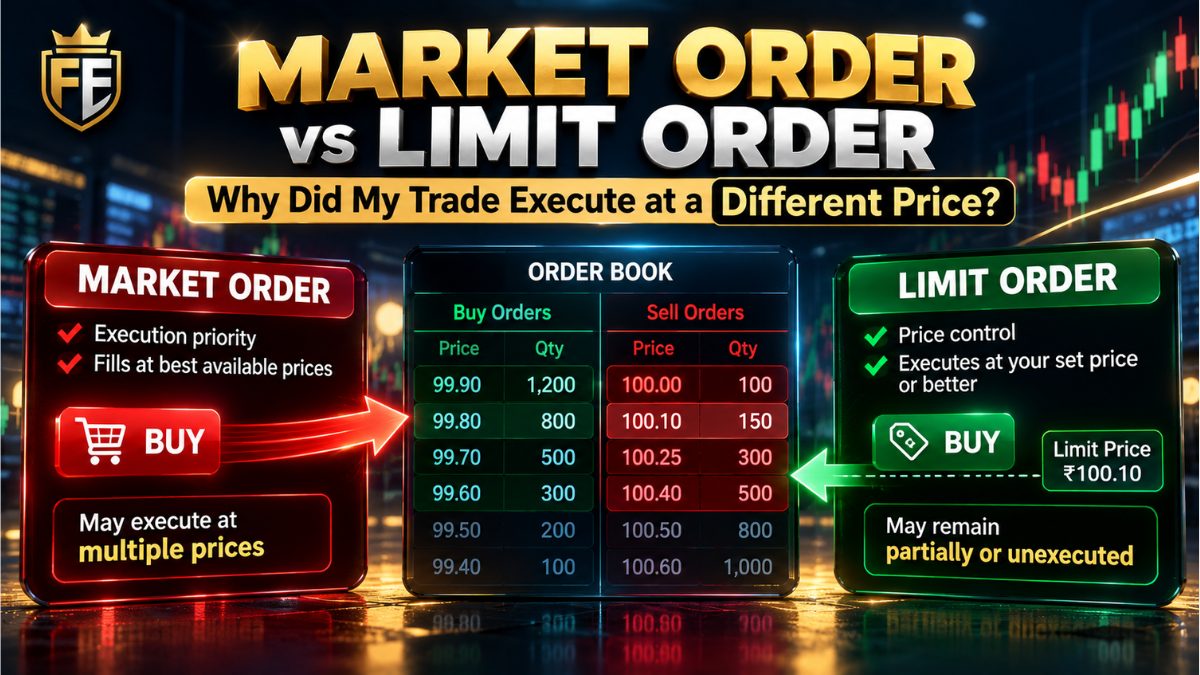
Market Order vs Limit Order is one of the most important execution concepts for traders because the price you see on screen is not always the price at which your full order will execute.
Suppose a stock is showing ₹100.
You place a market buy order.
But your order confirmation shows an average execution price of ₹100.18.
Nothing necessarily went wrong.
The ₹100 you saw may have been the Last Traded Price (LTP), while your new buy order matched against the best available sell orders in the order book — some of which may have been priced above ₹100.
The core difference is simple:
Market order = execution priority, not a specific price guarantee.
Limit order = price control, not an execution guarantee.
Understanding this distinction explains many of the execution problems traders encounter after pressing Buy or Sell.
Quick Summary
- Market orders try to execute against the best available prices in the order book, not necessarily at the Last Traded Price.
- A market order can fill at multiple prices if there is not enough quantity available at the best price.
- Limit orders give price control by setting the maximum buy price or minimum sell price you are willing to accept.
- A limit order may remain partially filled or completely unexecuted if sufficient quantity is not available within the limit.
- Liquidity, bid-ask spread, market depth and order size can all affect the actual execution price.
What Is a Market Order?
A market order tells the exchange:
Buy or sell at the best price obtainable when the order reaches the market.
NSE describes a market order as an order to buy or sell securities at the best price obtainable at the time the order is entered.
That does not mean:
“Execute my entire order at the Last Traded Price.”
For a buy order:
Market Buy → available sell orders → starting with the best ask
For a sell order:
Market Sell → available buy orders → starting with the best bid
Therefore:
A market order prioritises execution against available liquidity, not a particular execution price.
It should also not be interpreted as a guarantee that every order will always execute completely. Liquidity, exchange controls, and market conditions can affect execution.
What Is a Limit Order?
A limit order allows you to specify the price boundary at which you are willing to trade.
Limit Buy
Suppose you place:
Buy 100 shares at a limit price of ₹100
You are effectively saying:
“Buy at ₹100 or lower. Do not buy above ₹100.”
Limit Sell
Suppose you place:
Sell 100 shares at a limit price of ₹105
You are saying:
“Sell at ₹105 or higher. Do not sell below ₹105.”
The trade-off is straightforward:
A limit order controls price but does not guarantee execution.
If the market never reaches an executable price — or there is not enough quantity available — the order may remain partially filled or completely unexecuted.
Market Order vs Limit Order: Key Differences
| Factor | Market Order | Limit Order |
|---|---|---|
| Main priority | Execution | Price |
| Price certainty | Lower | Higher |
| Execution likelihood | Generally higher, subject to liquidity and market conditions | Lower |
| Can fill at multiple prices? | Yes | Yes, within the limit |
| Can remain pending? | Less likely in liquid conditions | Yes |
| Slippage exposure | Higher | Price constrained |
| Main purpose | Prioritise execution | Prioritise price control |
Neither order type is universally better.
They solve different problems.
How Does the Exchange Match Orders?
This article focuses primarily on normal continuous-market trading.
That distinction matters because sessions such as the pre-open use different matching procedures and can determine trades at an equilibrium price rather than through normal continuous matching.
In NSE’s normal market, orders are stored and matched using price-time priority. NSE also assigns orders a distinctive order number and timestamp.
Price Priority
The better price gets priority.
For buyers:
Higher bid = better buy price
For sellers:
Lower ask = better sell price
Time Priority
If multiple orders are waiting at the same price, the order entered earlier gets priority.
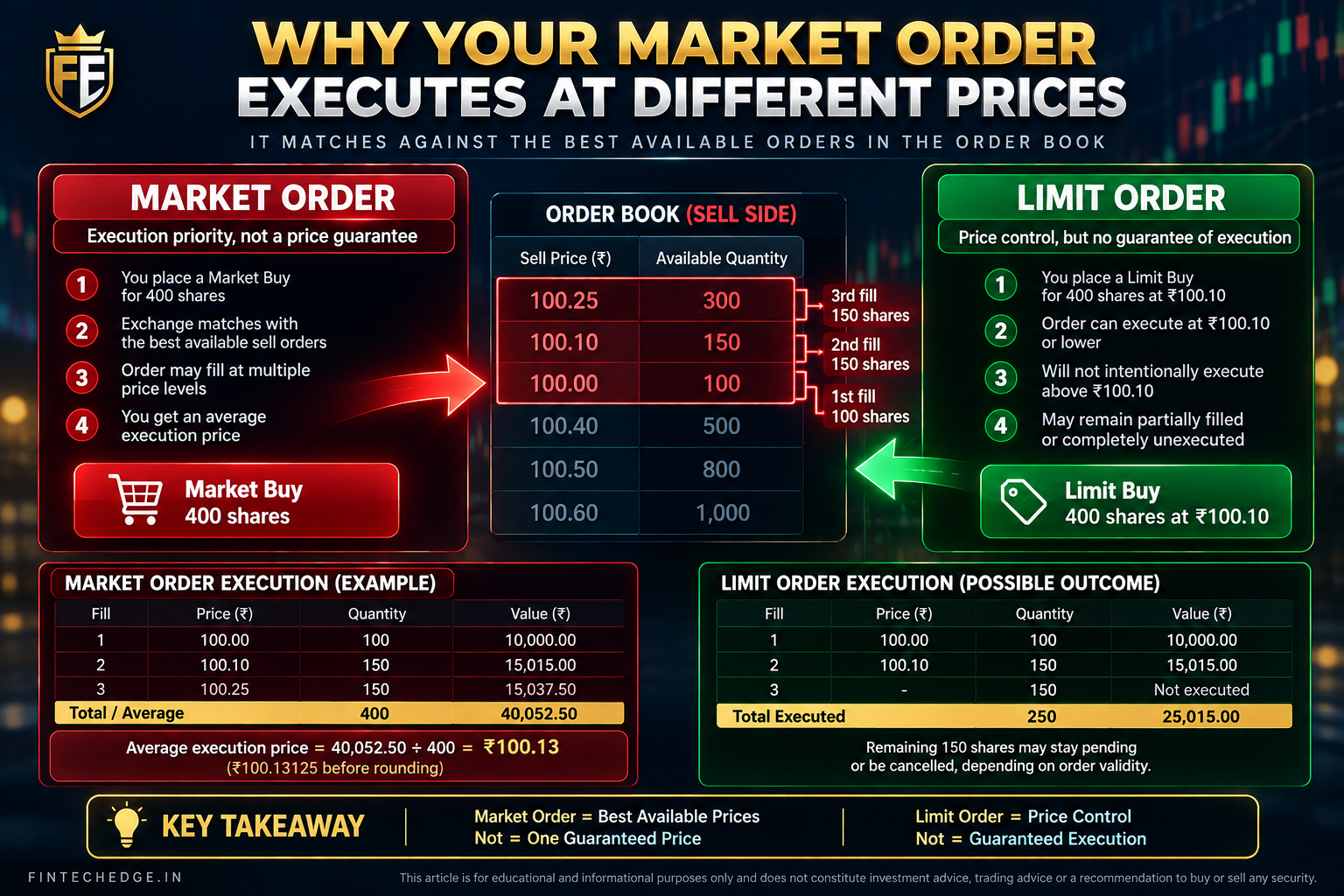
Suppose the sell side contains:
- ₹100.00 — 100 shares
- ₹100.10 — 150 shares
- ₹100.25 — 300 shares
An incoming buy order interacts with the lowest-priced eligible sell orders first.
Why Can a Market Order Execute at Multiple Prices?
Consider this sell-side order book:
| Sell Price | Available Quantity |
|---|---|
| ₹100.00 | 100 |
| ₹100.10 | 150 |
| ₹100.25 | 300 |
Now an investor places:
Market Buy — 400 shares
There are only 100 shares available at the best ask of ₹100.00.
So a possible execution is:
- 100 shares @ ₹100.00
- 150 shares @ ₹100.10
- 150 shares @ ₹100.25
The average execution price becomes:
(100 × ₹100.00 + 150 × ₹100.10 + 150 × ₹100.25) ÷ 400
= ₹40,052.50 ÷ 400
= ₹100.13 approximately
The calculation in the draft is correct at ₹100.13125 before rounding. Pasted text
Why didn’t all 400 shares execute at ₹100?
Because only 100 shares were available there.
The rest of the order had to interact with the next available sell prices.
This is often described as the order walking up the book.
The larger your order relative to available liquidity, the more price levels it may consume.
NSE explicitly notes that an order can match partially and result in multiple trades.
Why Is My Execution Price Different From the Last Traded Price?
Three prices are often confused.
Last Traded Price — LTP
The price at which the most recent transaction occurred.
It tells you what just happened.
It is not necessarily an offer available for your next order.
Best Bid
The highest price at which someone is currently willing to buy.
Best Ask
The lowest price at which someone is currently willing to sell.
Suppose:
LTP: ₹100.00
Best Bid: ₹99.95
Best Ask: ₹100.10
If you enter a market buy, it generally begins interacting with the sell side around ₹100.10 — not automatically at the ₹100 LTP.
Likewise, a market sell interacts with available buy orders beginning from the best bid.
So:
LTP is the last transaction. Bid and ask represent currently available orders.
That distinction explains many unexpected execution prices.
What Is the Bid-Ask Spread?
The bid is the best currently available buy price.
The ask is the best currently available sell price.
The difference is called the bid-ask spread.
For example:
Best Bid: ₹99.90
Best Ask: ₹100.10
Spread:
₹100.10 − ₹99.90 = ₹0.20
A wider spread can increase execution friction, particularly when using market orders.
The spread is not the same as brokerage.
It arises from the gap between available buyers and sellers in the market.
What Is Slippage?
Slippage is the difference between the price a trader expected or observed and the price at which the trade actually executes.
Slippage can happen because:
- available quantity changes
- prices move quickly
- the order book is thin
- bid-ask spreads are wide
- the order is large relative to available liquidity
- other orders execute before yours
- volatility increases
Slippage can occasionally work in your favour as well.
Most importantly:
Slippage by itself is not evidence that a broker manipulated your execution.
It is often a result of changing market prices and available liquidity.
Market Depth: Why Quantity Matters
The best bid or best ask tells you the nearest available price.
But it does not tell you how much quantity is available at that price.
Consider this order book.
Sell Side
| Price | Quantity |
|---|---|
| ₹100.10 | 100 |
| ₹100.50 | 500 |
| ₹101.00 | 1,000 |
Buy Side
| Price | Quantity |
|---|---|
| ₹100.00 | 300 |
| ₹99.90 | 600 |
| ₹99.50 | 1,200 |
The best ask is ₹100.10.
But only 100 shares are available there.
A market buy for 800 shares cannot necessarily execute entirely at ₹100.10.
It may consume quantity at higher ask levels.
That is why traders should not look only at the top price.
Price tells you where liquidity begins. Market depth tells you how much liquidity exists.
What Is a Partial Fill?
An order does not have to execute all at once.
Suppose you place:
Limit Buy — 500 shares @ ₹100
But only 200 shares are currently available at ₹100 or below.
A possible outcome is:
200 shares executed
and:
300 shares still pending
The remaining quantity may continue waiting according to the order’s validity and market conditions.
This is called a partial fill.
One order can therefore result in multiple individual trades.
Why Didn’t My Limit Order Execute Even Though the Price Touched My Level?
This is one of the most common trader questions.
Suppose you placed a limit buy at ₹100.
Later, you see the market traded at ₹100.
But your order remains unfilled.
That is possible.
1. Other Orders Were Ahead of You
NSE uses time priority among orders at the same price.
If other ₹100 buy orders were submitted before yours, they may have had priority.
2. Not Enough Quantity Traded
Suppose 10,000 shares are waiting to buy at ₹100 and your order is near the back of the queue.
If only 2,000 shares trade against that level, the price can print ₹100 without reaching your order.
3. The Price Only Touched Briefly
Seeing an LTP of ₹100 tells you that a transaction occurred there.
It does not mean every queued order at ₹100 was executed.
4. The Order Book Changed Quickly
In a fast market, displayed quantities can appear, execute or disappear quickly.
What was visible when you looked at the market depth may no longer be available when your order reaches the matching system.
The important takeaway is:
“The market touched my limit price” does not mean “my order was guaranteed to fill.”
Market Order vs Limit Order During Fast Markets
Execution differences become more important when prices are moving rapidly.
Examples include:
- market opening volatility
- earnings announcements
- major news
- gap openings
- sharp index moves
- illiquid stocks
- thinly traded options
In fast conditions:
Market orders may experience greater slippage.
Limit orders may protect the price boundary but remain unexecuted if the market moves away.
That is not necessarily a malfunction.
It reflects what each order type prioritises.
What Happens With a Large Market Order?
Suppose only a small quantity is available at the best price.
A comparatively large market order may consume several price levels.
That can cause:
- a worse average execution price
- increased slippage
- greater market impact
For example, if only 100 shares are offered at ₹100 but you try to buy 10,000 shares at market, the rest of the order must interact with other available sell prices if sufficient liquidity exists.
This is market impact.
It should not automatically be interpreted as manipulation.
Can a Limit Order Execute at a Better Price?
Yes.
Suppose you place:
Limit Buy @ ₹100
That means ₹100 is your maximum acceptable purchase price.
If an eligible sell order is available at ₹99.90, your buy may execute at the better price rather than necessarily at exactly ₹100.
Similarly:
A sell limit specifies the minimum acceptable selling price.
If a better price is available, execution can occur above the stated sell limit.
So:
A limit price is a boundary, not necessarily the exact execution price.
Does a Market Order Guarantee Execution?
No guarantee exists.
A market order generally prioritises immediate execution against available orders, but execution can still be affected by factors such as:
- insufficient liquidity
- exchange controls
- trading halts
- price restrictions or operating ranges
- order validation
- unusual market conditions
The correct principle is:
Market orders prioritise execution — they do not promise execution under every possible market condition.
Does a Limit Order Guarantee the Price?
A limit order gives you a price constraint, not a guaranteed trade.
A buy limit should not execute above your specified maximum price.
A sell limit should not execute below your specified minimum price.
But the order can:
- execute fully
- execute partially
- remain completely unexecuted
Stop-loss orders add another layer because they involve a trigger condition followed by execution mechanics.
For a deeper explanation, see:
Stop-Loss Triggered but Not Executed? SL vs SL-M
Market Order vs Limit Order in Options Trading
Order execution can become even more important in options.
Some option contracts can have:
- wide bid-ask spreads
- low market depth
- rapid price changes
- thin liquidity, particularly in far OTM strikes
Suppose an option shows:
Bid: ₹10.00
Ask: ₹10.50
The absolute spread is only ₹0.50.
But relative to the ₹10 bid, that represents 5%.
So a spread that appears small in rupee terms can still be significant relative to the option premium.
Before assuming that the displayed LTP is achievable, traders should understand the bid, ask, and available depth.
Common Order-Execution Mistakes
1. Assuming LTP Is the Guaranteed Execution Price
It is the price of the latest completed trade, not a guaranteed standing offer.
2. Ignoring Order-Book Quantity
The best price may have only a small quantity available.
3. Ignoring Liquidity When Using Market Orders
Thin liquidity and wide spreads can increase slippage.
4. Assuming a Limit Order Guarantees Execution
A limit order controls the acceptable price range.
It does not guarantee that someone will trade with you.
5. Assuming a Price Touch Guarantees a Fill
Queue position and actual traded quantity matter.
6. Ignoring Partial Fills
One order may execute through several trades or leave some quantity pending.
7. Ignoring the Bid-Ask Spread
The spread represents an important element of trading friction.
8. Confusing Slippage With Brokerage
Brokerage is a fee.
Slippage is the difference between the expected or observed price and the actual execution price.
FintechEdge Market Order vs Limit Order Decision Framework
Rather than asking which order type is universally better, ask what matters more in the specific transaction.
Is executing quickly more important than controlling the exact price?
Understanding market-order mechanics becomes important.
Is controlling the maximum purchase price or minimum selling price more important?
A limit order provides that price boundary.
Is the instrument illiquid?
Check:
- best bid
- best ask
- spread
- market depth
- available quantity
Is your order large relative to visible liquidity?
Understand that a market order may interact with multiple price levels.
Are you trading options?
Pay particular attention to:
- spread
- market depth
- available quantity
before assuming the LTP is achievable.
This framework is educational and is not personalised trading advice.
Practical FintechEdge Example
Suppose the trading screen shows:
- LTP: ₹100.00
- Best Bid: ₹99.95 × 200
- Best Ask: ₹100.10 × 100
- Next Ask: ₹100.20 × 200
- Next Ask: ₹100.40 × 500
Now a trader places:
Market Buy — 400 shares
A possible execution is:
- 100 shares @ ₹100.10
- 200 shares @ ₹100.20
- 100 shares @ ₹100.40
Total cost:
₹10,010 + ₹20,040 + ₹10,040
= ₹40,090
Average execution price:
₹40,090 ÷ 400
= ₹100.225
That is ₹0.225 per share above the ₹100 LTP — or ₹90 across 400 shares.
Nothing necessarily failed.
The market order consumed three price levels because the full 400-share quantity was not available at the best ask.
The calculations in the original draft are correct. Pasted text
What If the Trader Used a Limit Order Instead?
Suppose the trader instead places:
Limit Buy — 400 shares @ ₹100.20
Available eligible quantities are:
100 @ ₹100.10
200 @ ₹100.20
So 300 shares could be executed.
Their average execution price would be approximately:
₹100.17
But the remaining 100 shares would not cross up to the ₹100.40 ask because that exceeds the ₹100.20 limit.
Those shares could remain pending depending on order validity and future market conditions.
This single example captures the main trade-off:
Market order: completed the quantity but accepted worse available prices.
Limit order: protected the price boundary but left part of the order unfilled.
Frequently Asked Questions
What is a market order?
A market order is an instruction to buy or sell at the best prices obtainable from the available order book when the order reaches the market.
What is a limit order?
A limit order specifies the maximum price you are willing to pay when buying or the minimum price you are willing to accept when selling.
Why did my market order execute at a different price?
Because the order matched against currently available orders rather than automatically executing at the Last Traded Price.
If insufficient quantity was available at the best price, the remaining order could execute at additional price levels.
Can a market order execute at multiple prices?
Yes.
One market order can generate multiple fills if the required quantity is spread across several available price levels.
Why did my limit order not execute?
Possible reasons include queue position, insufficient traded quantity at your price or the market moving away before sufficient quantity reached your order.
If the market touched my limit price, why didn’t my order fill?
Orders at the same price are prioritised by time.
A trade occurring at your limit price does not mean enough quantity traded to reach every waiting order at that level.
What is slippage?
Slippage is the difference between the expected or observed price and the actual execution price.
What is the bid-ask spread?
It is the difference between the best available sell price and best available buy price.
What is market depth?
Market depth shows how much order quantity is available at different buy and sell price levels.
Can a limit order execute at a better price?
Yes.
A buy limit can execute at the limit price or lower, while a sell limit can execute at the limit price or higher.
Does a market order guarantee execution?
No guarantee exists.
A market order prioritises execution, but available liquidity and exchange conditions can still affect the result.
Which is better: market order or limit order?
Neither is universally better.
A market order prioritises execution.
A limit order prioritises price control.
The appropriate choice depends on the objective and prevailing market conditions.
Final Takeaway
The most important thing to understand about Market Order vs Limit Order is that neither the LTP nor the price visible on your screen guarantees the price at which your entire order will execute.
A market order says:
Execute against the best available prices.
A limit order says:
Do not trade beyond my specified price boundary.
The trade-off is:
Market Order → greater execution priority, less price certainty
Limit Order → greater price control, less execution certainty
And underneath both lies the same mechanism:
the order book.
The actual result depends on:
- best bid and ask
- available quantity
- market depth
- spread
- queue priority
- order size
- market conditions
Once you understand those mechanics, many seemingly strange executions become much easier to explain.
Sources & References
- NSE Trading System — normal-market order matching and price-time priority NSE India
- NSE Equity Derivatives Trading System — order matching and partial trades NSE India
- NSE Pre-Open Session — equilibrium-price matching mechanics NSE India
- NSE Pre-Open Session — matching sequence and equilibrium price
This article is for educational and informational purposes only and does not constitute investment advice, trading advice or a recommendation to buy or sell any security.
Our content is written for educational purposes and focuses on clarity, evidence, risk awareness and practical decision-making.