Expense Ratio vs Tracking Error: Which Matters More in Index Funds?
Expense ratio vs tracking error is an important comparison for index-fund investors because the two metrics measure different things. Expense ratio tells you what the fund charges, while tracking error tells you how consistently the fund follows its benchmark.
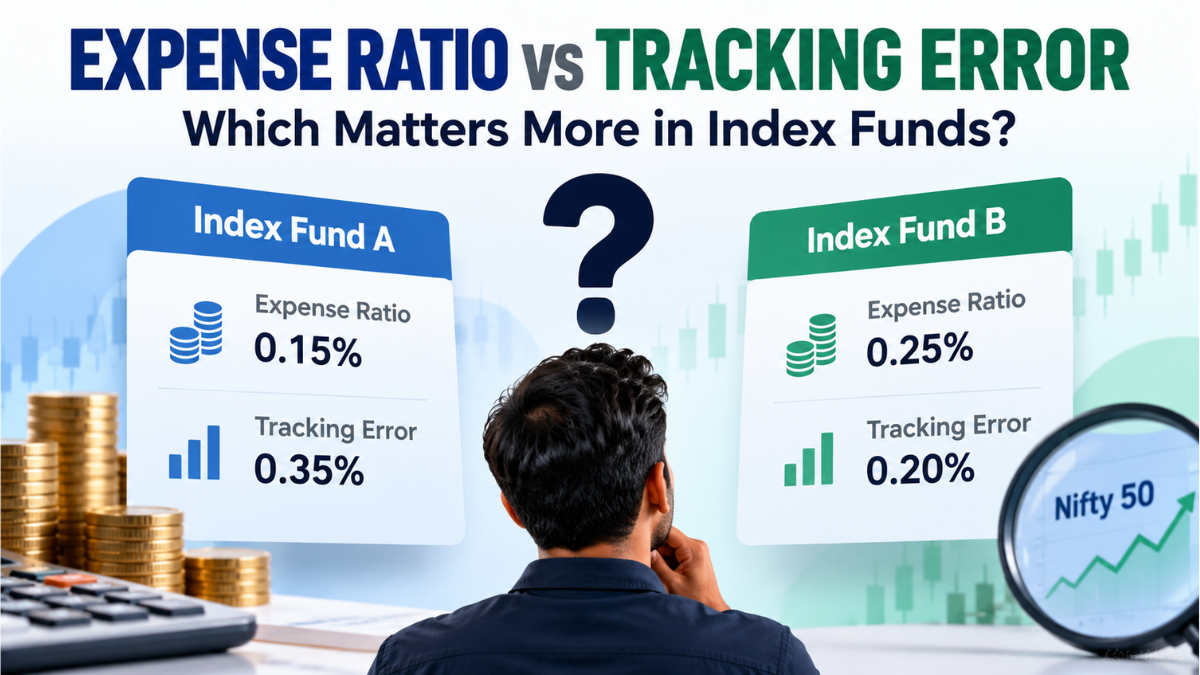
Fund A has a lower expense ratio. Fund B has a lower tracking error.
Which one should an investor focus on?
There is no simple winner because the two metrics answer different questions.
Expense ratio tells you what the fund charges. Tracking error tells you how consistently the fund has followed its benchmark.
Both matter when comparing passive funds, but they are not interchangeable. A fund can look better on one metric and weaker on another.
Understanding expense ratio vs tracking error can therefore help investors compare index funds and ETFs more intelligently instead of simply choosing the cheapest option.
Quick Summary
- Expense ratio measures the recurring cost of running a mutual fund scheme.
- Tracking error measures how consistently a passive fund has followed its benchmark.
- A lower expense ratio does not automatically guarantee lower tracking error.
- Expenses can contribute to benchmark deviation, but they are not the only cause.
- When comparing similar passive funds, investors should consider expense ratio, tracking error and tracking difference together.
What Is Expense Ratio?
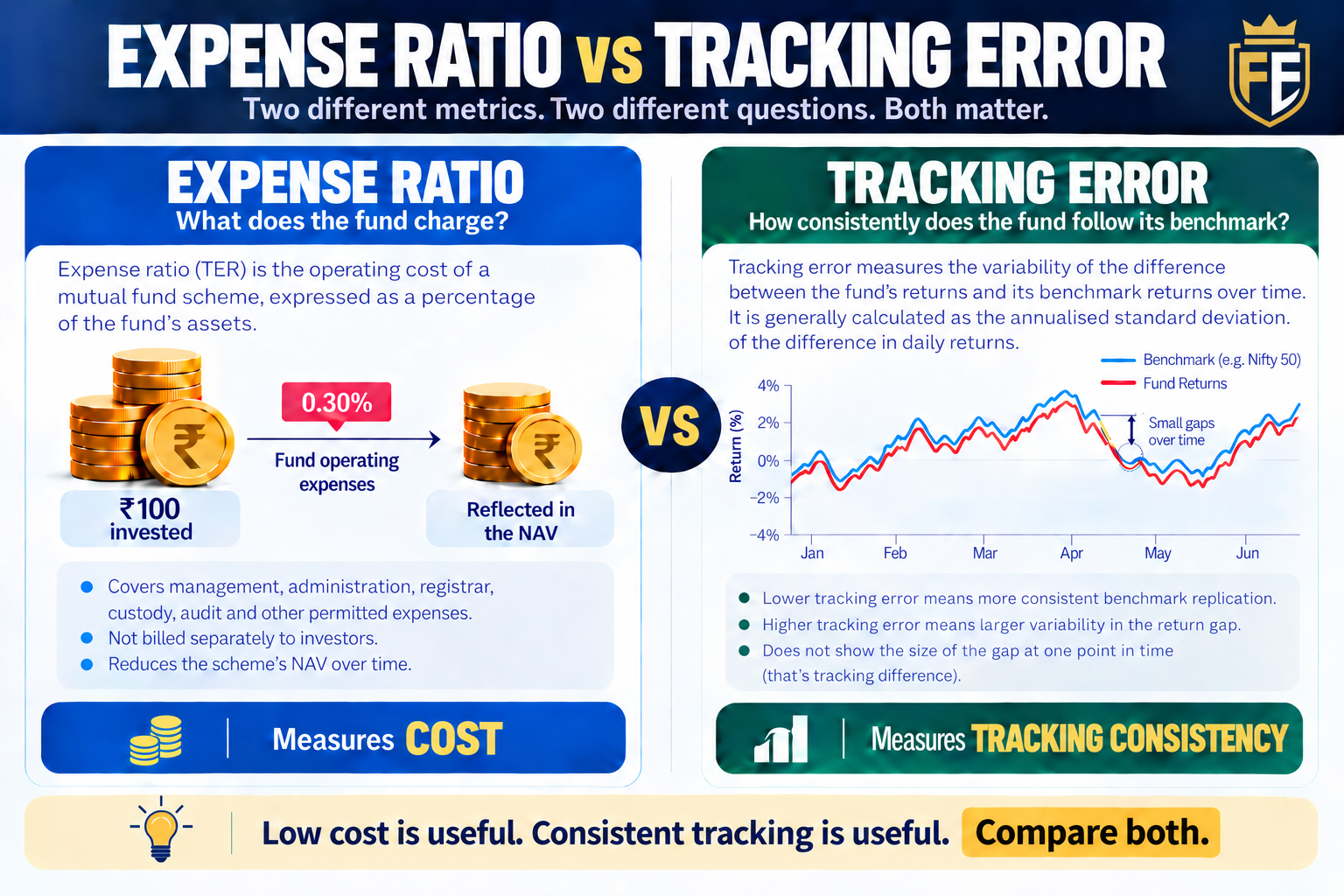
Expense ratio, commonly referred to as the Total Expense Ratio or TER, represents expenses incurred in operating and managing a mutual fund scheme relative to its assets.
These expenses can include permitted costs relating to areas such as:
- investment management
- administration
- registrar services
- custody
- audit
- other permitted scheme expenses
For example, suppose an index fund has an expense ratio of 0.30%.
That does not mean an investor receives a separate annual bill for 0.30% of the investment. Instead, scheme expenses are accounted for while calculating the fund’s NAV.
TER can also change over time, so investors should not assume the expense ratio seen today will remain unchanged indefinitely.
How Expense Ratio Affects Returns
The underlying idea is straightforward.
Suppose two funds generate exactly the same portfolio performance before expenses.
All else being equal, the fund with higher expenses would leave less return for investors.
Imagine:
Gross portfolio/benchmark-like return: 10.00%
Fund expenses: 0.30%
It may be tempting to conclude that the fund must therefore deliver exactly 9.70%.
Real passive-fund performance is not quite that simple.
Expense is one source of return drag, but there can be several other reasons why an index fund’s return differs from its benchmark.
So the important principle is:
Expense ratio contributes to the return gap, but it does not fully explain tracking performance.
What Is Tracking Error?
Tracking error measures the variability of the difference between a portfolio’s returns and the returns of its benchmark.
You do not need to calculate standard deviation yourself to understand the concept.
For a passive fund:
Lower tracking error generally means the fund’s relative performance has remained more consistent around its benchmark.
Higher tracking error means the return gap has fluctuated more.
There is one important distinction:
Tracking error is not simply benchmark return minus fund return over one period.
That is closer to tracking difference.
Tracking error focuses on the variability of those differences over time.
Simple Tracking Error Example
Consider this simplified hypothetical example:
| Period | Benchmark Return | Fund Return | Difference |
|---|---|---|---|
| 1 | 1.00% | 0.96% | -0.04% |
| 2 | -0.50% | -0.53% | -0.03% |
| 3 | 0.80% | 0.74% | -0.06% |
The differences are:
-0.04%, -0.03% and -0.06%
Tracking error looks at how much such differences vary over time.
If the gap remains relatively stable, tracking error tends to be lower.
If the gap changes substantially from period to period, tracking error tends to be higher.
This table is purely illustrative and is not intended to calculate an actual annualised tracking-error figure.
Expense Ratio vs Tracking Error: Key Differences
| Factor | Expense Ratio | Tracking Error |
|---|---|---|
| What it measures | Cost of operating the fund | Variability of benchmark-relative returns |
| Expressed as | Percentage relating to scheme assets | Annualised variability of return differences |
| Main question | What does the fund charge? | How consistently has it tracked its benchmark? |
| Lower generally desirable? | Usually, all else equal | Usually for passive replication |
| Explains all benchmark deviation? | No | Measures consistency, not the entire return gap |
| Relevant to | Mutual funds generally | Especially important for passive funds |
The easiest distinction to remember is:
Expense ratio is primarily a cost metric. Tracking error is a benchmark-replication consistency metric.
How Are Expense Ratio and Tracking Error Related?
Expenses can contribute to differences between an index fund and its benchmark.
But expenses are not the only reason.
SEBI materials identify several circumstances that can lead to tracking deviations, including fees and expenses, cash balances, corporate actions, changes to the underlying index and difficulties in replicating the benchmark precisely.
Other practical factors can include:
- transaction costs
- timing of portfolio rebalancing
- purchase or sale timing
- liquidity constraints
- settlement timing
- changes in index constituents
- temporary cash holdings
- valuation or execution differences
Therefore:
A low expense ratio does not automatically guarantee low tracking error.
Can a Lower Expense Ratio Still Have Higher Tracking Error?
Yes.
Consider two hypothetical index funds tracking the same benchmark:
Fund A
Expense ratio: 0.15%
Tracking error: 0.35%
Fund B
Expense ratio: 0.25%
Tracking error: 0.20%
Fund A is cheaper.
Fund B has demonstrated more consistent benchmark-relative performance in this hypothetical example.
That does not automatically make either fund the superior choice.
The example simply shows why expense ratio vs tracking error should not be treated as the same comparison.
One measures cost.
The other measures consistency of benchmark replication.
What Is Tracking Difference?
Tracking difference measures the return gap between a fund and its benchmark over a specified period.
For example, if a benchmark returns 12% and a fund returns 11.7% over the relevant period, there is a return gap between the two.
Tracking error answers a different question: how much did that relative-return gap fluctuate over time?
A useful way to remember the distinction is:
Tracking difference tells you what you got. Tracking error tells you how consistently you got it.
We explain this in detail in our guide to Tracking Error vs Tracking Difference.
Expense Ratio vs Tracking Difference
Expense ratio and tracking difference are also not identical.
Suppose an index fund has a TER of 0.20%.
You should not automatically assume that its tracking difference will be exactly -0.20%.
Why?
Because fund performance can also be influenced by factors such as:
- transaction costs
- cash drag
- portfolio-rebalancing timing
- corporate actions
- sampling or replication methods
- operational differences
- securities-lending income where applicable
Therefore, expense ratio may contribute to tracking difference, but there is no simple equation saying:
Tracking Difference = Expense Ratio
Why the Lowest Expense Ratio Is Not Automatically the Best Index Fund
One common approach is:
Sort index funds by expense ratio → choose the cheapest fund.
That is incomplete.
Low cost is useful, but passive investing also depends on how effectively the scheme replicates its benchmark.
A cheaper fund could still have:
- less consistent benchmark tracking
- a larger realised tracking difference
- operational differences affecting replication
- ETF liquidity considerations, if the product is exchange traded
Therefore, expense ratio should be considered as one part of passive-fund evaluation, not the entire decision.
Index Fund vs ETF: Does Tracking Error Matter to Both?
Yes.
Both index mutual funds and ETFs generally seek to replicate an underlying benchmark, so tracking quality matters to both.
ETFs, however, introduce another layer because their units trade on an exchange.
An ETF investor may also need to consider:
- trading liquidity
- bid-ask spread
- market price relative to NAV
These trading characteristics can affect the investor’s actual transaction experience even when the ETF’s underlying portfolio tracks the benchmark well.
Expense Ratio vs Tracking Error: Which Matters More?
Neither metric should be treated as the universal winner.
They answer different questions.
When comparing passive funds tracking the same benchmark:
Expense ratio tells you about cost.
Tracking error tells you about consistency of benchmark-relative performance.
Tracking difference tells you about the realised return gap.
A more complete comparison therefore considers all three.
Low cost matters. Consistent tracking matters. The actual return gap matters too.
How to Compare Two Index Funds Tracking the Same Benchmark
A practical comparison can follow this sequence.
1. Confirm the Benchmark
First make sure both funds track the same index.
A Nifty 50 index fund and a Nifty Next 50 index fund are not like-for-like alternatives merely because both are passive funds.
2. Check Expense Ratio
Compare the cost of similar schemes.
All else equal, lower cost is generally preferable.
3. Check Tracking Error
Look at how consistently each fund has followed the benchmark.
Do not confuse this with the absolute size of the return gap.
4. Check Tracking Difference
Evaluate how much the fund’s actual performance has differed from the benchmark over relevant periods.
5. Check the Product Structure
Determine whether you are comparing:
- index mutual funds
- ETFs
- or products with different structures
6. For ETFs, Check Liquidity and Bid-Ask Spread
The expense ratio is not the only potential cost of using an ETF.
Trading conditions matter as well.
7. Look Across More Than One Period
Avoid judging a passive fund solely from one short period.
Tracking behaviour can change with market conditions, portfolio rebalancing and other operational factors.
Example: Comparing Two Hypothetical Nifty 50 Index Funds
Suppose two hypothetical funds track the same Nifty 50 benchmark:
| Metric | Fund A | Fund B |
|---|---|---|
| Expense Ratio | 0.15% | 0.22% |
| Tracking Error | 0.30% | 0.18% |
| 1-Year Tracking Difference | -0.28% | -0.24% |
These numbers are entirely hypothetical.
What can we learn?
Fund A has the lower expense ratio.
So it is cheaper based on that metric.
Fund B has the lower tracking error.
So its benchmark-relative performance has been more consistent in this hypothetical example.
Their one-year tracking differences are relatively close.
The example demonstrates why choosing automatically based only on the lowest TER can miss useful information.
It does not establish that either hypothetical fund is the better investment overall.
Common Mistakes When Comparing Passive Funds
1. Choosing Only the Lowest Expense Ratio
A lower TER is useful, but it does not tell you everything about replication quality.
2. Confusing Tracking Error With Tracking Difference
Tracking difference measures the return gap.
Tracking error measures the variability of benchmark-relative returns.
They are related but different.
3. Comparing Different Benchmarks
Tracking metrics become much more useful when comparing funds pursuing the same underlying index.
4. Looking at Only One Period
A short measurement period may not provide a complete picture of how consistently a fund has tracked its index.
5. Ignoring ETF Trading Conditions
ETF investors should also consider liquidity and bid-ask spreads.
6. Assuming Past Tracking Error Will Continue
Historical tracking data describes past behaviour.
It does not guarantee future tracking performance.
FintechEdge Passive Fund Comparison Framework
When comparing two passive funds, use this simple framework:
Same benchmark?
If not, stop.
It is not a like-for-like comparison.
Expense Ratio
How much does the fund cost?
Tracking Error
How consistently has the fund followed its benchmark?
Tracking Difference
What return gap actually occurred?
ETF?
Also consider:
Liquidity + bid-ask spread
The core principle is:
Cost tells you one part of the story. Tracking quality tells you another.
And neither metric should be used in isolation when making a broader fund-selection decision.
For that broader framework, see our guide on How to Choose the Best Mutual Fund in India.
Frequently Asked Questions
What is expense ratio in mutual funds?
Expense ratio represents expenses incurred in operating and managing a mutual fund scheme relative to its assets.
These expenses are reflected in the scheme’s NAV rather than normally being billed separately to the investor.
What is tracking error in index funds?
Tracking error measures the variability of a fund’s returns relative to its benchmark.
Is a lower expense ratio always better?
Lower cost is generally beneficial, all else equal.
However, a lower expense ratio does not guarantee better benchmark replication or a smaller tracking difference.
Is lower tracking error better for an index fund?
For a passive strategy designed to replicate an index, lower tracking error generally indicates more consistent benchmark-relative performance.
It should still be interpreted alongside other relevant metrics.
Can a low-cost index fund have high tracking error?
Yes.
Expense ratio and tracking error measure different things, so a low-cost fund can still experience greater variability relative to its benchmark.
What is the difference between tracking error and tracking difference?
Tracking difference measures the return gap between the fund and benchmark over a period.
Tracking error measures how variable that relative performance has been over time.
Does expense ratio cause tracking error?
Fund expenses can contribute to deviations from the benchmark, but they are not the only factor.
Cash balances, rebalancing, corporate actions, transaction and execution effects, index changes and other factors can also contribute.
Should I choose an index fund only by expense ratio?
No single metric provides the entire picture.
When comparing similar passive funds, expense ratio can be considered alongside tracking error, tracking difference and relevant product-specific characteristics.
Where can I find a fund’s expense ratio and tracking data?
Is tracking error relevant for ETFs?
Yes.
ETFs also aim to replicate underlying benchmarks, so tracking quality remains relevant. ETF investors may additionally need to consider exchange-trading factors such as liquidity and bid-ask spreads.
Final Takeaway
The difference between expense ratio vs tracking error becomes much easier once you stop treating them as competing versions of the same number.
Expense ratio measures cost.
Tracking error measures consistency of benchmark-relative performance.
Tracking difference measures the realised return gap.
A lower expense ratio is useful, but it does not automatically guarantee better index replication.
Likewise, tracking error alone does not tell you everything about the cost or actual return shortfall of a passive fund.
When comparing index funds or ETFs tracking the same benchmark, the more useful approach is to examine all three:
Expense Ratio → Cost
Tracking Error → Consistency
Tracking Difference → Actual Return Gap
That gives investors a much clearer picture than choosing a passive fund based on one metric alone.
Sources & References
- SEBI Investor — Understanding Tracking Error
- SEBI — Master Circular for Mutual Funds, March 20, 2026, including passive-fund tracking-error and tracking-difference provisions
- AMFI — Total Expense Ratio (TER) of Mutual Fund Schemes
- AMFI — Investor Education: Expense Ratio
This article is for educational and informational purposes only and does not constitute investment advice, trading advice or a recommendation to buy or sell any security.
Our content is written for educational purposes and focuses on clarity, evidence, risk awareness and practical decision-making.