SIP vs STP in Mutual Funds: What’s the Difference and When Should You Use Each?

An investor wants to invest ₹10,000 every month.
If that money comes from a bank account, it may be a SIP.
If the same ₹10,000 is transferred periodically from one mutual fund scheme into another, it may be an STP.
The monthly amount can look identical, but the mechanics are very different.
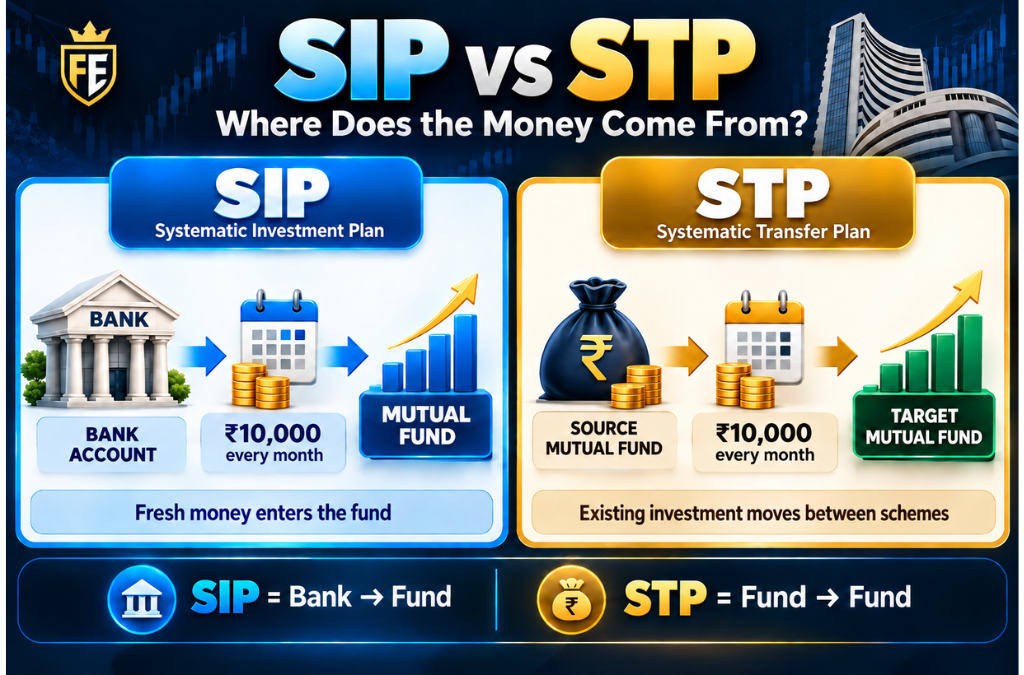
SIP brings fresh money from your bank account into a mutual fund. STP moves money already invested in one mutual fund scheme into another scheme.
That distinction explains most of the SIP vs STP difference.
Quick Summary
- SIP invests money periodically, usually from a bank account, into a mutual fund scheme.
- STP transfers money periodically from one mutual fund scheme into another eligible scheme.
- SIP generally brings fresh money into the investment, while STP reallocates money that is already invested.
- STP involves a switch-out/redemption from the source scheme and a purchase or switch-in into the target scheme.
- STP can have capital-gains tax and exit-load implications, depending on the source investment and applicable scheme rules.
What Is SIP?
SIP stands for Systematic Investment Plan.
AMFI describes SIP as an investment methodology through which an investor contributes a fixed amount to a mutual fund scheme periodically instead of making a single lump-sum investment.
The basic flow is:
Bank Account → Mutual Fund Scheme
A SIP is important to understand as a method of investing, not a separate asset class or mutual fund product.
You are not investing “in a SIP.”
You are using SIP as the transaction method to invest periodically in a particular mutual fund scheme.
How Does SIP Work?
Suppose an investor starts a ₹10,000 monthly SIP.
Each month:
Bank Account
↓
₹10,000 invested
↓
Mutual fund units purchased at the applicable NAV
The number of units purchased depends on the NAV applicable to each transaction.
For example, the same ₹10,000 buys more units when the NAV is lower and fewer units when the NAV is higher.
Periodic investing is commonly associated with rupee-cost averaging, because purchases take place across multiple market levels rather than at one single entry point. AMFI also discusses rupee-cost averaging as a feature of SIP investing.
However, SIP does not:
- eliminate market risk
- guarantee profits
- guarantee superior returns
- ensure that the average purchase price will always produce a better outcome than lump-sum investing
It simply spreads investments across multiple dates.
What Is STP?
STP stands for Systematic Transfer Plan.
Under an STP, money is transferred periodically from one mutual fund scheme—the source scheme—into another eligible mutual fund scheme—the target scheme.
Scheme documents filed with SEBI describe STP as a facility where units of the source scheme are redeemed at the applicable NAV and the transferred amount is invested into the target scheme.
Source Scheme
The mutual fund scheme from which the money is being transferred.
Target Scheme
The mutual fund scheme receiving the transfer.
The simplest way to visualise it is:
Source Mutual Fund → Target Mutual Fund
STP facilities are commonly offered between eligible schemes within the same mutual fund/fund house, subject to the AMC and scheme terms. Investors should check the relevant scheme documents rather than assuming every scheme combination is eligible.
How Does STP Work?
Suppose an investor has ₹6,00,000 invested in a source scheme.
They arrange an STP of ₹50,000 each month into another eligible scheme.
The process might look like:
Month 1
Source scheme → ₹50,000 → Target scheme
Month 2
Source scheme → ₹50,000 → Target scheme
Month 3
Source scheme → ₹50,000 → Target scheme
and so on.
Behind that simple transfer are two separate transaction legs:
Source side: units are redeemed or switched out.
Target side: the proceeds are used to purchase or switch into new units.
That distinction matters because the source-side transaction can have tax and exit-load consequences.
SIP vs STP: Key Differences
| Factor | SIP | STP |
|---|---|---|
| Full form | Systematic Investment Plan | Systematic Transfer Plan |
| Money generally comes from | Bank account | Existing mutual fund investment |
| Destination | Mutual fund scheme | Another eligible mutual fund scheme |
| Fresh money enters? | Generally yes | Generally no |
| Existing MF holding required? | No | Yes |
| Source-side redemption? | No | Yes |
| Tax consequence on setup/investment itself? | A normal investment is not a redemption | Source-side transfer may realise capital gains |
| Exit load | Not an entry charge on SIP investment | May apply to source-side units |
| Common purpose | Periodic investing | Periodic transfer between schemes |
The simplest distinction is:
SIP is primarily an investment method. STP is primarily a transfer mechanism.
SIP vs STP: Where Does the Money Come From?
This is the easiest way to remember SIP vs STP.
SIP
BANK ACCOUNT
↓
Periodic investment
↓
MUTUAL FUND
STP
SOURCE MUTUAL FUND
↓
Periodic transfer
↓
TARGET MUTUAL FUND
So:
SIP = Bank → Fund
STP = Fund → Fund
SIP vs STP With the Same ₹10,000 Monthly Amount
Consider two hypothetical investors.
Investor A — SIP
₹10,000 is debited from the investor’s bank account every month and invested into a mutual fund scheme.
Investor B — STP
₹10,000 is transferred every month from an existing source mutual fund scheme into another eligible target scheme.
Both transactions involve ₹10,000 per month.
But they are fundamentally different.
Investor A is adding new capital to the investment portfolio.
Investor B is reallocating capital that is already invested.
The amount and frequency do not define whether something is SIP or STP.
The source of the money does.
When Is SIP Commonly Used?
SIP is commonly used by investors who want to:
- invest regularly from salary or other income
- build investments gradually
- maintain a recurring investment habit
- contribute periodically toward financial goals
- avoid waiting to accumulate a large lump sum before starting
This does not make SIP universally preferable to lump-sum investing.
It is simply one way of structuring investment contributions.
When Is STP Commonly Used?
STP may be used when an investor already has money invested in one scheme and wants to transfer it progressively into another eligible scheme.
Common situations can include:
- gradually changing portfolio allocation
- moving an existing lump sum between schemes over time
- spreading purchases in the target scheme over multiple dates
- implementing a predefined transfer schedule
A frequently discussed example is transferring money progressively from a liquid or debt-oriented source scheme into an equity-oriented target scheme.
That is an illustration of the mechanism, not a recommendation to use that strategy.
Does STP Reduce Market Timing Risk?
STP can reduce dependence on a single target-scheme entry date because the transfer happens across several dates.
However, that does not mean STP eliminates market risk.
Suppose markets rise steadily during the STP period.
An investor who transferred gradually might end up purchasing later units at progressively higher prices compared with investing immediately.
If markets fall during the period, gradual entry may appear more favourable retrospectively.
Neither outcome is known beforehand.
Therefore:
STP spreads entry timing. It does not guarantee a better return than lump-sum investing.
Is STP Tax-Free?
No. An STP should not be assumed to be tax-free.
On the source side, units are redeemed or switched out as the transfer occurs. Scheme documents explicitly treat the source leg as a redemption/switch-out and the target leg as a subscription or switch-in.
That means the source transaction can potentially realise capital gains.
The actual tax treatment can depend on factors such as:
- type of source scheme
- purchase/acquisition date
- holding period
- applicable tax law at the time of the transaction
The important principle is:
Money remaining invested elsewhere does not automatically make the source-side redemption tax-free.
For a deeper explanation of these mechanics, see Mutual Fund Switch vs Redemption.
Can Exit Load Apply to STP?
Yes, depending on the source scheme’s applicable exit-load structure.
Because an STP involves redemption/switch-out of source units, an exit load may apply if those units fall within the scheme’s exit-load conditions.
Current scheme documents show that STP transactions can be included in applicable exit-load provisions, but the exact rules vary by scheme.
Therefore, neither of these statements is safe:
“All STPs attract exit load.”
or
“STPs never attract exit load.”
The correct answer is:
Check the current exit-load rules of the source scheme.
Does STP Reset the Holding Period?
For units purchased in the target scheme, each target-side transaction represents a new purchase.
So those units receive their own acquisition dates.
For example:
Transfer 1 purchases target units on 1 January.
Transfer 2 purchases more units on 1 February.
Transfer 3 purchases additional units on 1 March.
Those are separate purchase lots with separate acquisition dates.
The holding period of the old source-scheme units is not simply carried across to the newly purchased target-scheme units.
SIP vs STP and XIRR
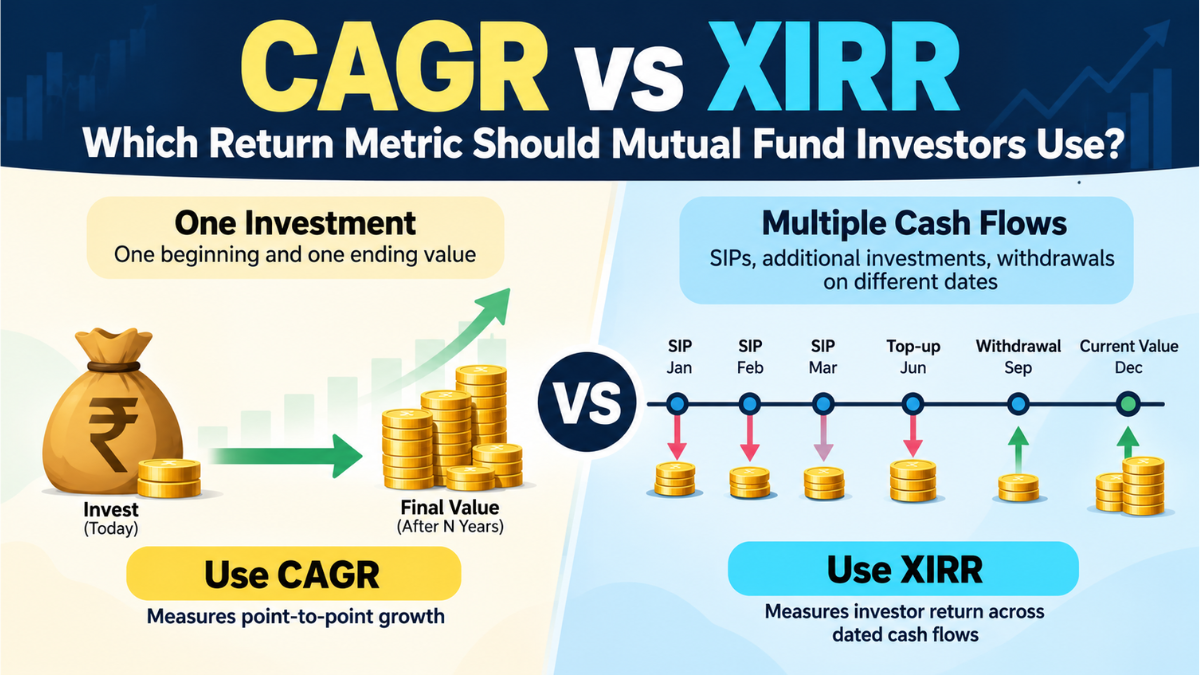
Both SIPs and STPs can create multiple transactions on different dates.
That matters when measuring an investor’s own return.
A simple point-to-point metric may not properly reflect multiple dated cash flows.
This is where XIRR can become useful because it accounts for both the amount and timing of cash flows.
For a detailed explanation, see:
CAGR vs XIRR: Which Return Metric Should Mutual Fund Investors Use?
SIP vs STP vs SWP
There is one more similar acronym worth separating from the other two.
| Mechanism | What happens |
|---|---|
| SIP | Money periodically enters a mutual fund |
| STP | Money periodically moves from one mutual fund scheme to another |
| SWP | Money is periodically withdrawn from a mutual fund |
So the simple framework is:
SIP = Invest
STP = Transfer
SWP = Withdraw
Can SIP and STP Run at the Same Time?
Potentially, yes.
An investor could have:
- a SIP bringing fresh money into one scheme
- an STP transferring an existing investment between other eligible schemes
They serve different purposes.
Availability and operational conditions depend on the relevant AMC and scheme facilities, so investors should check the applicable scheme terms.
Common SIP vs STP Mistakes
1. Thinking SIP and STP Are the Same
Both are systematic and can run on recurring schedules, but their money sources and transaction mechanics differ.
2. Assuming STP Is Tax-Free
The source-side redemption can have capital-gains implications.
3. Ignoring Exit Load
The source scheme’s exit-load provisions may apply to the transferred units.
4. Assuming STP Always Beats Lump Sum
Gradual transfer and immediate investment can perform differently depending on subsequent market movements.
There is no guaranteed winner beforehand.
5. Ignoring Risk in the Source Scheme
Money waiting in a source scheme during an STP is still invested.
That scheme has its own risks.
6. Treating SIP as a Guaranteed-Return Strategy
SIP changes how and when you invest.
It does not guarantee what the underlying investment will return.
FintechEdge SIP vs STP Decision Guide
Ask where the money is currently located.
Money is in your bank account and you want to invest periodically?
SIP may be the relevant mechanism.
Money is already invested in one mutual fund and you want to transfer it periodically?
STP may be the relevant mechanism.
You want regular withdrawals from a mutual fund?
That is closer to an SWP.
You want to measure returns across multiple dated transactions?
XIRR may be useful.
Remember that choosing how to invest is separate from choosing which mutual fund scheme to use.
For the latter, see:
How to Choose the Best Mutual Fund in India
Practical FintechEdge Example
Suppose an investor has ₹6 lakh available and invests it in an eligible source mutual fund scheme.
They then arrange a fixed monthly STP into another eligible target scheme.
Each month:
- units of the source scheme are redeemed/switch-out
- the corresponding amount is transferred
- new units are purchased in the target scheme
The source-side transaction can potentially create a taxable capital gain.
An exit load may also apply if the source units fall under the scheme’s exit-load conditions.
The newly purchased target units receive their own acquisition dates.
This example demonstrates the mechanics of STP only.
It does not suggest that this strategy, asset allocation or sequence is suitable for every investor.
Frequently Asked Questions
What is SIP in mutual funds?
SIP, or Systematic Investment Plan, is a method of investing a fixed amount periodically into a mutual fund scheme. It is commonly funded through recurring debits from the investor’s bank account.
What is STP in mutual funds?
STP, or Systematic Transfer Plan, allows an investor to transfer money periodically from a source mutual fund scheme into an eligible target mutual fund scheme.
What is the main difference between SIP and STP?
SIP generally brings fresh money from a bank account into a mutual fund.
STP moves money already invested in one mutual fund scheme into another eligible scheme.
Can STP be done between different AMCs?
Standard STP facilities are generally structured between eligible schemes of the same mutual fund/fund house. Specific facilities and eligible source/target schemes depend on AMC terms, so investors should verify the current scheme documents rather than assuming cross-fund-house STP is available.
Is STP tax-free?
No.
Because the source-side leg involves redemption or switch-out, it can potentially realise capital gains and therefore have tax consequences.
Does STP attract exit load?
It can.
Whether an exit load applies depends on the source scheme’s current exit-load structure and the units being transferred.
Which is better: SIP or STP?
They serve different functions rather than being direct substitutes.
SIP generally invests fresh money periodically.
STP transfers an existing mutual-fund investment between eligible schemes.
Does STP guarantee better returns than lump sum?
No.
Spreading a transfer across multiple dates changes entry timing but does not guarantee a superior result.
Can SIP and STP both be active?
Potentially yes, subject to the facilities and rules of the relevant schemes and AMC.
Is XIRR useful for SIP and STP returns?
It can be useful when measuring investor-level returns involving multiple dated transactions because XIRR accounts for the timing of those cash flows.
Final Takeaway
The easiest way to understand SIP vs STP is to focus on where the money comes from.
SIP = Bank → Mutual Fund
STP = Source Mutual Fund → Target Mutual Fund
A SIP is generally used to introduce fresh money into an investment periodically.
An STP systematically reallocates money that is already invested in a mutual fund.
That difference also creates important practical consequences.
With STP, the source-side transfer can involve:
- redemption
- capital-gains implications
- possible exit load
while the target-side transaction creates new units with new acquisition dates.
Neither mechanism is universally better.
They solve different problems.
Understanding those mechanics is more useful than choosing between SIP and STP simply because both involve recurring transactions.
Sources & References
- AMFI — Systematic Investment Plan (SIP)
- SEBI-filed mutual fund scheme documents — STP source/target and redemption mechanics
- SEBI-filed scheme documents — Switch-out/redemption and applicable exit-load treatment
- Relevant AMC Scheme Information Documents for operational STP eligibility, frequency and exit-load terms.
This article is for educational and informational purposes only and does not constitute investment advice, trading advice or a recommendation to buy or sell any security.
Our content is written for educational purposes and focuses on clarity, evidence, risk awareness and practical decision-making.