Indian Stock Market Today: Nifty Rises 0.51% as Smallcaps Fall 1.85%

Quick Summary
- Nifty 50 rose 0.51% to 23,053.10, while Sensex gained 0.42% to 74,459.53.
- Broader markets weakened sharply, with Next 50 down 0.61%, Midcap 100 down 0.93%, and Smallcap 100 down 1.85%.
- Bank Nifty declined 0.41%, showing that the headline-index gain was not broad-based.
- For October, Nifty gained about 1.9% and Sensex rose 2.7%, while smallcaps and midcaps finished the month lower.
- IT surged about 17.7% in October, its strongest monthly performance in more than six years.
- FIIs bought ₹3,599 crore, while DIIs sold ₹818 crore in the stock segment.
- Brent crude moved above $117 per barrel, while the rupee ended near ₹94.95 per dollar.
Indian Market Performance — 30 October 2026
Daily change in key Indian equity indices
Indian Stock Market Today: Closing Summary
Indian stock market today ended October on a positive note on 30 October 2026, with the Nifty 50 rising 0.51% to 23,053.10 and the Sensex gaining 0.42% to 74,459.53. But the headline gains masked considerable weakness underneath: Bank Nifty fell 0.41%, the Nifty Next 50 declined 0.61%, the Midcap 100 lost 0.93%, and the Smallcap 100 dropped 1.85%. Pasted text
The divergence also captured October’s broader market story. Large-cap benchmarks finished the month higher, helped by exceptional strength in IT, while midcaps and smallcaps remained under pressure. Meanwhile, FIIs returned as strong buyers on the final session of the month, crude oil moved back above $117 per barrel, and the rupee completed its strongest month in eight months.
Indian Market Performance
| Index | Close | Change |
|---|---|---|
| Nifty 50 | 23,053.10 | +0.51% |
| Sensex | 74,459.53 | +0.42% |
| Bank Nifty | 54,686.95 | -0.41% |
| Nifty Next 50 | 67,709.10 | -0.61% |
| Nifty Midcap 100 | 57,301.25 | -0.93% |
| Nifty Smallcap 100 | 18,463.60 | -1.85% |
The Nifty’s move above 23,000 looks constructive at first glance. But today’s internal market structure tells a more cautious story.
Only the Nifty and Sensex among these six indices finished higher. Smallcaps suffered the deepest decline, while midcaps, the Next 50 and Bank Nifty also ended in the red.
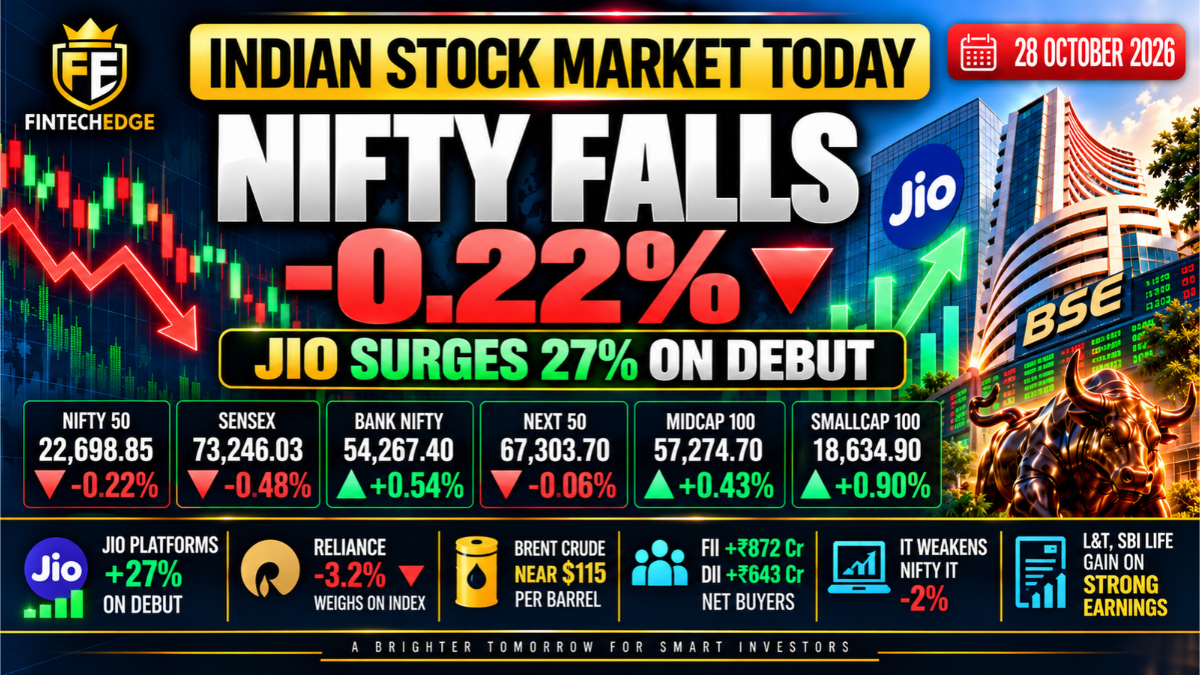
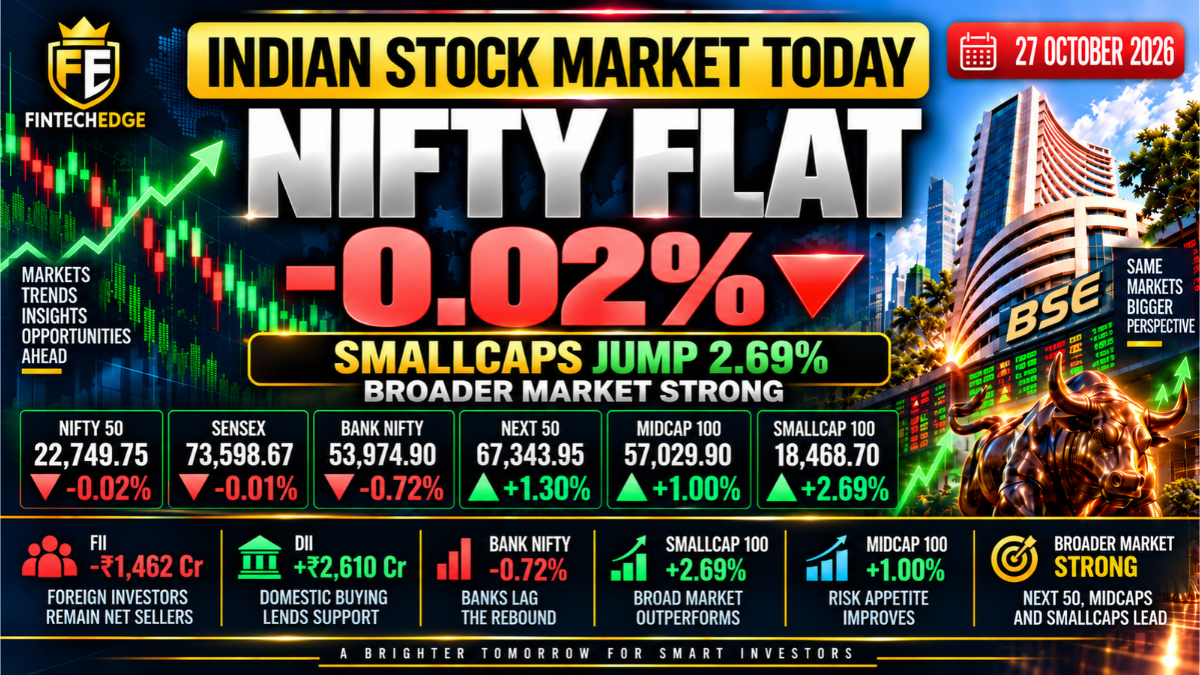
That is almost the reverse of 28 October, when the headline indices fell but smallcaps, midcaps and banks remained relatively resilient.
Large Caps Rise, Broader Market Falls
The biggest takeaway from the session is the widening gap between the benchmark indices and the broader market.
The Nifty gained 0.51%, yet the Smallcap 100 fell 1.85%. The Midcap 100 dropped 0.93%, and the Next 50 declined 0.61%.
For investors, that distinction matters.
A portfolio concentrated in large-cap stocks could have experienced a reasonably positive session. A portfolio tilted towards smaller companies may have produced a very different result.
That is why the headline Nifty number alone does not fully describe the market.
The latest weakness also interrupts the broader-market rebound seen earlier this week. Smallcaps had rallied strongly on 26 and 27 October, including a 2.69% surge on 27 October.
Those gains did not prevent smaller companies from finishing October materially weaker overall.
October Ends Positive for Nifty and Sensex
At the benchmark level, October ended on a better note.
The Nifty gained about 1.9% during the month, while the Sensex rose around 2.7%, ending a two-month losing streak.
That is important after the sustained pressure seen through parts of August and September.
But the monthly gain was uneven.
A relatively small number of heavyweight sectors—particularly IT—contributed disproportionately to benchmark performance.
So the more useful interpretation is not simply that “October was a positive month.”
It was a positive month for large-cap benchmarks, while the wider market remained much weaker.
Smallcaps and Midcaps Finish October Lower
The monthly performance of smaller companies tells a very different story.
Smallcaps fell around 4.2% in October, while midcaps declined approximately 3.4%.
Today’s session reinforced that weakness:
- Smallcap 100: -1.85%
- Midcap 100: -0.93%
The contrast with the Sensex is particularly striking.
Sensex: +2.7% for October
Smallcaps: -4.2% for October
That is a difference of almost seven percentage points.
The divergence shows why market-cap allocation mattered so much this month.
There were sharp relief rallies in smaller companies during the final week, but they were not enough to reverse the damage accumulated earlier.
This does not tell us whether smallcaps will continue falling in November. It simply shows where the October weakness was concentrated.
IT Posts Best Month in More Than Six Years
IT was the clear sector leader.
The IT index surged around 17.7% in October, its strongest monthly performance in more than six years. Major IT stocks gained roughly 16%–22% over the month.
That performance played an important role in supporting the Nifty and Sensex.
IT has substantial weight in the benchmark indices, so a sector rally of this magnitude can meaningfully lift headline performance even when many smaller stocks remain weak.
This helps explain October’s unusual combination:
- benchmarks higher;
- smallcaps and midcaps lower;
- IT dramatically stronger.
It would be premature to assume that IT’s momentum will automatically continue into November.
But in terms of what actually drove October, IT was clearly the standout leadership sector.
FIIs Buy ₹3,599 Crore, DIIs Sell ₹818 Crore
Institutional flows produced another notable reversal.
Your 30 October stock-segment data showed:
- FII: +₹3,599 crore
- DII: -₹818 crore
FIIs were therefore strong net buyers, while domestic institutions were net sellers.
That is the opposite of the pattern seen through much of October, when foreign selling was repeatedly offset by domestic buying.
The monthly totals provide crucial perspective:
- October FII stocks: -₹45,162 crore
- October DII stocks: +₹62,220 crore
So despite the strong FII buying today, foreign investors still finished October as substantial net sellers overall.
One strong session does not reverse the monthly trend.
But if foreign buying begins to persist into November, that would represent a meaningful change from October’s flow pattern.
Oil Rises Above $117
Crude oil remains one of the clearest external risks.
Brent rose about 2% to $117.14 per barrel, with supply concerns pushing prices higher again.
For India, oil matters because the country imports a substantial proportion of its energy needs.
Sustained crude prices at these levels can affect:
- imported inflation;
- the current account;
- the trade deficit;
- corporate input costs;
- the rupee;
- and interest-rate expectations.
High oil does not explain every daily stock-market movement, but it materially affects India’s macro backdrop.
This is one reason November begins with an unresolved external risk despite the Nifty finishing October higher.
Rupee Posts Best Month in Eight
The rupee delivered a more positive month-end signal.
The currency strengthened to around ₹94.95 per dollar and gained roughly 1% in October, its strongest monthly performance since February.
That is notable because it occurred despite high crude prices.
Recent RBI measures and currency-market support helped stabilise the rupee after significant pressure earlier in the year.
Still, the currency remains exposed to the same external variables:
- crude oil;
- US yields;
- the dollar;
- and foreign capital flows.
So the stronger October performance reduces immediate pressure but does not remove the underlying risks.
Bank Nifty Lags
Bank Nifty fell 0.41%, even as the Nifty and Sensex finished higher.
That matters because banking and financial stocks carry significant weight in India’s main benchmarks.
Banks had participated strongly in the 29 October rebound, when Bank Nifty gained 1.18%.
Today, that support disappeared.
This is another reason the Nifty’s 0.51% gain should not be treated as evidence of a uniformly strong market.
Large-cap strength was selective rather than broad.
Market Breadth Weakens Again
The weakness in smallcaps, midcaps and the Next 50 also signals deterioration in market breadth.
A positive index close becomes more convincing when gains are spread widely across sectors and market-cap segments.
That was the case on 29 October.
Today was different.
The headline indices gained, but several important market segments declined.
This does not make the Nifty’s rise unimportant—it simply changes the interpretation.
The correct description is:
Large-cap benchmarks ended higher, but participation beneath the surface weakened materially.
October’s Story Was Rotation, Not Uniform Strength
Putting the entire month together produces a clearer picture.
The Nifty and Sensex recovered.
IT surged.
The rupee strengthened.
But smallcaps and midcaps fell.
FIIs remained substantial monthly sellers.
And crude oil finished the month above $117.
That combination makes October a month of rotation rather than broad market strength.
Capital moved unevenly between sectors and market-cap categories.
Investors who looked only at the benchmark return would therefore miss much of what happened underneath.
What to Watch Next
Broader-market participation
The most important domestic question is whether smallcaps and midcaps can stabilise after ending October materially lower than the benchmarks.
FII flows
FIIs bought ₹3,599 crore today but remained heavy net sellers for October. Whether foreign buying persists into November will be important.
Brent crude
Oil above $117 remains one of India’s biggest macro risks.
IT leadership
IT just completed its strongest month in more than six years. Whether that leadership continues or rotates elsewhere will matter for the benchmarks.
Bank Nifty
Banks weakened today. Stronger bank participation would improve the quality of any further large-cap rally.
Rupee
October was the rupee’s strongest month in eight months. Sustaining that improvement with crude above $117 would be constructive.
FintechEdge View
The Indian stock market today closed October with a positive headline but a much more mixed internal picture.
The Nifty finished above 23,000 and gained 1.9% for the month, while the Sensex rose 2.7%.
But smallcaps lost 4.2% in October, midcaps fell 3.4%, and today’s Smallcap 100 dropped another 1.85%.
IT did much of the heavy lifting, surging 17.7% for the month, while foreign investors remained net sellers overall despite strong buying in today’s session.
Meanwhile, Brent above $117 ensures that the external macro backdrop remains challenging.
The clearest conclusion from October is therefore not simply that the benchmarks recovered.
It is that the recovery was highly uneven, with large-cap leadership masking considerably weaker performance across the broader market.
November will begin with one key question: whether that gap starts to close or becomes even wider.
Sources & References
- Indian shares end October higher as IT and earnings support benchmarks — Reuters
- Indian equities face oil and AI-related risks heading into November — Reuters
- Nifty 50, Sensex, Bank Nifty and broader index closing data — NSE market data
- FII/DII stock-segment activity — 30 October market data supplied for FintechEdge
This article is for educational and informational purposes only and does not constitute investment advice, trading advice or a recommendation to buy or sell any security.
Our content is written for educational purposes and focuses on clarity, evidence, risk awareness and practical decision-making.