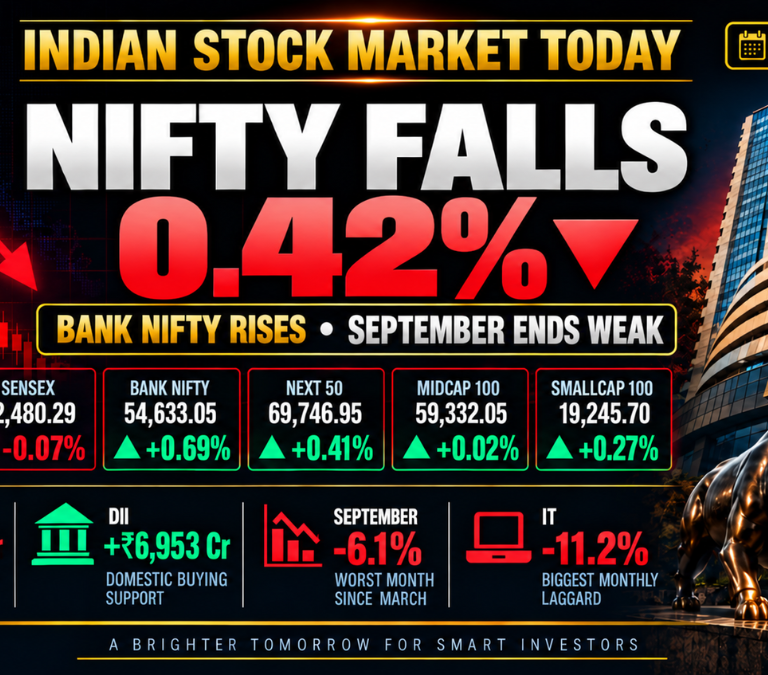
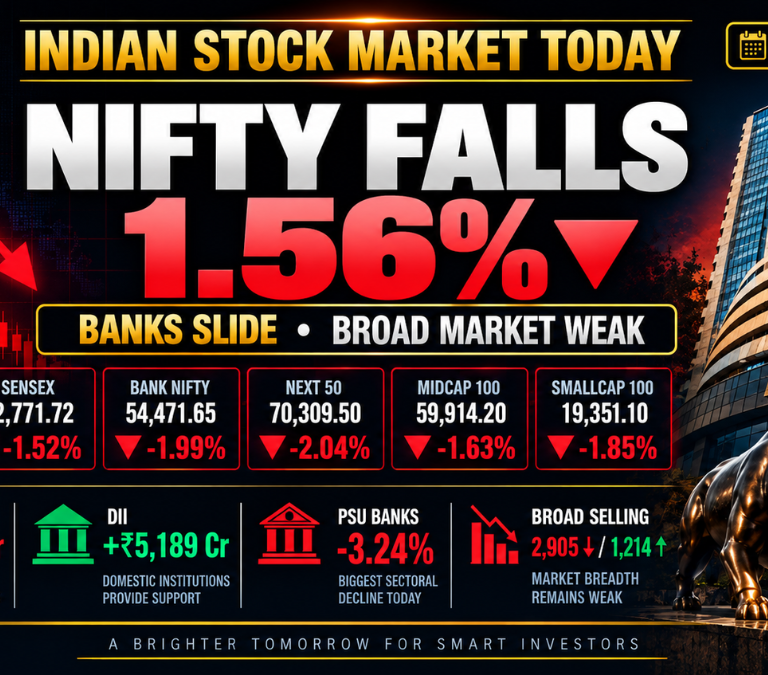
Indian Stock Market Today: Nifty Falls 0.88% as Oil, Yields and FII Selling Weigh

Quick Summary
- Nifty 50 fell 0.88% to 22,421.95, while Sensex declined 0.79% to 71,909.70.
- Bank Nifty showed relative resilience, falling only 0.33%.
- Broader markets remained weak: Next 50 fell 1.10%, Midcap 100 1.01%, and Smallcap 0.97%.
- FIIs sold ₹9,484 crore, while DIIs bought ₹10,042 crore.
- The US 10-year Treasury yield climbed to around 5.34%.
- Indian benchmarks completed an eighth consecutive weekly decline.
Indian Market Performance — 1 October 2026
Daily change in key Indian equity indices
Indian Stock Market Today: Nifty Falls 0.88% as Oil, Yields and FII Selling Weigh
Indian equities extended their decline on 1 October 2026, with the Nifty 50 and Sensex ending lower as elevated crude oil prices, a weaker rupee, rising global bond yields and continued foreign selling weighed on sentiment.
The Nifty 50 fell 0.88% to 22,421.95, while the Sensex declined 0.79% to 71,909.70. Bank Nifty showed relative resilience, slipping only 0.33%.
The broader market remained under heavier pressure. The Nifty Next 50 fell 1.10%, the Nifty Midcap 100 declined 1.01%, and the Nifty Smallcap index lost 0.97%.
The session also extended an unusually long period of market weakness, with Indian benchmarks completing an eighth consecutive weekly decline. Auto stocks were among the biggest sectoral laggards, while IT was a rare pocket of strength.
Indian Market Performance — 1 October 2026
| Index | Close | Change |
|---|---|---|
| Nifty 50 | 22,421.95 | -0.88% |
| Sensex | 71,909.70 | -0.79% |
| Bank Nifty | 54,450.75 | -0.33% |
| Nifty Next 50 | 68,981.35 | -1.10% |
| Nifty Midcap 100 | 58,732.00 | -1.01% |
| Nifty Smallcap | 19,058.65 | -0.97% |
Sources: NSE market data | FintechEdge Research.
Oil and Rupee Weakness Add Pressure
Crude oil and the currency remained important pressure points for Indian markets.
Higher oil prices matter particularly for India because the country imports a large proportion of its energy requirements. A sustained rise in crude can increase the import bill, add to inflation pressure, increase demand for US dollars and place additional pressure on the rupee.
The rupee’s weakness therefore adds another layer to the equity-market story.
When oil prices, the currency and equities are simultaneously under pressure, investors are dealing with a broader macro challenge rather than weakness isolated to one industry.
US 10-Year Treasury Yield Adds to Global Pressure
Global bond yields were another major source of pressure.
The US 10-year Treasury yield moved to around 5.34%, leaving global financial conditions substantially tighter.
Higher US yields matter for Indian equities because they increase the attractiveness of relatively low-risk US fixed-income assets.
That can:
- attract capital toward US bonds;
- strengthen the dollar;
- reduce foreign appetite for emerging-market equities;
- pressure currencies such as the rupee;
- and increase global borrowing costs.
This remains one of the key external pressures facing Indian equities.
FIIs Sell ₹9,484 Crore, DIIs Buy ₹10,042 Crore
Institutional activity showed a striking split.
For 1 October:
- FIIs sold ₹9,484 crore
- DIIs bought ₹10,042 crore
Unlike some recent sessions where only previous-day flow data was available, these numbers belong to today’s session.
Domestic institutions therefore bought slightly more than foreign investors sold.
That provided an important cushion to the market.
However, continued heavy FII selling remains a concern because foreign investors have been reducing exposure while global bond yields remain elevated.
The strong DII response has prevented those foreign outflows from translating into even larger benchmark declines, but continued dependence on domestic institutional buying is itself worth monitoring.
Autos Lead the Decline
The auto sector was among the weakest areas of the session.
The Nifty Auto index fell around 3.46%, considerably more than the Nifty 50.
That made autos an important contributor to Thursday’s weakness.
One day’s decline should not automatically be interpreted as a long-term sector trend, but the scale of the fall clearly made autos one of the most important sectoral developments of the session.
IT Bucks the Trend
Information technology moved in the opposite direction.
The Nifty IT index gained around 2.17%, making it one of the strongest pockets in an otherwise weak market.
That is particularly interesting because IT had been one of the major laggards during September.
The move therefore represents a notable change in relative sector performance.
However, one strong session is not enough to confirm a lasting change in trend.
For now, the useful conclusion is simply that IT provided relative strength while most of the market remained under pressure.
Broader Markets Remain Weak
Selling was not confined to the Nifty 50.
The Next 50 fell 1.10%, Midcap 100 declined 1.01%, and Smallcap lost 0.97%.
That means broader-market performance remained weaker than the banking index and broadly consistent with continued risk aversion.
This is an important signal because a healthier market environment generally involves participation across multiple market-cap segments.
For now, weakness across the Next 50, midcaps and smallcaps indicates that underlying market breadth remains fragile.
Eight Straight Weekly Losses
The statistic is significant because it shows how persistent the selling pressure has become.
But it should not be turned into a market prediction.
Eight losing weeks do not automatically mean:
- the market has bottomed;
- a rebound must follow;
- or selling has been exhausted.
The streak describes what has happened.
It does not determine what happens next.
That distinction is important for FintechEdge because historical patterns should provide context, not be presented as certainty.
GST Growth Shows Domestic Resilience
One domestic data point provided a notable contrast to the weak equity-market environment.
September gross GST collections rose 14.7% year-on-year to ₹2.04 trillion.
That suggests economic and formal-sector activity remained resilient even while equity markets faced significant pressure.
The apparent contradiction is not unusual.
Equity prices respond not only to domestic growth but also to:
- global interest rates;
- foreign capital flows;
- currencies;
- crude oil;
- liquidity conditions;
- and valuation changes.
Strong GST collections therefore do not eliminate the pressures currently affecting equities, but they do show that weak market sentiment does not necessarily imply equally weak domestic economic activity.
What to Watch Next
US Treasury yields:
The US 10-year yield near 5.34% remains one of the most important variables for emerging-market flows.
Foreign institutional selling:
FII selling remains extremely heavy. Whether DIIs can continue absorbing those flows will matter.
Crude oil:
Higher crude keeps India exposed to inflation, currency and external-balance pressure.
The rupee:
Continued currency weakness would increase imported-inflation concerns.
Broader-market participation:
Next 50, midcaps and smallcaps would need to stabilise for market breadth to improve.
FintechEdge View
The Indian stock market today reflected several of the pressures that have been building for weeks.
Nifty fell 0.88%, broader-market indices lost around 1%, foreign investors remained heavy sellers and global bond yields stayed elevated.
Domestic institutional buying continued to provide an important buffer, while IT emerged as a rare area of relative strength.
The eight-week losing streak is historically notable, but it remains a description of the market’s recent path rather than a prediction of what comes next.
A more durable improvement would require better broader-market participation, moderation in foreign selling and some easing in external pressures from crude oil, the dollar and global bond yields
Sources & References
- Reuters — Indian benchmark shares post longest weekly losing run in 25 years
Supports the eight-week losing streak, weekly Nifty/Sensex performance and foreign-selling context. - Reuters — Rupee drops to two-month low as global bond rout deepens, oil jumps
Supports the rupee at 96.3150/$, Brent above $100 and pressure from global yields. - Reuters — 10-year US Treasury yield hits highest since 2002
Supports the US 10-year yield reaching about 5.342%.
This article is for educational and informational purposes only and does not constitute investment advice, trading advice or a recommendation to buy or sell any security.
Our content is written for educational purposes and focuses on clarity, evidence, risk awareness and practical decision-making.