Indian Stock Market Today: Nifty Ends Lower as September Posts Worst Month Since March
Quick Summary
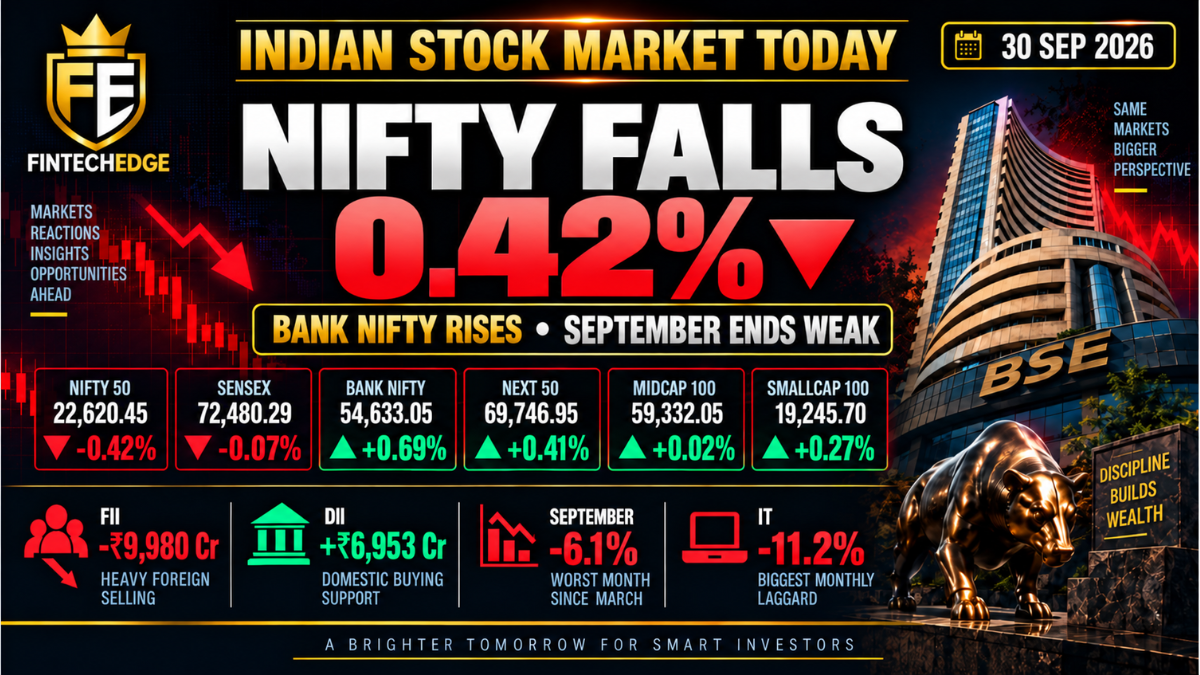
- Nifty 50 fell 0.42% to 22,620.45, while Sensex slipped just 0.07% to 72,480.29.
- Bank Nifty outperformed with a 0.69% gain to 54,633.05.
- Broader markets held up better: Next 50 rose 0.41%, Midcap 100 gained 0.02%, and Smallcap advanced 0.27%.
- September was the worst month for Indian benchmarks since March, with Nifty down about 6.1%.
- IT was September’s biggest major-sector laggard, falling about 11.2%.
- In the previous session, FIIs sold ₹9,980.22 crore while DIIs bought ₹6,952.71 crore.
Indian Market Performance — 30 September 2026
Daily change in key Indian equity indices
Indian Stock Market Today: Nifty Ends Lower as September Posts Worst Month Since March
Indian equities ended September on a mixed note, with the Nifty 50 closing lower while Bank Nifty and several broader-market indices finished in positive territory.
The Nifty 50 fell 0.42% to 22,620.45, while the Sensex ended almost flat at 72,480.29, down 0.07%. Bank Nifty moved in the opposite direction, gaining 0.69% to 54,633.05.
The broader market also held up better than the headline Nifty. The Nifty Next 50 gained 0.41%, the Nifty Midcap 100 finished almost unchanged at +0.02%, and the Nifty Smallcap index rose 0.27%.
That divergence made the final session of September different from several recent trading days, when weakness had spread more evenly across large caps, midcaps and smallcaps.
However, the more important story was the month itself. September ended as the weakest month for Indian benchmark indices since March, with the Nifty losing around 6.1% and the Sensex falling about 5.8%
Indian Market Performance — 30 September 2026
| Index | Close | Change |
|---|---|---|
| Nifty 50 | 22,620.45 | -0.42% |
| Sensex | 72,480.29 | -0.07% |
| Bank Nifty | 54,633.05 | +0.69% |
| Nifty Next 50 | 69,746.95 | +0.41% |
| Nifty Midcap 100 | 59,332.05 | +0.02% |
| Nifty Smallcap | 19,245.70 | +0.27% |
Sources: NSE market data | FintechEdge Research.
Bank Nifty Outperforms as Nifty Ends Lower
The clearest feature of the Indian stock market today was the divergence between the Nifty 50 and banking stocks.
While the Nifty fell 0.42%, Bank Nifty gained 0.69% and closed at 54,633.05.
That matters because financial stocks carry significant weight in India’s benchmark indices. Strength in banks helped prevent the broader market from experiencing the kind of widespread sell-off seen in several recent sessions.
The divergence also shows why a negative Nifty close does not necessarily mean every part of the market was weak.
Today’s session was much more selective.
Banking stocks showed relative strength, while weakness in some large-cap stocks kept the headline Nifty under pressure.
Broader Markets Hold Up Better Than Nifty
The performance of broader indices was another important signal.
The Nifty Next 50 gained 0.41%, Smallcap rose 0.27%, and Midcap 100 ended almost unchanged at +0.02%.
All three performed better than the Nifty 50.
The pattern suggests that today’s selling pressure was concentrated more heavily in selected large-cap names rather than reflecting broad risk aversion across the entire equity market.
That does not mean risk appetite has fully recovered.
But it does mean today’s decline was narrower and more selective than some of the broad-based weakness seen earlier in the week.
September Ends as the Worst Month Since March
Today’s daily performance needs to be viewed in the context of a difficult month.
That makes September considerably more important than the relatively mixed final trading session.
The month saw repeated pressure from:
- foreign institutional selling;
- elevated global bond yields;
- higher oil prices;
- geopolitical uncertainty;
- and weakness in several major sectors.
The final session showed pockets of resilience, but one relatively stable day does not erase the damage accumulated over the month.
Foreign Selling Remains a Major Pressure Point
Foreign institutional investors remained one of the biggest sources of pressure during September.
The draft data indicates that foreign investors sold roughly $2.7 billion of Indian equities during the month.
Persistent foreign selling was also visible during the broad market weakness seen earlier this week.
On 29 September, FIIs sold ₹9,980.22 crore, while domestic institutional investors bought ₹6,952.71 crore.
Those numbers must remain clearly labelled as previous-session data.
They are not September 30 FII/DII figures.
The broader takeaway is that domestic institutions continued to absorb a substantial part of foreign selling, but persistent overseas outflows remained an important headwind for the Indian market.
IT Was September’s Biggest Sectoral Laggard
Information technology was one of the weakest areas of the market during September.
The sector fell around 11.2% for the month, making it the largest major-sector laggard.
That weakness was not confined to one trading day.
IT underperformance appeared repeatedly through the month as markets dealt with concerns around:
- high US interest rates;
- tighter global financial conditions;
- and uncertainty around technology spending.
The scale of the monthly decline makes IT more relevant as a September story than any single-day movement in the sector.
A stabilisation in IT would remove one of the significant drags that affected the broader market during the month.
Oil and Global Bond Yields Remain Important Macro Headwinds
September’s weakness was not driven by a single event.
Instead, several macro pressures built up at the same time.
Higher global bond yields made fixed-income assets more attractive relative to equities and tightened financial conditions.
For emerging markets such as India, higher US yields can also contribute to:
- stronger demand for the US dollar;
- pressure on foreign portfolio flows;
- tighter liquidity;
- and lower equity valuations.
Oil also remained important because India is heavily dependent on imported energy.
Higher crude prices can increase the import bill, add to inflation pressure and create additional demand for dollars.
These pressures did not disappear simply because the final trading session showed better performance in banks and broader indices.
They remain part of the backdrop heading into October.
Why Today’s Divergence Matters
The final day of September produced a market structure worth paying attention to.
Nifty fell 0.42%, but:
- Bank Nifty gained 0.69%;
- Next 50 rose 0.41%;
- Smallcap gained 0.27%;
- Midcap 100 was nearly flat.
This tells us that today was not a uniform risk-off session.
The benchmark decline was being driven more selectively.
That is a healthier internal picture than a day when large caps, midcaps, smallcaps and banks all fall together.
At the same time, one day of relative strength is not enough to establish a change in the broader trend.
The market still enters October after a difficult September.
Previous-Session FII/DII Context
Because confirmed September 30 institutional flow data was not available at the time of finalisation, only the previous session’s figures should be used:
- FII: -₹9,980.22 crore
- DII: +₹6,952.71 crore
These figures are from 29 September 2026.
The unusually large foreign outflow reinforces the wider monthly trend of persistent selling by overseas investors.
What to Watch in October
Foreign institutional flows
After significant foreign selling during September, the direction of FII activity remains one of the most important factors to monitor.
A meaningful reduction in foreign outflows would improve the market backdrop.
Bank Nifty
Banks showed clear relative strength on the final trading day of September.
Because financials carry heavy index weight, continued banking strength could provide support to the broader benchmarks.
Broader-market participation
The Next 50 and Smallcap indices both outperformed the Nifty today.
If that participation continues, it would represent an improvement from the broader weakness seen earlier in the week.
Information technology
IT finished September with one of the steepest sectoral declines.
Stabilisation in the sector would remove one important drag on benchmark performance.
Oil prices
Oil remains an important variable for India’s inflation, currency and external-balance outlook.
Global bond yields
High US Treasury yields continue to keep financial conditions tight globally and remain relevant to emerging-market capital flows.
FintechEdge View
The Indian stock market today ended September with two very different signals.
At the daily level, the internal structure improved.
Nifty fell 0.42%, but Bank Nifty gained 0.69%, Next 50 rose 0.41%, Smallcap advanced 0.27%, and Midcap 100 was almost unchanged.
That indicates that today’s weakness was relatively selective rather than broad-based.
The monthly picture, however, remains much more challenging.
Nifty lost about 6.1% in September, IT declined around 11.2%, and persistent foreign selling continued to pressure equities.
The final trading day therefore offered some relative strength, but not enough evidence to conclude that the pressures behind September’s decline have disappeared.
A healthier October setup would require continued broader-market participation, moderation in foreign selling, stabilization in lagging sectors such as IT, and some easing in external pressures from global yields and energy prices.
This article is for educational and informational purposes only and does not constitute investment advice, trading advice or a recommendation to buy or sell any security.
Our content is written for educational purposes and focuses on clarity, evidence, risk awareness and practical decision-making.